This is a new edition in the Self-Assessment Colour Review series that covers ornamental fish. It includes 200 colour illustrated cases in random order, as they would be presented in practice. It presents questions based on each case with answers that fully explore the disease/disorder. This new edition contains 250 new cases. The book should appeal to candidates preparing for examinations and to practitioners in their continuing education.
eBook - ePub
Ornamental Fishes and Aquatic Invertebrates
Self-Assessment Color Review, Second Edition
- 236 pages
- English
- ePUB (mobile friendly)
- Available on iOS & Android
eBook - ePub
Ornamental Fishes and Aquatic Invertebrates
Self-Assessment Color Review, Second Edition
About this book
Information
Answers
CASE 1
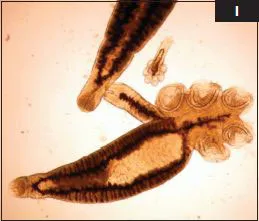
1 What is your next diagnostic step considering the delicate nature of bonnethead sharks? Testing stray electrical current and copper are always warranted in cephalofoil sharks. Both of these were tested and considered normal before proceeding. A full examination requiring capture of an adult can be stressful but may be necessary. An iSTAT or similar device is recommended to monitor blood pH and lactic acid during shark examinations. In this case, a quick examination of the gill slits found numerous monogeneans that were confirmed with microscopic examination as Erpocotyle tiburonis (1). The previous praziquantel immersions should have resolved this condition.
2 Had there been evidence of lactic acidosis how would you manage this problem? Sodium bicarbonate can be given in the dorsal fin sinus, ventral tail vein, or IM at 1.0 mEq/kg as often as necessary. Juvenile bonnethead sharks are easy to catch at the surface, although their small size can make administration of bicarbonate difficult. Using oxygen to saturate the water to 115–150% can alleviate lactic acidosis, and staff agreed to a quick examination on a bonnethead juvenile despite no findings on necropsy.
CASE 2
1 Why are there still monogeneans present in Case 1 despite the praziquantel treatment and how will you proceed using the same drug? Repeat use of certain chemotherapeutics can alter the biological filter, which adapts to use certain drugs as carbon sources. Without complete disinfection between quarantines, the biofilter became accustomed to consuming praziquantel, which allowed a monogenean infection to occur. Juveniles were first affected due to their small size and naivety. In this case, a 3.0 ppm dose was administered with water samples collected for validation by high pressure liquid chromatography. Praziquantel levels were found to fall below therapeutic levels within 3 hours instead of the usual 7–10 days. The infection was controlled by several methods including one 10.0 ppm praziquantel 4 hour bath, two 10.0 ppm chloroquine prolonged immersions, and a slow reduction in salinity to 20 ppt to reduce monogenean egg fecundity. This case also highlights the need to have an experienced veterinarian on staff for examinations and necropsy to assist aquarists with disease detection.
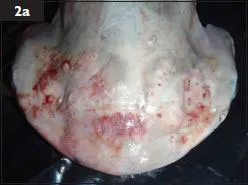
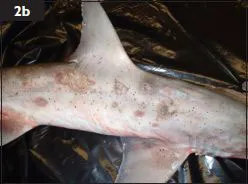
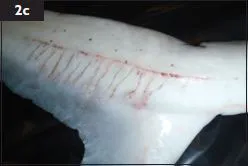
2 What is the correlation between tank temperature and pathogen-induced dermatitis in the bonnethead sharks (Sphyrna tiburo) in Case 1? Four common pathogens in captive bonnethead sharks are Fusarium solani, Amyloodinium, monogeneans, and parasitic copepods. The latter three organisms are obligate pathogens that are amenable to treatment. F. solani is an opportunistic pathogen and ubiquitous fungus in salt water. Immunocompromized sharks can succumb to a chronic F. solani dermatitis that is very difficult to treat. Small abrasions, overcrowding, pregnancy, poor water quality, or other infection may predispose a bonnethead shark to the fungal infection, which initially presents as ulcers along the head and lateral line system (2a–c). Raising the tank water temperature to 26.7–27.8°C (80–82°F) or more appears effective in combination with good filtration (ozone, UV light) to prevent or reduce incidence of F. solani infections.
CASE 3
1 What are your top differentials for the acute mortality? It is possible the traumatic lesions were more extensive than initially determined and caused death due to organ failure. Also, since the hospital tank was empty, a large fish may have caused a rapid change in the water quality, such as decreased DO level or increased ammonia levels, if the tank was not properly cycled.
2 What further testing do you want to do? Water quality testing and radiography.
3 What abnormalities would you expect to find? Radiographs confirm there are no fractures and no deeper lesions or internal contusions are noted on necropsy. However, the gills are dark red to purple, confirming the suspicion of ammonia toxicity. Water quality testing reveals the ammonia is 1.5 ppm total ammonia nitrogen (TAN) and the pH is 8.5. All other results are within normal limits, including DO.
4 How would you manage the problem identified by your diagnostic work up? Treatments for ammonia toxicity include an immediate water change and the addition of biofiltration from an established tank or the addition of ‘seeding’ products that contain nitrifying microorganisms that convert ammonia to nitrite. An easily overlooked aspect of ammonia toxicity is its increased harmful nature with increased pH. Unionized ammonia (NH3) is more toxic than ionized ammonia or ammonium (NH4+). Thus a lower level of TAN is more likely to be lethal at a pH of 8.5 than a pH of 7.0. The DO level should be increased to 110–120% to increase the concentration gradient across the gills and ease oxygen consumption by the fish until the gills have healed. Frequent water quality testing and water changes should be conducted until the life support system is established and the ammonia normalizes.
CASE 4
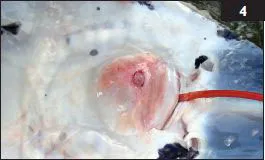
1 How is the clinical presentation of goiter usually different in elasmobranchs as compared with bony fish? In sharks and rays the swelling is usually in the ventral gular area and not directly associated with the gills (4).
CASE 5
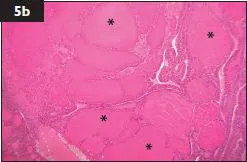
1 What is your top differential diagnosis? Thyroid hyperplasia (goiter) should be your top differential based on the appearance and location of the mass/swelling. The goiter may be unilateral or bilateral. Goiter has been identified in many species of both freshwater and saltwater fish. Goiter in fish is a result of iodide (I−) deficiency, which is the form of iodine available for uptake by the thyroid gland. Deficiency may be a result of water depleted of iodide, dietary deficiency of iodide, or by goiterogenic compounds. In bony fish, other tumors of the oral cavity and pharyngeal structures do occur but are less common. In elasmobranchs, trauma or local infection are other possible causes for the swelling but are less common. Aspiration or biopsy can be used to confirm a diagnosis but is usually reserved until there is no improvement with treatment. Aspiration and cytology typically reveal blood cells but can sometimes yield viscous clear to yellow colloid. Biopsy is usually diagnostic and can help distinguish between hyperplasia and neoplasia. Numerous colloid filled nodules were present (5b, asterisks) consistent with thyroid hyperplasia.
2 What are your recommendations for treatment and prevention of this problem? The most common treatment for goiter is oral supplementation with iodide, typically in the form of potassium iodide (KI) salt at a dose of 10 mg/kg body weight once weekly. Alternatively, water supplementation with KI salt or Lugol’s iodine at or above the amount found in natural seawater may be effective, but caution must be used as elemental iodine in Lugol’s can be toxic if overdosed. Treatment may need to be continued for several months or longer to see significant reduction in the size of the goiter. Oral supplemental treatment with thyroxine at 0.02 mg/kg may be of benefit in treating any concurrent hypothyroidism, and decrease the over production of thyrotropin-releasing hormone and thyroid-stimulating hormone, but it is not typically required. Some residual hypertrophied tissue may remain despite resolution of the clinical disease. Measures should be initiated to prevent recurrence and new cases.
Prevention of goiter should focus on maintenance of sufficient iodide levels in the water and/or oral supplementation in the diet and correction of elevated nitrate (NO3−) levels. The preventive method used must be tailored to the fish species and system being evaluated. Iodide levels in natural seawater are in the range 0.01–0.06 mg/L, but they can vary widely and be much lower in freshwater. Recommended tank iodide levels to prevent goiter in marine tanks are 0.10–0.15 µM (0.02–0.03 mg/L). Testing for iodide rather than iodate (IO3) is recommended but requires special methodologies that can be challenging.
Biological utilization and oxidation of iodide are the main ways it is depleted in aquaria. Replenishment is most often accomplished through regular water changes or commercially available liquid supplements added weekly. Ozonation of seawater for disinfection rapidly oxidizes iodide to iod...
Table of contents
- Cover
- Half Title
- Title Page
- Copyright Page
- Dedication
- Table of Contents
- Preface
- Contributors
- Acknowledgments
- Picture acknowledgments
- Abbreviations
- Broad classification of cases
- Questions
- Answers
- Index
- Also available in the Self-Assessment Color Review series
Trusted by 375,005 students
Access to over 1.5 million titles for a fair monthly price.
Study more efficiently using our study tools.
Frequently asked questions
Yes, you can cancel anytime from the Subscription tab in your account settings on the Perlego website. Your subscription will stay active until the end of your current billing period. Learn how to cancel your subscription
No, books cannot be downloaded as external files, such as PDFs, for use outside of Perlego. However, you can download books within the Perlego app for offline reading on mobile or tablet. Learn how to download books offline
Perlego offers two plans: Essential and Complete
- Essential is ideal for learners and professionals who enjoy exploring a wide range of subjects. Access the Essential Library with 800,000+ trusted titles and best-sellers across business, personal growth, and the humanities. Includes unlimited reading time and Standard Read Aloud voice.
- Complete: Perfect for advanced learners and researchers needing full, unrestricted access. Unlock 1.5M+ books across hundreds of subjects, including academic and specialized titles. The Complete Plan also includes advanced features like Premium Read Aloud and Research Assistant.
We are an online textbook subscription service, where you can get access to an entire online library for less than the price of a single book per month. With over 1.5 million books across 990+ topics, we’ve got you covered! Learn about our mission
Look out for the read-aloud symbol on your next book to see if you can listen to it. The read-aloud tool reads text aloud for you, highlighting the text as it is being read. You can pause it, speed it up and slow it down. Learn more about Read Aloud
Yes! You can use the Perlego app on both iOS and Android devices to read anytime, anywhere — even offline. Perfect for commutes or when you’re on the go.
Please note we cannot support devices running on iOS 13 and Android 7 or earlier. Learn more about using the app
Please note we cannot support devices running on iOS 13 and Android 7 or earlier. Learn more about using the app
Yes, you can access Ornamental Fishes and Aquatic Invertebrates by Gregory A. Lewbart in PDF and/or ePUB format, as well as other popular books in Medicine & Veterinary Medicine. We have over 1.5 million books available in our catalogue for you to explore.