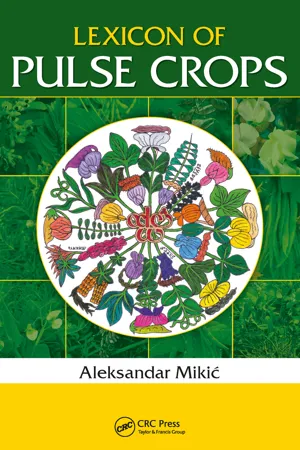
Lexicon of Pulse Crops
eBook - ePub

Lexicon of Pulse Crops

  1. 361 pages
  2. English
  3. ePUB (mobile friendly)
  4. Available on iOS & Android
eBook - ePub

Lexicon of Pulse Crops

About this book

Lexicon of Pulse Crops integrates botanical and linguistic data to analyze and interpret the grain legume significance from the earliest archaeological and written records until the present day. Aimed at both agronomic and linguistic research communities, this book presents a database containing 9, 500 common names in more than 900 languages and dialects of all ethnolinguistic families, denoting more than 1, 100 botanical taxa of 14 selected pulse crop genera and species.

The book begins with overviews of the world's economically most important grain legume crops and their uncultivated relatives, as well as the world's language families with their inner structure, including both extinct and living members. The main section of the text presents 14 specialized book chapters covering Arachis, Cajanus, Cicer, Ervum, Faba, Glycine, Lablab, Lathyrus, Lens, Lupinus, Phaseolus, Pisum, Vicia, and Vigna. They provide the reader with extensive lists of the botanically accepted species and subtaxa and surveys lexicological abundance in all world's ethnolinguistic families, comprising extinct and living as well as natural and constructed languages, while the vernacular names for the most significant taxa are presented in comprehensive tables. Each of these chapters also presents the existing etymologies and novel approaches to deciphering the origins of common names, accompanied by one original color plate depicting possible root evolutions in the form of corresponding pulse crop plants.

Frequently asked questions

Yes, you can cancel anytime from the Subscription tab in your account settings on the Perlego website. Your subscription will stay active until the end of your current billing period. Learn how to cancel your subscription.
No, books cannot be downloaded as external files, such as PDFs, for use outside of Perlego. However, you can download books within the Perlego app for offline reading on mobile or tablet. Learn more here.
Perlego offers two plans: Essential and Complete
  • Essential is ideal for learners and professionals who enjoy exploring a wide range of subjects. Access the Essential Library with 800,000+ trusted titles and best-sellers across business, personal growth, and the humanities. Includes unlimited reading time and Standard Read Aloud voice.
  • Complete: Perfect for advanced learners and researchers needing full, unrestricted access. Unlock 1.4M+ books across hundreds of subjects, including academic and specialized titles. The Complete Plan also includes advanced features like Premium Read Aloud and Research Assistant.
Both plans are available with monthly, semester, or annual billing cycles.
We are an online textbook subscription service, where you can get access to an entire online library for less than the price of a single book per month. With over 1 million books across 1000+ topics, we’ve got you covered! Learn more here.
Look out for the read-aloud symbol on your next book to see if you can listen to it. The read-aloud tool reads text aloud for you, highlighting the text as it is being read. You can pause it, speed it up and slow it down. Learn more here.
Yes! You can use the Perlego app on both iOS or Android devices to read anytime, anywhere — even offline. Perfect for commutes or when you’re on the go.
Please note we cannot support devices running on iOS 13 and Android 7 or earlier. Learn more about using the app.
Yes, you can access Lexicon of Pulse Crops by Aleksandar Mikić in PDF and/or ePUB format, as well as other popular books in Ciencias biológicas & Biología. We have over one million books available in our catalogue for you to explore.

Information

Publisher
CRC Press
Year
2018
eBook ISBN
9781351612258
Edition
1
Subtopic
Biología
1
World’s Pulses
Where the global pulse beats mightiest was the title of the seventh issue of the journal Legume Perspectives, devoted to the major grain legume scientific event in 2014, held in Saskatoon, Canada, one of the pivotal places where the research of various pulse crops advances in great moves to the common welfare. This title was, of course, a wordplay with two meanings of the word pulse, the one in an agronomic sense, where it denotes a grain legume crop used for human and animal nutrition, and the other from a medical viewpoint, referring to a normally regular beat caused by the pumping action of the heart. A similar wordplay was used to entitle the carte blanche of this journal’s issue, A meeting with pulse beating (Warkentin 2014). Both titles, as well as the front cover artwork, showing a stripe made of pulse grains running across our planet in the form of a normal electrocardiography line, referred not only to the contribution made by pulses to the global health, but also attempted to point out how these two meanings of this word, or, more precisely, these two homonyms, rhythmically pulse in human metabolism and human diets. The modern English term pulse, in its botanical sense, either came together with the Norman conquest of England in the eleventh century, having evolved from the Old French pols, pouls, or directly from the Latin puls, denoting meal or porridge; in its turn, the latter is a borrowing of the Ancient Greek póltos, relating to porridge, and, ultimately, originates from the Proto-Indo-European *pel, *pelə, *plē-, meaning dust or flour (Pokorny 1959, Nikolayev 2012). The pulse crops are, as already said, legumes that belong to the immensely abundant plant family of Fabaceae Lindl. (syn. Leguminosae Juss., Papilionaceae Giseke), with between 700 and 800 genera and around 19,000 systematized species (Christenhusz and Byng 2016). Among the economically most important pulse crops in the world and throughout the known human history are the taxa of the genera Arachis L., Cajanus Adans, Cicer L., Glycine Willd., Lablab Adans, Lathyrus L., Lens Mill., Lupinus L., Phaseolus L., Pisum L., Vicia L., and Vigna Savi and the species Vicia ervilia (L.) Willd., and Vicia faba L. (Figure 1.1). As a rule, the pulses are considered food legumes, in the form of an immature or mature grain and, sometimes, an immature pod, which is the reason why the terms pulse and grain legume are regarded as synonyms (Turner et al. 2001). Their additional forms of use often comprise mature grain in animal feeding, fresh and field-dried forage, forage meal, str...

Table of contents

  1. Cover
  2. Half Title
  3. Title Page
  4. Copyright Page
  5. Dedication
  6. Table of Contents
  7. Foreword
  8. Author
  9. Chapter 1 World’s Pulses
  10. Chapter 2 World’s Languages
  11. Chapter 3 Arachis L.
  12. Chapter 4 Cajanus Adans.
  13. Chapter 5 Cicer L.
  14. Chapter 6 Ervum L.
  15. Chapter 7 Faba Mill.
  16. Chapter 8 Glycine Willd.
  17. Chapter 9 Lablab Adans.
  18. Chapter 10 Lathyrus L.
  19. Chapter 11 Lens Mill.
  20. Chapter 12 Lupinus L.
  21. Chapter 13 Phaseolus L.
  22. Chapter 14 Pisum L.
  23. Chapter 15 Vicia L.
  24. Chapter 16 Vigna Savi
  25. Afterword
  26. References
  27. Index