The Archaeology of the Spanish Civil War offers the first comprehensive account of the Spanish Civil War from an archaeological perspective, providing an alternative narrative on one of the most important conflicts of the twentieth century, widely seen as a prelude to the Second World War.
Between 1936 and 1939, totalitarianism and democracy, fascism and revolution clashed in Spain, while the latest military technologies were being tested, including strategic bombing and combined arms warfare, and violence against civilians became widespread. Archaeology, however, complicates the picture as it brings forgotten actors into play: obsolete weapons, vernacular architecture, ancient structures (from Iron Age hillforts to sheepfolds), peasant traditions, and makeshift arms. By looking at these things, another story of the war unfolds, one that pays more attention to intimate experiences and anonymous individuals. Archaeology also helps to clarify battles, which were often chaotic and only partially documented, and to understand better the patterns of political violence, whose effects were literally buried for over 70 years. The narrative starts with the coup against the Second Spanish Republic on 18 July 1936, follows the massacres and battles that marked the path of the war, and ends in the early 1950s, when the last forced labor camps were closed and the anti-Francoist guerrillas suppressed.
The book draws on 20 years of research to bring together perspectives from battlefield archaeology, archaeologies of internment, and forensics. It will be of interest to anybody interested in historical and contemporary archaeology, human rights violations, modern military history, and negative heritage.
- 368 pages
- English
- ePUB (mobile friendly)
- Available on iOS & Android
eBook - ePub
The Archaeology of the Spanish Civil War
About this book
Information
1 Introduction
A war too close
The Spanish Civil War broke many things apart. It shattered families and hopes. It destroyed a country physically and socially for decades. Spain has, in many ways, never recovered from the wounds. We are still fighting, by other means, some of the old battles—about national identity, religion and class. The past looms large in political discourses on the right and on the left; the remains of the conflict (mass graves and monuments) are the object of heated controversies, and war and dictatorship appear in daily conversations and in the media. The Spanish Civil War may be moving away from the present in chronological terms, but the temporality of the conflict is still the now—a non-absent past, as Domanska (2005) would put it. It is still a war too close. The growing political polarization inaugurated after the 2008 global crisis and the rise of the extreme right has contributed to bring it even nearer to the present. Yet interest in the war and in its material legacy has been high since 2000, when the first scientific exhumation of a Spanish Civil War mass grave took place (Silva and Macías 2003). The grandchildren of those who experienced the conflict—like myself—had come of age at the turn of the millennium and wanted to know more and to talk more about what had been silenced. We were free from the constraints of our parents, who suffered (or benefitted from) the dictatorship, or our grandparents, who experienced war as victims, perpetrators or bystanders. It is telling that the discovery of the traumatic past has come in the shape of archaeological excavation. Historical truth had to be unburied, literally. The memory struggle and the archaeology of the Spanish Civil War emerged at the same time and for the same reasons.
The Spanish Civil War is a crucial historical event of the twentieth century—and not just for Spaniards. The conflict, which started as a coup d’état staged by reactionary and fascist officers against a young democracy, is widely regarded as the prelude to the Second World War, the beginning of a cycle of violence that only finished with the end of the Greek Civil War (1946 ̶ 1950): Spain became the testing ground for many of the weapons and tactics that were later used in the global conflict and witnessed the involvement of Nazi Germany, Fascist Italy and the Soviet Union. Seen by many at the time as the last opportunity to stop fascism, it provoked enthusiasm and fear all over the world—and the mobilization of tens of thousands of people who went to fight (and die) in Spain on the Republic’s side. The Spanish conflict also preluded the Second World War in the scale of violence against civilians: around half of the 300,000 casualties were non-combatants, murdered by different militias or by the indiscriminate bombing of towns and villages. Unlike the Second World War, the Spanish conflict ended with the triumph of fascism: General Francisco Franco and António Oliveira de Salazar in Portugal were the only far-right dictators from interwar Europe that managed to perpetuate themselves in power until the 1970s.
The relevance of the history of the Spanish Civil War is out of the question, but why archaeology? Let me point out two reasons that are specific to the case study: first, as noted above, an important part of the history of the conflict has been buried, both literally and metaphorically. There are many aspects (mass graves, concentration camps, violence against civilians) that had been concealed or distorted, first by a dictatorship interested in erasing or downplaying its own crimes, then by a democratic transition that wanted to look only forward—out of conviction, but also out of fear. A history of political violence during the Spanish Civil War and after without archaeology can only be incomplete. Second, much of what has been written about the war in Spain falls within the realm of political, military and economic history. There has been very little academic interest about the lives of ordinary soldiers and civilians, about aspects of culture, sociality and everyday life (and death). We know comparatively little about the experiences in the trenches in Spain—compared to the First or Second World Wars. Archaeology provides extraordinary insights into all these phenomena. It makes war seem more realistic, more mundane and more culturally specific. Also more intimate. It is probably not a paradox that by putting the focus on things, we come closer to people.
Beyond Spain, the archaeology of the civil war has much to offer to the expanding fields of battlefield archaeology (Scott et al. 2009; Scott and McFeaters 2011), the archaeology of internment (Myers and Moshenska 2011) and forensic archaeology and the archaeology of crimes against humanity (Sturdy Colls 2015). These subfields have often developed independently, but they have to be understood in an integrated manner (see Theune 2018). In Spain compartmentalization is simply untenable. Unlike later civil clashes, the Spanish Civil War was a fully-fledged military conflict, with huge standing armies and neat frontlines; like later civil wars, however, it saw extreme violence against civilians—legal, paralegal and illegal—guerrilla and paramilitary actions. Being both civil conflict and total war, then, it is impossible to understand the period if we only look at the frontlines or leave aside the battlefields to focus on the concentration camps or the mass graves.
The present book differs from most publications on the archaeology of contemporary conflict in that it does not adopt a thematic approach or focus on a specific site or region. My intention has been to write an archaeological account of the Spanish Civil War, which does not mean that I will only be drawing from the archaeological record. As the reader will see, oral and written sources have been vital in my work. What it means is that things (objects, bones, ruins, landscapes) guide my narrative as much as possible. This is of necessity a fragmentary account, because there are many events and phenomena that had not yet been explored archaeologically—some of them simply cannot be. But archaeology is fragmentary by nature and this does not mean that it is not meaningful (Burström 2013). Quite the opposite. The fragments of war that I will present here, I expect, are anything but meaningless. Fragments, small details, are not just evocative: they might tell the entire truth of the war: “‘Small details’,” writes Svetlana Alexievich (2018: xxv), “are what is most important for me, the warmth and vividness of life: a lock left on the forehead once the braid is cut; the hot kettles of kasha and soup, which no one eats, because out of a hundred persons only seven came back from the battle…” The same can be said of archaeological finds: the bullet of a coup de grâce; a bottle of perfume lost in the frontline; a baby rattle in a grave; a howitzer shell that did not explode; a graffiti with the name of somebody who is going to be executed; an ammunition pouch full of smuggled cartridges… These are powerful things; things that ask to be narrated. I thus undertake the traditional work of a historian—to write a story about the past—with the sensibility and the tools of an archaeologist—a material narrative. My story starts with the bloodbath of the summer of 1936. It makes its way through the battlefields of Madrid, Guadalajara, the Basque Country, Asturias, Aragón and the Ebro—an irregular conflict transformed into total war. It then meanders through the trenches of those who were about to be defeated and those who were about to become victors for 40 years. It does not stop in 1939, but continues across concentration camps, prisons, guerrilla camps and more mass graves. Until 1952: 16 years of violence and misery (Figure 1.1). Of ruins and bones that archaeologists have been digging for the last two decades.
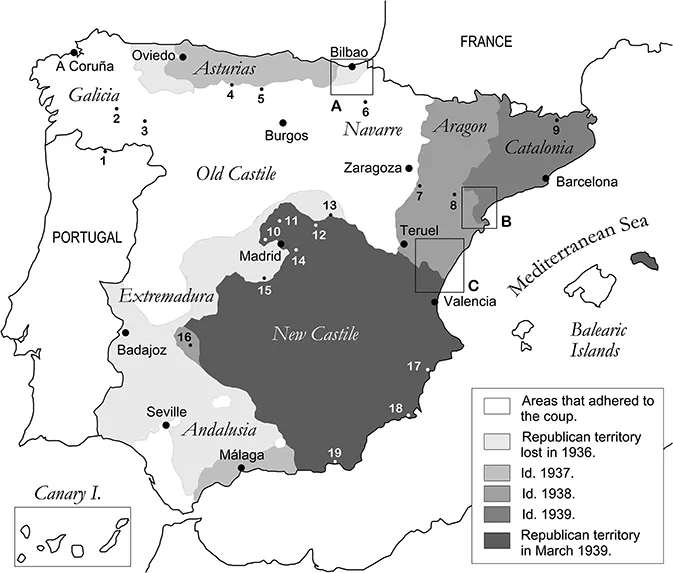
Figure 1.1 Map of Spain during the Civil War with some of the main sites mentioned in the text.
Notes: 1. Cambedo; 2. Repil; 3. Casaio; 4. Castiltejón; 5. Mount Bernorio; 6. Fort San Cristóbal; 7. Belchite and Mediana; 8. Caspe; 9. Vall de Camprodon; 10. Brunete; 11. Bustarviejo; 12. Brihuega; 13. Abánades; 14. Jarama Valley; 15. Toledo; 16. Castuera; 17. Alicante; 18. Cartagena; 19. Almería. For the sites within the squares, see the corresponding chapters: A. Chapter 5; B. Chapter 8; C. Chapter 7.
Source: © Author.
Outline of the book
The book follows a more or less a linear narrative that starts with the beginning of the war and ends in the early 1950s, when the last guerrillas surrendered or were exterminated and the camps closed. Chapter 2 outlines very briefly the path toward the Spanish Civil War and then addresses the unrestrained violence that followed the right-wing coup of 18 July 1936, which led to the conflict. The period of irregular political violence extended through 1936 and the beginning of 1937, after which killings generally plummeted, as expedient militia justice was replaced by formal, and usually more restrained, forms of punishment. Since 2000, scientific exhumations have produced a wealth of data on the patterns of politically motivated assassinations, mostly those perpetrated by right-wing groups. Osteological remains and artifacts associated with the bones also provide unique insight into the identity and the lives of the murdered.
While the carnage of civilians was going on in cities and countryside, the rebels progressed fast toward Madrid from Andalusia. War was waged by highly mobile columns of the colonial army of Morocco that fought against poorly trained Republican militias, while engaging in the kind of indiscriminate violence to which they had become accustomed in Africa. The situation changed in the outskirts of Madrid. Raids muted into all-out industrialized warfare and the archaeological record changes accordingly. Chapter 3 examines the combats around the city, focusing on the Battle of Madrid (7 ̶ 23 November 1936) and its aftermath. It deals mainly with two scenarios: Casa de Campo, a large park in front of the capital where the International Brigades had their baptism of fire, and the University City, which was the furthermost point inside Madrid reached by the Nationalist Army. In Casa de Campo, my team and I excavated one of the few intact trenches still preserved related to the combats of November 1936. The scarcity of documentary evidence associated with these combats offers an opportunity to rewrite a major episode of the Spanish Civil War from the point of view of archaeology. The same happens with the campus: most attention has been paid to the area closer to the city, but we have discovered traces of an unrecorded attack through the northern fringe of the University City, an attack that might have changed the course of the war. We also conducted excavations and surveys in one of the hotspots of the Battle of Madrid: the University Hospital, which, despite heavy modifications after the conflict, furnished astonishing material evidence of the brutal fighting—which preludes urban combats during the Second World War.
In Chapter 4 I abandon the linear narrative to look at the war in Madrid, from the end of the battles for the capital, in January 1937, to the autumn of 1938. After the hyper-eventful days of 1936, Madrid was besieged by the Nationalists and became prey to the monotony of a war of attrition, more redolent of the First World War than the Second. My team and I excavated a Nationalist base at the salient of the University Hospital and several Republican positions on the campus. Archaeology and archival documentation offer a fascinating picture of everyday life on a long-lasting urban front, which anticipated, on a smaller scale, the predicament of Leningrad or Stalingrad. This novel type of war included specific military tactics (such as mine warfare and underground combats) and terror against civilians (aerial and artillery bombings, clandestine centers of repression, murders), all of which have left material traces.
In military terms, the Battle of Madrid was a foretaste of what was to come. During 1937, the unconventional, symmetrical war of the previous months mutated into total war, with both sides deploying hundreds of thousands of soldiers in the field, backed by airplanes, tanks and artillery. The landscape of conflict and its materiality at large changed. Some of the most memorable battles of the Spanish Civil War, from Jarama to Teruel, took place or began in 1937. This was also the year in which the Northern Front collapsed, putting the Republic in a dire situation. Chapter 5 summarizes archaeological research conducted in the Jarama area, the Basque Country, Asturias and the mountains of León and Castile. War in the North is particularly interesting from an archaeological point of view, as its materiality is remarkably different from other scenarios, a phenomenon that has to do with vernacular traditions, peripheral nationalism and the military isolation of the North, which was cut off from the rest of Republican territory. The chapter also describes work that we have carried out in one of the lieux de mémoire of the Spanish Civil War: Belchite. The town was besieged and finally captured by the Republicans during a failed offensive against Zaragoza (one of Spain’s major cities in the hand of the Nationalists). It was presented at the time as a glorious victory by the Republic and as an epic act of resistance by the Nationalists. The fact that Franco decided to preserve the town as a memorial of the war—a sort of Oradour-sûr-Glâne avant la lettre—further projected the myths into the future. We carried out our research both inside Belchite and in the surroundings, where major (and largely forgotten) battles were fought in August and September 1937.
In Chapter 6 we take a detour from the quick pace of the war to glimpse at everyday life in three fronts that remained largely static through the winter of 1938: Badajoz, Guadalajara and Zaragoza. Soldiers ate, drank, played, drew graffiti, wrote, got ill, and dug trenches, but about this historians have had little to say as a rule, concerned as they are with the large operations and political maneuvers that decided the conflict. Archaeology can counterbalance the focus on the dynamic by taking a look at quiet, secondary frontlines. Soldiers also died there: static does not mean that there was no fighting. Men stationed in the rural fronts of Extremadura and Zaragoza experienced artillery attacks, night raids and even local offensives. Through our archaeological surveys in Mediana de Aragón we were able to reconstruct with precision several small raids launched by both Republicans and Nationalists in the vast steppe between Belchite and Zaragoza. Eventually, calm was shattered to pieces in Aragón, where the Nationalists launched an offensive after winning the Battle of Teruel, which ended on 22 February 1938. The Republicans retreated en masse, leaving a trail of corpses behind that archaeologists have in some cases found and exhumed.
The Republicans tried to stop the Nationalist advance toward the Mediterranean that threatened to cut the government’s territory into two by launching an offensive in Guadalajara, in one of those static fronts described in the previous chapter. In Chapter 7, I describe the forgotten Offensive of the Upper Tajuña River of April 1938 using a combination of archaeological and archival sources. The latter are scarce, while references in history books are virtually non-existent, despite the battle involving tens of thousands of men, tanks and aircraft. The chapter follows in the footsteps of the soldiers of the Popular Army from their departing positions to the furthermost point that they reached in a war landscape that has been preserved largely unaltered. The Offensive of the Upper Tajuña was not the only forgotten battle of 1938. Another was the Levante Offensive, which took place immediately afterwards in the hills near the Mediterranean coast in the Valencia region. Here the Nationalists launched an attack to capture the Republican wartime capital. It was a total failure, which explains the oblivion into which the battle has fallen. Archaeological research in the area has explored battlefields, soldiers’ graves and the formidable belts of fortifications that largely thwarted the Nationalist offensive. Also the relentless bombing to which Mediterranean cities and towns were subjected by the rebels.
Chapter 8 examines the most famous battle of the Spanish Civil War: the Battle of the Ebro. Unlike the offensives described in the previous chapter, the Ebro was the largest and most decisive battle of the conflict and for this reason the most prominent in Spanish collective memory. It raged during most of the second half of 1938, consumed staggering quantities of men and matériel (around 80,000 casualties), and ended with a crushing defeat for the Popular Army. After the Ebro, the Republic would not be able to recover and their chances to win the war vanished forever. The first part of the chapter summarizes research conducted on the different scenarios of the Ebro, from the Fayón salient, where Republican soldiers were besieged and exterminated, to the rearguard airfields and boot camps. It also tackles the problem of the ubiquitous human remains still littering the landscape. The second half of the chapter describes the last Republican stronghold in the Ebro, where we found powerful traces of the last day of combats.
The last months of the conflict were of painful agony for the Republic. Chapter 9 takes the reader from the scenarios of the Republican retreat in the Pyrenees and the refugee camps of southern France to the last trenches of the war. Excavations by my team in both Republican and Nationalist positions dated from late 1938 to early 1939 furnish a moving image of the wildly differing experiences of soldiers combatting in the Nationalist and Republican armies. The poverty of the Republic is painfully obvious in the trenches of Madrid, Jarama and Guadalajara, as is the overabundance of material resources of the Nationalists. These differences are particularly clear in the kind and amount of food that combatants had at their disposal, in the different patterns and rates of recycling in both armies and in the medicines they were consuming. Our team also had the chance to excavate one of the last attacks of the Popular Army, which was launched on ...
Table of contents
- Cover
- Half Title
- Title Page
- Copyright Page
- Dedication
- Table of Contents
- List of figures
- List of abbreviations
- Acknowledgements
- Dies Irae
- 1. Introduction
- 2. Time to kill: July 1936–February 1937
- 3. Capital of glory: October 1936–January 1937
- 4. Capital of misery: July 1936–October 1938
- 5. The path to total war: February–October 1937
- 6. Wait and retreat: November 1937–March 1938
- 7. Forgotten battles: April–July 1938
- 8. The Battle of the Ebro: July–November 1938
- 9. Dead men walking: November 1938–March 1939
- 10. The never-ending war: April 1939–1952
- 11. Aftermath: Heritage and memory
- Conclusions
- References
- Annex: Tables
- Index
Trusted by 375,005 students
Access to over 1.5 million titles for a fair monthly price.
Study more efficiently using our study tools.
Frequently asked questions
Yes, you can cancel anytime from the Subscription tab in your account settings on the Perlego website. Your subscription will stay active until the end of your current billing period. Learn how to cancel your subscription
No, books cannot be downloaded as external files, such as PDFs, for use outside of Perlego. However, you can download books within the Perlego app for offline reading on mobile or tablet. Learn how to download books offline
Perlego offers two plans: Essential and Complete
- Essential is ideal for learners and professionals who enjoy exploring a wide range of subjects. Access the Essential Library with 800,000+ trusted titles and best-sellers across business, personal growth, and the humanities. Includes unlimited reading time and Standard Read Aloud voice.
- Complete: Perfect for advanced learners and researchers needing full, unrestricted access. Unlock 1.5M+ books across hundreds of subjects, including academic and specialized titles. The Complete Plan also includes advanced features like Premium Read Aloud and Research Assistant.
We are an online textbook subscription service, where you can get access to an entire online library for less than the price of a single book per month. With over 1.5 million books across 990+ topics, we’ve got you covered! Learn about our mission
Look out for the read-aloud symbol on your next book to see if you can listen to it. The read-aloud tool reads text aloud for you, highlighting the text as it is being read. You can pause it, speed it up and slow it down. Learn more about Read Aloud
Yes! You can use the Perlego app on both iOS and Android devices to read anytime, anywhere — even offline. Perfect for commutes or when you’re on the go.
Please note we cannot support devices running on iOS 13 and Android 7 or earlier. Learn more about using the app
Please note we cannot support devices running on iOS 13 and Android 7 or earlier. Learn more about using the app
Yes, you can access The Archaeology of the Spanish Civil War by Alfredo González-Ruibal in PDF and/or ePUB format, as well as other popular books in Social Sciences & European History. We have over 1.5 million books available in our catalogue for you to explore.