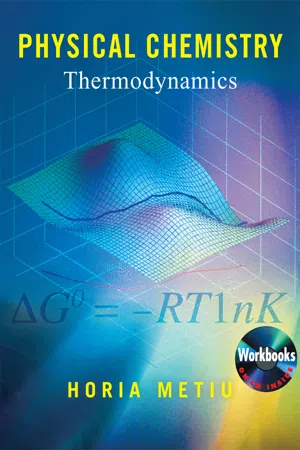
This is a new undergraduate textbook on physical chemistry by Horia Metiu published as four separate paperback volumes. These four volumes on physical chemistry combine a clear and thorough presentation of the theoretical and mathematical aspects of the subject with examples and applications drawn from current industrial and academic research. By using the computer to solve problems that include actual experimental data, the author is able to cover the subject matter at a practical level. The books closely integrate the theoretical chemistry being taught with industrial and laboratory practice. This approach enables the student to compare theoretical projections with experimental results, thereby providing a realistic grounding for future practicing chemists and engineers. Each volume of Physical Chemistry includes Mathematica® and Mathcad® Workbooks on downloadable resources.Metiu's four separate volumes-Thermodynamics, Statistical Mechanics, Kinetics, and Quantum Mechanics-offer built-in flexibility by allowing the subject to be covered in any order.These textbooks can be used to teach physical chemistry without a computer, but the experience is enriched substantially for those students who do learn how to read and write Mathematica® or Mathcad® programs. A TI-89 scientific calculator can be used to solve most of the exercises and problems.
® Mathematica is a registered trademark of Wolfram Research, Inc.
® Mathcad is a registered trademark of Mathsoft Engineering & Education, Inc.
- 729 pages
- English
- PDF
- Available on iOS & Android
eBook - PDF
About this book
Information
Table of contents
- Cover
- Half Title
- Title Page
- Copyright Page
- Contents
- Preface
- How to use the workbooks, exercises, and problems
- Chapter 1 Temperature, pressure, molar volume, and equilibrium
- Chapter 2 The equation of state
- Chapter 3 How to use the equation of state
- Chapter 4 Thermodynamic transformations
- Chapter 5 Work
- Chapter 6 Heat
- Chapter 7 Reversible and irreversible transformations
- Chapter 8 Path-dependent and path-independent quantities
- Chapter 9 First and second laws of thermodynamics
- Chapter 10 Helmholtz and Gibbs free energies
- Chapter 11 How to calculate the change of entropy in an equilibrium transformation
- Chapter 12 Enthalpy and energy change during a thermodynamic transformation
- Chapter 13 Thermochemistry
- Chapter 14 The change of chemical potential during an equilibrium transformation
- Chapter 15 The chemical potential of a compound in a mixture
- Chapter 16 Mixtures: partial molar quantities and activities
- Chapter 17 Chemical equilibrium
- Chapter 18 Chemical equilibrium: the connection between the equilibrium constant and composition
- Chapter 19 Chemical equilibrium: how to calculate K from ΔG[sup(0)] = – RT ln K
- Chapter 20 Chemical equilibrium: dependence of equilibrium constant on temperature and pressure
- Chapter 21 Chemical equilibrium of coupled reactions
- Chapter 22 Phase transitions in one-component systems: the phenomena
- Chapter 23 Phase transitions in one-component systems: the equilibrium conditions
- Chapter 24 Phase transitions in one-component systems: how to use the equilibrium conditions
- Chapter 25 Phase equilibria in binary systems: the phenomena
- Chapter 26 Equilibrium conditions for binary systems with two phases: application to vapor–liquid equilibrium
- Chapter 27 Electrolyte solutions
- Chapter 28 Galvanic cells: phenomena
- Chapter 29 Galvanic cells: equilibrium conditions
- Appendices
- Further Reading
- Index
Trusted by 375,005 students
Access to over 1.5 million titles for a fair monthly price.
Study more efficiently using our study tools.
Frequently asked questions
Yes, you can cancel anytime from the Subscription tab in your account settings on the Perlego website. Your subscription will stay active until the end of your current billing period. Learn how to cancel your subscription
No, books cannot be downloaded as external files, such as PDFs, for use outside of Perlego. However, you can download books within the Perlego app for offline reading on mobile or tablet. Learn how to download books offline
Perlego offers two plans: Essential and Complete
- Essential is ideal for learners and professionals who enjoy exploring a wide range of subjects. Access the Essential Library with 800,000+ trusted titles and best-sellers across business, personal growth, and the humanities. Includes unlimited reading time and Standard Read Aloud voice.
- Complete: Perfect for advanced learners and researchers needing full, unrestricted access. Unlock 1.5M+ books across hundreds of subjects, including academic and specialized titles. The Complete Plan also includes advanced features like Premium Read Aloud and Research Assistant.
We are an online textbook subscription service, where you can get access to an entire online library for less than the price of a single book per month. With over 1.5 million books across 990+ topics, we’ve got you covered! Learn about our mission
Look out for the read-aloud symbol on your next book to see if you can listen to it. The read-aloud tool reads text aloud for you, highlighting the text as it is being read. You can pause it, speed it up and slow it down. Learn more about Read Aloud
Yes! You can use the Perlego app on both iOS and Android devices to read anytime, anywhere — even offline. Perfect for commutes or when you’re on the go.
Please note we cannot support devices running on iOS 13 and Android 7 or earlier. Learn more about using the app
Please note we cannot support devices running on iOS 13 and Android 7 or earlier. Learn more about using the app
Yes, you can access Physical Chemistry by Horia Metiu in PDF and/or ePUB format, as well as other popular books in Physical Sciences & Chemistry. We have over 1.5 million books available in our catalogue for you to explore.