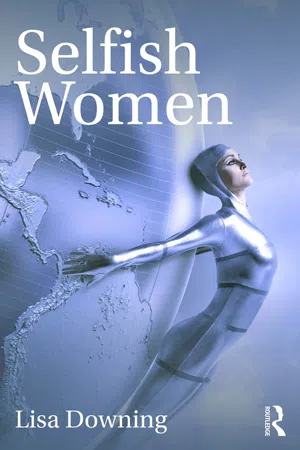
This book proceeds from a single and very simple observation: throughout history, and up to the present, women have received a clear message that we are not supposed to prioritize ourselves. Indeed, the whole question of "self" is a problem for women – and a problem that issues from a wide range of locations, including, in some cases, feminism itself. When women espouse discourses of self-interest, self-regard, and selfishness, they become illegible. This is complicated by the commodification of the self in the recent Western mode of economic and political organization known as "neoliberalism," which encourages a focus on self-fashioning that may not be identical with self-regard or self-interest.
Drawing on figures from French, US, and UK contexts, including Rachilde, Ayn Rand, Margaret Thatcher, and Lionel Shriver, and examining discourses from psychiatry, media, and feminism with the aim of reading against the grain of multiple orthodoxies, this book asks how revisiting the words and works of selfish women of modernity can assist us in understanding our fraught individual and collective identities as women in contemporary culture. And can women with politics that are contrary to the interests of the collective teach us anything about the value of rethinking the role of the individual?
This book is an essential read for those with interests in cultural theory, feminist theory, and gender politics.
The vices attributed to individualism by its critics are self-absorption, narcissism, unscrupulous competition, alienation, atomism, privatism, deviance, rationalization, worship of objectivity, relativism and nihilism.
Much of our distress comes from a sense of disconnection. We have a narcissistic society where self-promotion and individuality seem to be essential, yet in our hearts that’s not what we want. We want to be part of a community, we want to be supported when we’re struggling, we want a sense of belonging. Being extraordinary is not a necessary component to being loved.
I think writers and artists are the most narcissistic people. I mustn’t say this, I like many of them.
Narcissism is one of those terms that has both a lay meaning and a technical one. In everyday social discourse, narcissism has come to mean vanity, toxic self-obsession, egotism, and – most literally – excessive self-love. In the psy sciences its definition has evolved over time from Freud’s turn-of-the-century Vienna, where it is understood as a failure of mature, adult “object love” to its current manifestation as a “personality disorder” in twenty-first-century psychiatry. It is a fascinating and timely concept, as it is at once an individual diagnosis of pathology with a discrete clinical history, and yet also it has become a metaphorical descriptor of our modern and post-modern Western cultural Zeitgeist. Certain periods of European and North American history have been characterized as eras with an especially narcissistic character. These include the nineteenth-century fin de siècle, characterized by the rise of the modern individual and by Decadent solipsism, the “permissive” post-1960s era (with the 1970s being dubbed the “Me Decade”1), and most recently, the decades characterized by what is often known as “neoliberalism,” an economic philosophy of free markets that has allegedly led, according to critics, to selfish, atomized, unhappy citizens who view themselves first as consumers and a generation of young people obsessed with image and surface. (Psychologist Oliver James and psychoanalyst Paul Verhaeghe have both written searing critiques of the effects of this worldview on the subjects living with it.2) In 2000, psychoanalytic critic Jessica Benjamin stated that in our consumerist and celebrity-obsessed culture, “Narcissus has replaced Oedipus as the myth of our time.”3 Yet, while there may be some validity to seeing narcissism as a description of the collective character of our culture, it is also the case that both diagnoses of individual narcissism as a pathological clinical entity and accusations of cultural narcissism as a more widespread phenomenon can reveal much about attitudes to gender in contemporary culture, since narcissism has a particularly gendered history.4
In this chapter, I will explore the history of the gendering of the clinical concept of narcissism in the psy sciences. My history will cover narcissism in the foundational texts and ideas of psychoanalysis that were produced in Europe at the turn of the century, in twentieth-century American ego-psychology (which both built on and deviated from psychoanalysis), and in the American Psychiatric Association’s diagnostic schema which first included “narcissistic personality disorder” in the Diagnostic and Statistical Manual of Mental Disorders in DSM III, published in 1980. I will also read the foundational text of psychoanalytic theory about narcissism, Sigmund Freud’s “On Narcissism: An Introduction” (1914), with and through historically contemporaneous literary portrayals of female “narcissism” by the French Decadent writer Rachilde (Marguerite Vallette-Eymery, 1860–1953). I will then contextualize later psychological and psychiatric theories of narcissism by reading them alongside social commentary about cultural narcissism in order to further our understanding of the process of subjectification of the gendered narcissistic subject. I mean this, of course, in the broadly Foucauldian sense of a “specified individual,”5 who comes about, can be thought, and can think themselves only as a result of the meeting of particular historical epistemological disciplines and discourses. In this case, those discourses are clinical psychology and psychiatry, the rise of economic/philosophical ideologies of individualism, and the socially changing gender roles brought about by the women’s liberation movement and the branches of feminism which have followed on from it. I will conclude by making some broader points about the ways in which the conceptualization of specifically female narcissism may say as much about attitudes to women in modern Western culture, as about the so-called narcissistic women in question. I want to ask what notions of female narcissism reveal about the forms of female selfhood that are psychosocially allowed for. I also want to explore the extent to which narcissism really can be understandable as self-love or self-regard (the focus of this book), as distinct from their opposite – a compensation for damaged self-regard – since narcissism is a knotty concept that seems, according to those experts who write on it, to have as much to do with fragility as self-valuation, and to be far from a straightforward synonym for extreme selfishness or self-interest. Indeed, for Nathaniel Branden, the father of the modern self-esteem movement and Ayn Rand’s sometime intellectual heir, narcissism is not a manifestation of genuine self-worth – excessive or otherwise – but, rather, a counterfeit form of it.6
Freud’s female narcissist – a deviation from a myth
The figure who lent his name to the concept we are considering, Narcissus, the beautiful youth of Greek mythology, is a tragic and a cautionary one. Cursed by Nemesis, a goddess whose remit was to guard against hubris, Narcissus was compelled to fall in love with his own image, glimpsed in a pool. Unable to leave self-contemplation, even for a moment, or to accept the advances of other would-be lovers, Narcissus pined to death as the result of unrequited desire for his own image. The gendering of the Narcissus myth is telling. The vain and self-loving figure is male. Ovid’s Metamorphoses introduced the female figure of Echo, who came upon Narcissus while out walking. When Narcissus called out “who’s there?” Echo was compelled to repeat his words, fell in love with the beautiful youth, and became henceforth nothing but an echo when he rejected her, deprived of the ability to voice her desire. In Ovid’s version, Nemesis’s punishment of Narcissus came as a direct result of his treatment of Echo. In a 1988 book that reads the Narcissus and Echo myth as a structuring model for the relationships between the sexes drawn in a selection of modern French literary narratives, Naomi Segal argues that, archetypically, male figures function as narrative doubles, while female characters function as mere echos.7 She argues for the need to restore Echo’s desire, and to acknowledge the silenced voice of female, here heterosexual, desire that is cast into shadow by the grandiosity of Narcissus’s self-focused plight. While, as I will explore in what follows, the psychological diagnosis to which Narcissus lent his name has little to do with the more fanciful details of the myth, something of the gender power play and politics of Ovid’s version of the myth, as brought out by Segal’s innovative reading, can indeed be discerned.
In his essay “On Narcissism: An Introduction” Freud attributes the first coining of the term, understood as a psychological pathology, to Paul Näcke, the Russian-born, German-based criminologist and sexologist, who used it in 1899.8 Subsequently, Freud acknowledged that Havelock Ellis had used the term “narcissus-like” to describe a psychological attitude in 1898, a year earlier than Näcke.9 Significantly, Näcke’s 1899 account of “Narzissmus” categorized it primarily as a sexual perversion rather than as the regressive ego disturbance it would become for Freud. In Näcke’s version, the narcissistic pervert desires, eroticizes, and stimulates his own body and derives complete satisfaction from this autoeroticism, in the very way, he says, that a “normal” person would with a sexual partner. In this respect, Näcke’s version of narcissism is close to the autoerotic and romantic inspiration provided by the figure of Narcissus, who eschewed Echo’s wooing in favour of complete, all-consuming self-love to the point of annihilation. Freud’s essay is groundbreaking in that it deviates from Näcke’s classification of narcissism as one of the sexual perversions and provides the point of origin for the way in which subsequent iterations – both clinical and cultural – of narcissism would be understood (whether in the form of a building-upon or reacting-against its tenets).
The essay proceeds according to a rather typical Freudian method and logic. Freud begins by seeking evidence of pathological narcissistic phenomena before arriving at the conclusion that there is also such a thing as healthy or normal narcissism. The ego comes into being, Freud speculates, by taking the self as the first love object (supplanting primary mother-love). This is primary narcissism. This is in line with Freud’s major contribution to our understanding of human psychology, which holds that all of us are, to some degree, sick – at the very least neurotic – as a result of the trauma of socio-psychical development through which we all pass: the so-called “psychopathology of everyday life.” Freud locates the child’s earliest developmental stage as the autoerotic stage that precedes both the primary narcissism that gives birth to the ego, and the establishment of object relations. So, Freud remarks, “we are bound to suppose that a unity comparable to the ego cannot exist in the individual from the start; the ego has to be developed. The auto-erotic instincts, however, are there from the very first …”10 He highlights primary narcissism as a “normal” stage in psychosexual and ego development, but one that could be subject to arrest or regression in adulthood, and which could become psychopathological. For Freud, the growing child must choose between self and mother (and later mother-substitute) as sexual object. Freud writes:
We say that a human being has originally two sexual objects – himself and the woman who nurses him – and in doing so we are postulating a primary narcissism in everyone, which may in some cases manifest itself in a dominating fashion in his object choice.11
Freud goes on to differentiate between male and female narcissism in a way that seems at first glance to suggest that women are more likely than men to be narcissistic. Men over-value their sexual object, he says, drawing on their latent primary narcissistic energy that has been diverted into son-to-mother-love (his translator, James Strachey, calls this the “anaclitic” type of love. In the original German “anaclisis” is Anlehnung). Women, on the other hand, develop their affect differently, owing in part to genital difference and penis envy. Woman, as the embodiment of lack, compensates for her insignificant genitalia with the satisfaction gained from her ability to attract and be attractive; she eroticizes her own desirability. Additionally, the ambivalence that Freud insists girls feel with regard to their mothers – that original love object who will become both erotic rival and source of disappointment on learning of the fact of sexual difference, means that she has no object to idealize unproblematically in the way that sons do. This leads women to what Freud calls the narcissistic type of love:
With the onset of puberty the maturing of the female sexual organs […] seems to bring about an intensification of the original narcissism, and this is unfavourable to the development of a true object-choice with its accompanying sexual overvaluation. Women, especially if they grow up with good looks, develop a certain self-contentment […] Strictly speaking, it is only themselves that such women love with an intensity comparable to that of the man’s love for them. Nor does their need lie in the direction of loving, but of being loved…12
Unlike our Classical mythical version of Narcissus, so in love with himself that it is of no interest to him how others may perceive him, Freud’s female narcissists are described as having at best a...
Table of contents
Cover
Half Title
Title Page
Copyright Page
Table of Contents
List of figures
Acknowledgements
Introduction
1 The psychopathology of selfishness: On narcissism and norms of gender
2 The philosophy of selfishness: On Ayn Rand and rational self-interest
3 The politics of selfishness: On Margaret Thatcher and exceptional women
4 Personal and professional practices of selfishness: On babies, boardrooms, and ballot boxes
5 A feminist ethics of selfishness? Beyond individualism and collectivism
Conclusion
Index
Trusted by 375,005 students
Access to over 1.5 million titles for a fair monthly price.
Study more efficiently using our study tools.
Frequently asked questions
Yes, you can cancel anytime from the Subscription tab in your account settings on the Perlego website. Your subscription will stay active until the end of your current billing period. Learn how to cancel your subscription
No, books cannot be downloaded as external files, such as PDFs, for use outside of Perlego. However, you can download books within the Perlego app for offline reading on mobile or tablet. Learn how to download books offline
Perlego offers two plans: Essential and Complete
Essential is ideal for learners and professionals who enjoy exploring a wide range of subjects. Access the Essential Library with 800,000+ trusted titles and best-sellers across business, personal growth, and the humanities. Includes unlimited reading time and Standard Read Aloud voice.
Complete: Perfect for advanced learners and researchers needing full, unrestricted access. Unlock 1.5M+ books across hundreds of subjects, including academic and specialized titles. The Complete Plan also includes advanced features like Premium Read Aloud and Research Assistant.
Both plans are available with monthly, semester, or annual billing cycles.
We are an online textbook subscription service, where you can get access to an entire online library for less than the price of a single book per month. With over 1.5 million books across 990+ topics, we’ve got you covered! Learn about our mission
Look out for the read-aloud symbol on your next book to see if you can listen to it. The read-aloud tool reads text aloud for you, highlighting the text as it is being read. You can pause it, speed it up and slow it down. Learn more about Read Aloud
Yes! You can use the Perlego app on both iOS and Android devices to read anytime, anywhere — even offline. Perfect for commutes or when you’re on the go. Please note we cannot support devices running on iOS 13 and Android 7 or earlier. Learn more about using the app
Yes, you can access Selfish Women by Lisa Downing in PDF and/or ePUB format, as well as other popular books in Social Sciences & Ethics & Moral Philosophy. We have over 1.5 million books available in our catalogue for you to explore.