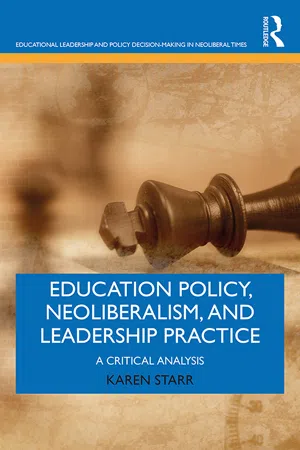
Education Policy, Neoliberalism, and Leadership Practice is a foundational book describing all aspects of neoliberalism and its broad scale impact in education. Drawing on research and canvassing policy developments across a range of contexts, this book critically analyzes neoliberal education policies, the practices and outcomes they spawn, and the purposes they serve. It interrogates how education leaders perceive and interpret neoliberal influences and the dilemmas and opportunities they create, while unpacking questions of why neoliberalism is the basis for educational policy, how neoliberalism impacts on education, and what this means for the future.
- 178 pages
- English
- ePUB (mobile friendly)
- Available on iOS & Android
eBook - ePub
About this book
Information
PART I
A Rising Tide Lifts All Boats
‘A rising tide lifts all boats’ – a neoliberal aphorism – sums up Part I of this book, which discusses neoliberalism in education. The chapters in this section explain the origins of neoliberalism, its major principles or axioms, and describes and critiques how these ideas play out in education policy and leadership practice.
Chapter 1 sets the scene for the discussion in the rest of the book. It summarizes the impetus for the book, the research underpinning it, and explains the conception of ‘policy’ as the term is used throughout the book.
Chapter 2 is foundational to all subsequent chapters – it discusses the intersecting influences of globalization, free market economics, and attendant neoliberal discourses as the dominant organizing framework for education policy. Chapter 2 explores how these forces function and perform recursively and influence each other. It discusses the history, evolution, and current manifestations of global free market neoliberalism, explains how and why education policy is caught up in neoliberal pursuits, and the interests so served. This is an important backdrop and essential information for the arguments pursued through the remainder of the book.
Neoliberalism’s fundamental tenets are inextricably linked and mutually reinforcing. However, to provide a thorough explanation, each axiom is discussed in turn to form the focus of an individual chapter. Chapters 3 through 11 analyze the sentiments behind each neoliberal precept, the education policies and practices so inspired, and the impact, implications, and consequences for leadership practice. As a set these chapters describe the powerful coalition of ideas that form ‘neoliberalism’, but each chapter is also designed to stand alone. They focus on:
- Individualism, including institutional autonomy
- Privatization
- Choice
- Competition
- Improvement, innovation, and entrepreneurialism
- Efficiency
- Productivity
- Performativity
- Accountability.
1
Introduction
The Misguided Impatience of Education Policy
What is education for? What is its purpose? These are simple yet important, foundational questions for any education system or institution anywhere. The answers to these questions – even if implicit and unspoken – have profound effects on all aspects of life. This statement may sound far-fetched, yet our beliefs about education’s purposes reveal our hopes for the society we want to live in, now and in the future. Of course, there can be many answers to these questions, and the purposes of education are contested. However, one might hope that there would be some broad agreement about education’s fundamental objectives and functions.
We may assume, for example, that the major purpose of education in developed democracies is to prepare students for family and community life, productive work, engaged democratic citizenship, and lifelong learning. 1 Behind such a purpose is a vision of the kind of society we wish to develop: a peaceful, democratic, and just society of educated, informed citizens, cohesive and functional communities and families, and effective representative governments, where everyone can make a fulfilling contribution through employment and recreation. Our collective hopes, therefore, would be for individuals to be respected, supported to make wise decisions that benefit themselves and others, while contributing to the common weal through their social, cultural, economic, and political engagement.
Underpinning this vision, we may further assume that people matter and that we bear some collective responsibility to take care of everyone as we strive to develop and maintain a good life. Infused in a vision of a ‘good’ society are notions of freedom, inclusion, democracy, peace, sustainability, justice, and equity. These are perhaps best summarized as “life, liberty and the pursuit of happiness” mentioned in the United States Declaration of Independence and in its Constitution, which speaks to justice, tranquility, common defense, general welfare, liberty, and national posterity. In other words, we collectively want these things for ourselves, others and future generations and we are willing to defend these ideals. If we think about it, who could disagree? Is there anyone wishing for an unhappy, unfortunate life for themselves or their children?
In a society wishing to pursue such ideals as these, education is pivotal. It is so important, in fact, that during the years of primary and secondary schooling it is compulsory and free. Every young person, irrespective of background, is compelled to be educated, so as to enable this vision and pursuit of a ‘good’ society.
Perhaps these contentions sound like ‘the bleeding obvious’ yet one would be hard pushed to find any clear statements like these or other explicit purposes on the websites of major education systems and authorities anywhere. But we should ponder what functions we want education to perform on behalf of all of us. Because at the current time many educators are concerned about policy direction and have serious doubts about where education and their work are heading. There is a general sense that things are off course – that the democratic, just and socially cohesive societies we imagine to be at the heart of the education vision are being undermined, even corrupted – and this disquiet is palpable and widespread. Discussions with education leaders leave one with the strong and sad sense that all is not right in education and it’s getting worse.
Powerful politicians and policymakers (most of whom have never worked as teachers or with students) are viewed as arrogantly pronouncing that education is failing and in crisis, undertaking to ramp up its efforts, squeezing educators and learners for more productivity, demanding ‘efficiencies’ to save rising costs in the belief that education returns little value for money, while instigating high-stakes measurement and compliance schemes to whip the whole ‘enterprise’ into shape. This entrenched and inimical state of play stretches left and right of politics while an obliging media uncritically applauds and drums up legitimacy for even tougher ‘reforms.’
But to what end? What’s gone wrong? Why is education perceived and pronounced in such deficit terms? Why are educators so widely disrespected and denounced? Why is the bleak mood amongst educators so broad-sweeping – what do they fear and why are they cynical and pessimistic? And, of critical importance to this book, what does this mean for education leadership practice and education policy futures?
What’s wrong and what’s causing widespread anxiety lies at the heart of this book. What’s wrong concerns a widening gulf between the views of educators – who thought they were pursuing the kind of purposes described above – and a new wave of politics and economics that have been embraced across developed democracies as the organizing framework for society, including education and all other social services. We can no longer assume we know what education is for – we now have to question who and what education is serving, why, and to what ends. This is the prime focus of this book.
Although there is a long list of tensions, struggles, and grievances mentioned in the following chapters, they mostly stem from the same roots: globalization and the pervasive infiltration of neoliberal market principles in education policy and practice. This book is about the macro international events and circumstances that impact national governments and local education systems and their policymakers, with concomitant effects in individual education institutions where their leaders are responsible for policy enactment.
Governments of varying political hues have instigated ongoing structural reforms to align national education agendas with the demands of intensified global economic competition. As a result, education policies throughout the westernized world have subsumed increasingly economistic imperatives to achieve these national objectives.
Current education policy is heavily influenced by the needs, values, and underlying philosophy of neoliberal market agendas which frustrate and undermine, rather than enhance and support, traditional education aims. As a laissez-faire economic and neoliberal policy hegemony is constantly reinvigorated and fortified, so education policies, operations, and leadership behaviors are regulated to adapt and adjust to align with market imperatives. In so doing, education’s role in national and international economic fortunes has assumed primacy over its individual, civic, or social benefits.
The way we envisage, experience, and conduct learning, teaching, and education leadership is rapidly changing, as are the ways in which we speak and think about education. Public assumptions once steeped in the common weal appear to have been sullied and weakened as faith in the neoliberal free market continues to triumph and intensify. These are turbulent times for educators and education leaders who must come to grips with the incongruities that neoliberal policy produces, but which always demand change – from minor adjustments to radical transformations. The new remit of education leadership rests on the aims, expectations, and decisions embodied in neoliberal policy ambitions and pursuits.
Education Policy, Neoliberalism, and Leadership Practice critically analyses education policies, processes, and assumptions, their rationale/s and the purposes they serve. It bases this analysis on the perceptions and sentiments of those who lead and manage education institutions. This book traces the origins of leaders’ experiences and concerns back to their neoliberal roots, and analyzes influences on education, education policy and practice, education outcomes, and the professional lives of education leaders. It interrogates how education leaders perceive, comprehend, and rationalize policy decisions, the factors that influence their reactions and actions, and documents emerging concerns and ideas for redress. The book responds to the following questions:
- Why are neoliberal policies influencing education and education policy?
- How is education influenced by neoliberal policy agendas? How are neoliberal policy agendas enacted?
- What are the effects?
- Whose interests are served?
- How do education leaders explain and respond to neoliberal policy agendas in practice?
While reporting on a very disheartening state of affairs, the book looks to opportunities within neoliberal policy regimes. It chronicles how education leaders perceive, interpret, and try to use policy discourses for education pursuits of a very different kind – a kind that speaks to what Biesta (2013) calls “the beautiful risk of education,” highlighting how its ‘weakness’ – in neoliberal terms – is its strength, and how its strength lies in the minds of thinking, agential, free-willed human beings who can shape rather than react to policy futures.
Policy
‘Policy’ is generally understood to refer to “a course or principle of action, adopted or proposed by a government, party, business or individual” (Oxford English Dictionary, 2013). Policy is part of the schemata of government, government agencies, organizations, and institutions (see for example, The University of Sydney, 2011; John Hopkins University, 2013). Policy concerns direction, a stance, a platform, corporate goals, or a position that informs a set of actions towards institutionalizing definitive goals. In this sense, policy refers to an intention to institutionalize certain values and actions, usually developed, controlled, and regulated in hierarchical and authoritarian ways. However, this is quite a conservative definitional stance.
Policies are not simply material artifacts or statements of formal goals and intentions. Policymaking is necessarily a political process. Many ideologies, philosophies, agendas, discourses, and activities comprise policy. In terms of education, policy activities are imbued with the political positions, demands, and expectations of numerous stakeholders, 2 such that policy statements are an amalgam of compromises that will never suit everybody, making it ad hoc and messy. Dealing with many stakeholders and interest groups makes policymaking convoluted and complex, so what emerges often embraces many paradoxes and contradictions (Starr, 2015), which makes education leadership all the trickier.
Formal education policy decisions made by governments carry weight and affect numerous people. It is unrealistic, however, to view the people affected by policy as impartial players in a value-neutral exercise. Education institutions cannot be relied upon to accommodate policy intentions with the unerring fidelity that policymakers intend.
Education leaders charged with policy ‘implementation’ make varying interpretations, have unpredictable levels of commitment or endorsement, undertake and experience numerous other activities and events, have untold demands on their time, and differing methods of undertaking change, some of which will be more ‘successful’ than others. Policy mandates may thus be subverted, altered, resisted, or ignored as leaders so decide. If policy is unpopular it can be distorted or disguised to fit real or perceived needs, or leaders may report that policy has been implemented, knowing that nothing is going to change.
Adding to ‘implementation’ problems is the fact that education policies often come and go so quickly, with one policy announced only to be replaced with a new policy issuing revised aims and intentions. Incoming governments focusing on short-term political agendas change the education policies of their predecessors, often appealing to popular concerns legitimated through negative political and media commentary. A consequence is that education policy changes constantly, making full ‘implementation’ impossible and policy effects inestimable while ensuring that educational institutions are constantly responding in some way to externally imposed change.
Uncertainty, complexity and policy fluidity are exacerbated by short-term governments and frequently changing business models. Constant major change is the new norm, which makes leadership, management, and governance more challenging, demanding, and inherently riskier. Further, policy can have unimaginable and unintended consequences and can inadvertently introduce ‘wicked problems’ (Kets de Vries, 2001; Rittel & Webber, 1973). Hence, policy cannot be viewed as a tangible phenomenon in its definition, formulation, or ‘implementation.’
Policies, therefore, are processes and outcomes ...
Table of contents
- Cover
- Half Title
- Series Page
- Title Page
- Copyright Page
- Dedication
- Table of Contents
- Series Introduction
- Acknowledgments
- Part I: A Rising Tide Lifts All Boats
- Part II: An Ebbing Tide…?
- Concluding Remarks
- Index
Trusted by 375,005 students
Access to over 1.5 million titles for a fair monthly price.
Study more efficiently using our study tools.
Frequently asked questions
Yes, you can cancel anytime from the Subscription tab in your account settings on the Perlego website. Your subscription will stay active until the end of your current billing period. Learn how to cancel your subscription
No, books cannot be downloaded as external files, such as PDFs, for use outside of Perlego. However, you can download books within the Perlego app for offline reading on mobile or tablet. Learn how to download books offline
Perlego offers two plans: Essential and Complete
- Essential is ideal for learners and professionals who enjoy exploring a wide range of subjects. Access the Essential Library with 800,000+ trusted titles and best-sellers across business, personal growth, and the humanities. Includes unlimited reading time and Standard Read Aloud voice.
- Complete: Perfect for advanced learners and researchers needing full, unrestricted access. Unlock 1.5M+ books across hundreds of subjects, including academic and specialized titles. The Complete Plan also includes advanced features like Premium Read Aloud and Research Assistant.
We are an online textbook subscription service, where you can get access to an entire online library for less than the price of a single book per month. With over 1.5 million books across 990+ topics, we’ve got you covered! Learn about our mission
Look out for the read-aloud symbol on your next book to see if you can listen to it. The read-aloud tool reads text aloud for you, highlighting the text as it is being read. You can pause it, speed it up and slow it down. Learn more about Read Aloud
Yes! You can use the Perlego app on both iOS and Android devices to read anytime, anywhere — even offline. Perfect for commutes or when you’re on the go.
Please note we cannot support devices running on iOS 13 and Android 7 or earlier. Learn more about using the app
Please note we cannot support devices running on iOS 13 and Android 7 or earlier. Learn more about using the app
Yes, you can access Education Policy, Neoliberalism, and Leadership Practice by Karen Starr in PDF and/or ePUB format, as well as other popular books in Education & Education General. We have over 1.5 million books available in our catalogue for you to explore.