eBook - ePub
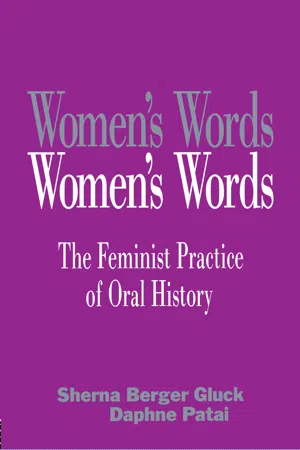
Women's Words
The Feminist Practice of Oral History
- 244 pages
- English
- ePUB (mobile friendly)
- Available on iOS & Android
eBook - ePub
Women's Words
The Feminist Practice of Oral History
About this book
Women's Words is the first collection of writings devoted exclusively to exploring the theoretical, methodological, and practical problems that arise when women utilize oral history as a tool of feminist scholarship. In thirteen multi-disciplin ary esays, the book takes stock of the implicit presuppositions , contradictions, and prospects of oral h
Information
I
Language and Communication
Oral history begins with talk. Because feminists, like social historians, were initially attracted to oral history as a way of recovering the voices of suppressed groups, they tended to ignore the problematic dimension of language as the basis of oral history. But as the thirst for information about women's lives began to be assuaged, it became apparent that attention had to be given to the very medium and process through which this information was being made available. The three essays in this section all focus on language and communication, and on the ways in which they are shaped by gender.
Coming from the discipline of history, many of the early feminist scholars collecting oral narratives were impeded by traditional historical methodology, above all by the belief that their main task was to ask the right questions in order to uncover new data about women's lives and activities. Kathryn Anderson and Dana Jack urge interviewers to abandon this stance, discard their protocols and presuppositions, and, instead, truly attend to narrators’ self-evaluative comments, meta-statements, and the overall logic of the narrative.
The active nurturing of the interview process is further elaborated by Kristina Minister, who argues that gender itself should become a basic unit of analysis in oral history methodology. Evoking an imaginary video of a group conversation, she explores how women's style of communication structures women's verbal and nonverbal interaction, and urges that we draw on these resources and abandon patriarchal models of communication.
Gwendolyn Etter-Lewis demonstrates the need for specific studies of the language and communication patterns of different groups, arguing that black women in the United States cannot be understood if their talk is examined using models created for white women. Analyzing the speech patterns of a group of Afro-American women and delineating three distinct narrative styles in their talk, Etter-Lewis shows how language shapes the representation of self.
Together, these essays move us beyond earlier prescriptions for women's oral history. They make us realize that women interviewing women is not an unproblematic activity. Taping a woman's words, asking appropriate questions, laughing at the right moment, displaying empathy—these are not enough. What is missing from this list is the realization that the interview is a linguistic, as well as a social and psychological, event, one that can be better understood by taking into account the specific characteristics and styles of the group being studied.
1
Learning to Listen: Interview Techniques and Analyses
Oral history interviews provide an invaluable means of generating new insights about women's experiences of themselves in their worlds. The spontaneous exchange within an interview offers possibilities of freedom and flexibility for researchers and narrators alike. For the narrator, the interview provides the opportunity to tell her own story in her own terms. For researchers, taped interviews preserve a living interchange for present and future use; we can rummage through interviews as we do through an old attic—probing, comparing, checking insights, finding new treasures the third time through, then arranging and carefully documenting our results.
Oral interviews are particularly valuable for uncovering women's perspectives. Anthropologists have observed how the expression of women's unique experience as women is often muted, particularly in any situation where women's interests and experiences are at variance with those of men.1 A woman's discussion of her life may combine two separate, often conflicting, perspectives: one framed in concepts and values that reflect men's dominant position in the culture, and one informed by the more immediate realities of a woman's personal experience. Where experience does not “fit” dominant meanings, alternative concepts may not readily be available. Hence, inadvertently, women often mute their own thoughts and feelings when they try to describe their lives in the familiar and publicly acceptable terms of prevailing concepts and conventions. To hear women's perspectives accurately, we have to learn to listen in stereo, receiving both the dominant and muted channels clearly and tuning into them carefully to understand the relationship between them.
How do we hear the weaker signal of thoughts and feelings that differ from conventional expectations? Carolyn Heilbrun urges biographers to search for the choices, the pain, the stories that lie beyond the “constraints of acceptable discussion.”2 An interview that fails to expose the distortions and conspires to mask the facts and feelings that did not fit will overemphasize expected aspects of the female role. More important, it will miss an opportunity to document the experience that lies outside the boundaries of acceptability.
To facilitate access to the muted channel of women's subjectivity, we must inquire whose story the interview is asked to tell, who interprets the story, and with what theoretical frameworks. Is the narrator asked what meanings she makes of her experiences? Is the researcher's attitude one of receptivity to learn rather than to prove preexisting ideas that are brought into the interview? In order to learn to listen, we need to attend more to the narrator than to our own agendas.
Interview Techniques: Shedding Agendas—
Kathryn Anderson
My awareness of how both personal and collective agendas can short-circuit the listening process developed while scanning oral histories for the Washington Women's Heritage Project. This statewide collaborative effort received major support from the National Endowment for the Humanities and the Washington Commission for the Humanities to develop educational workshops and to produce a traveling exhibit documenting women's lives in interviews and historical photographs. The first stage of the project involved training dozens of interviewers in a series of oral history workshops held throughout the state. A typical workshop provided information on equipment, processing tapes, interviewing techniques, and a crash course in the new women's history scholarship. Prospective interviewers left with a manual, which included Sherna Gluck's “Topical Guide for Oral History Interviews with Women.”3
To select excerpts for the exhibit, we reviewed dozens of interviews produced by project staff and workshop participants along with hundreds of interviews housed in archives and historical societies. We found them filled with passages describing the range and significance of activities and events portrayed in the photographs. To our dismay and disappointment, however, most of them lacked detailed discussions of the web of feelings, attitudes, and values that give meaning to activities and events. Interviewers had either ignored these more subjective dimensions of women's lives or had accepted comments at face value when a pause, a word, or an expression might have invited the narrator to continue. Some of us found discrepancies between our memories of interviews and the transcripts because the meaning we remembered hearing had been expressed through intense vocal quality and body language, not through words alone.
We were especially confused that our interviews did not corroborate the satisfactions and concerns other historians were discovering in women's diaries and letters, or the importance of relationships social scientists were uncovering in women's interviews. To understand why, I scrutinized the interviews with rural women that I had done for the project, paying special attention to interview strategies and techniques. My expectations that the interviews would give rural women a forum to describe their experiences in their own terms and to reflect on their experiences as women in the specific context of Washington state were thwarted to some extent by three factors: the project's agenda to document women's lives for the exhibit; an incomplete conversion from traditional to feminist historical paradigms; and the conventions of social discourse.
While the project's general goal was to accumulate a series of life histories, my special task was to discover women's roles in northwest Washington farming communities. Project deadlines and the need to cover a representative range of experiences combined to limit interviews to no more than three hours. In retrospect, I can see how I listened with at least part of my attention focused on producing potential material for the exhibit—the concrete description of experiences that would accompany pictures of women's activities. As I rummage through the interviews long after the exhibit has been placed in storage, I am painfully aware of lost opportunities for women to reflect on the activities and events they described and to explain their terms more fully in their own words.
In spite of my interest at the time in learning how women saw themselves as women in specific historical contexts, the task of creating public historical documents as well as the needs of the project combined to subvert my personal interests and led to fairly traditional strategies. As a result, my interviews tended to focus on activities and facts, on what happened and how it happened. They revealed important information about the variety of roles women filled on Washington farms, and how they disguised the extent and importance of their contributions by insisting that they were just “helping out” or “doing what needed to be done.” Left out, however, was the more subjective realm of feelings about what made these activities fun or drudgery, which ones were accompanied by feelings of pride or failure. The resulting story of what they did tells us something about the limitations under which they operated but less about the choices they might have made. My interests were not incompatible with the project's goals but my methods often failed to give women the opportunity to discuss the complex web of feelings and contradictions behind their familiar stories.
My background included both women's history and interpersonal communication, but no specific training in counseling. My fear of forcing or manipulating individuals into discussing topics they did not want to talk about sometimes prevented me from giving women the space and the permission to explore some of the deeper, more conflicted parts of their stories. I feared, for good reasons, that I lacked the training to respond appropriately to some of the issues that might be raised or uncovered. Thus, my interview strategies were bound to some extent by the conventions of social discourse. The unwritten rules of conversation about appropriate questions and topics—especially the one that says “don't pry!”—kept me from encouraging women to make explicit the range of emotions surrounding the events and experiences they related. These rules are particularly restrictive in the rural style I had absorbed as a child on an Iowa farm. In a context where weather, blight, pests, and disease were so crucial to productivity and survival, conversation often tended toward the fatalistic and pragmatic; we certainly did not dwell on feelings about things beyond our control. As I interviewed rural women, the sights, sounds, and smells of a farm kitchen elicited my habits of a rural style of conversation and constrained my interview strategies.
Another interviewer experienced tensions between project goals and rules of conversation in a different context for different reasons. As she interviewed Indian women from various Washington tribes, she felt torn between a need to gather specific information and an awareness of appropriate relationships between yound and old: the rules she had learned as an Indian child prohibited questioning elders, initiating topics, or disagreeing in any form, even by implying that a comment might be incomplete. When, as in these instances, interviewer and narrator share similar backgrounds that include norms for conversation and interaction, interview strategies must be particularly explicit to avoid interference.
Although I approached the interviews with a genuine interest in farm women's perceptions of themselves, their roles, and their relationships in the rural community, I now see how often the agenda to document farm activities and my habit of taking the comments of the farm women at face value determined my questions and responses. Both interfered with my sensitivity to the emotionally laden language they used to describe their lives. My first interview with Elizabeth illustrates a lost opportunity to explore her discussion of the physical and mental strains of multiple roles.4 We had been talking about her relationships with her mother and half-sister when she offered the following:
I practically had a nervous breakdown when I discovered my sister had cancer, you know; it was kind of like knocking the pins [out from under me]— and I had, after the second boy was born, I just had ill health for quite a few years. I evidently had a low-grade blood infection or something. Because I was very thin, and, of course, I kept working hard. And every fall, why, I'd generally spend a month or so being sick—from overdoing, probably.
Instead of encouraging further reflection on the importance of her relationship with her sister or on the difficulties of that period in her life, my next question followed my imperative for detailing her role on the farm: “What kind of farming did you do right after you were married?”
Elizabeth was a full partner with her husband in their dairy farm and continued to play an active role as the farm switched to the production of small grains. Her interview has the potential of giving us valuable information about the costs incurred by women who combined child-rearing and housework with the physical labor and business decisions of the farm. It also suggests something of the importance of relationships with family and close friends in coping with both roles. The interview's potential is severely limited, however, by my failure to encourage her to expand upon her spontaneous reflections and by my eagerness to document the details of her farming activity. Not until later did I realize that I do not know what she meant by “nervous breakdown” or “overdoing.” The fact that other farm women used the same or similar terms to describe parts of their lives alerted me to the need for further clarification. I ...
Table of contents
- Front Cover
- Half Title
- Title Page
- Copyright
- Contents
- Introduction
- Part I: Language and Communication
- Part II: Authority and Interpretation
- Part III: Dilemmas and Contradictions
- Part IV: Community and Advocacy
- Afterword
- Index
- Contributors
Trusted by 375,005 students
Access to over 1.5 million titles for a fair monthly price.
Study more efficiently using our study tools.
Frequently asked questions
Yes, you can cancel anytime from the Subscription tab in your account settings on the Perlego website. Your subscription will stay active until the end of your current billing period. Learn how to cancel your subscription
No, books cannot be downloaded as external files, such as PDFs, for use outside of Perlego. However, you can download books within the Perlego app for offline reading on mobile or tablet. Learn how to download books offline
Perlego offers two plans: Essential and Complete
- Essential is ideal for learners and professionals who enjoy exploring a wide range of subjects. Access the Essential Library with 800,000+ trusted titles and best-sellers across business, personal growth, and the humanities. Includes unlimited reading time and Standard Read Aloud voice.
- Complete: Perfect for advanced learners and researchers needing full, unrestricted access. Unlock 1.5M+ books across hundreds of subjects, including academic and specialized titles. The Complete Plan also includes advanced features like Premium Read Aloud and Research Assistant.
We are an online textbook subscription service, where you can get access to an entire online library for less than the price of a single book per month. With over 1.5 million books across 990+ topics, we’ve got you covered! Learn about our mission
Look out for the read-aloud symbol on your next book to see if you can listen to it. The read-aloud tool reads text aloud for you, highlighting the text as it is being read. You can pause it, speed it up and slow it down. Learn more about Read Aloud
Yes! You can use the Perlego app on both iOS and Android devices to read anytime, anywhere — even offline. Perfect for commutes or when you’re on the go.
Please note we cannot support devices running on iOS 13 and Android 7 or earlier. Learn more about using the app
Please note we cannot support devices running on iOS 13 and Android 7 or earlier. Learn more about using the app
Yes, you can access Women's Words by Sherna Berger Gluck, Daphne Patai, Sherna Berger Gluck,Daphne Patai in PDF and/or ePUB format, as well as other popular books in Storia & Storiografia. We have over 1.5 million books available in our catalogue for you to explore.