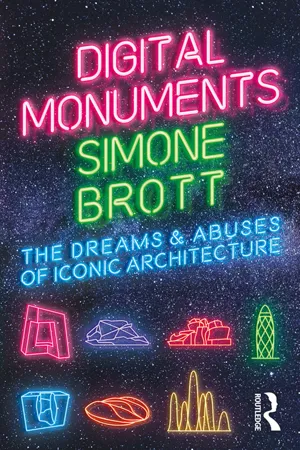
Digital Monuments radically explodes "iconic architecture" of the new millennium and its hijacking of the public imagination via the digital image. Hallucinatory constructions such as Rem Koolhaas's CCTV headquarters in Beijing, Frank Gehry's Guggenheim Museum in Bilbao and Zaha Hadid's Performing Arts Centre in Abu Dhabi are all introduced to the world by immortal digital imagery that floods the internet—yet comes to haunt the actualised buildings.
Like holograms, these "digital monuments," which violently push physics and engineering to their limits, flicker eerily between the real and the unreal—invoking fantasies of omnipotence, immortality and utopian cities. But this experience of iconic architecture as a digital dream on the ground conceals from the urban spectator the social reality of the buildings and the rigidity of their ideology.
In 18 micro-essays, Digital Monuments exposes the stereotypes of iconic architecture while depicting the savagery of the industry, from the Greek and Spanish crises triggered by financialised iconic development to mass labour-deaths on construction sites in the UAE.
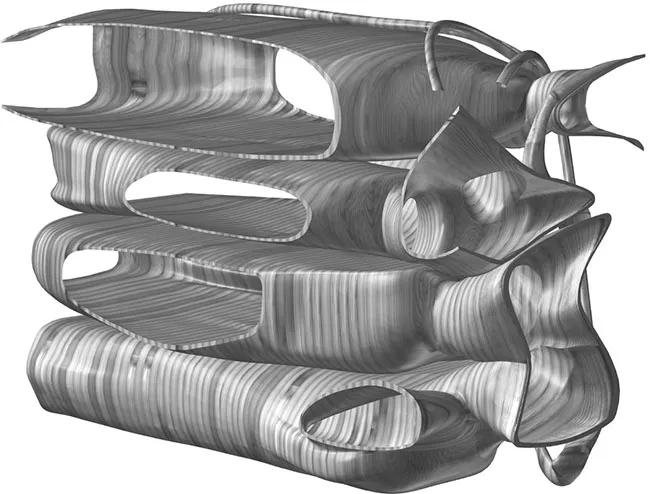
Figure 1.1: New-Territories/R&Sie(n). Digital rendering, Evolene “Scrambled Flat” (Swiss), unbuilt, 2003. Courtesy of New-Territories/R&Sie(n) by François Roche, Stéphanie Lavaux.
Theodor Adorno was opposed to the cinema because he felt it was too close to reality, and thus an extension of ideological capital.2 What troubled Adorno was the iconic nature of cinema—its ability to mimic the formal visual qualities of its referent.3 Iconicity finds its perfect example in the film’s ingenuous surface illusion of an unmediated reality. For the post-war Hollywood-film spectator, he wrote, “the world outside is an extension of the film he has just left” because realism is a precise instrument for the manipulation of the mass spectator by the culture industry, for which the filmic image is an advertisement for the world unedited.4 Mimesis, or the reproduction of reality, is a “mere reproduction of the economic base.”5 It is film’s iconicity, then, its “realist aesthetic . . . [that] makes it inseparable from its commodity character.”6
Adorno’s critique of what is facile in the cinematic image—its false immediacy—glimmers in the ubiquitous yet misunderstood term “iconic architecture” of our own episteme. For iconic architecture is not a formal genre or style so much as it is a rebuke. In the unfolding global financial crisis since 2008, and almost 20 years after the destruction of the World Trade Center towers in New York, iconic architecture as a form of celebrity culture is viewed by many ambivalently, perhaps with a degree of shame and hypocrisy (just as we both love and hate Hollywood). In the digital age of mediatic simulation, and the appearance of buildings such as Frank Gehry’s Guggenheim Museum in Bilbao, iconic architecture is loosely aligned with the cult of the architectural image that, in today’s globalised culture industry, accords fame to any number of brave buildings—the CCTV headquarters in Beijing, the Shard in London, or the Signature Towers in Dubai, to name only a few—by the distribution of computer-generated imagery prior to their construction and completion.
Yet to those within the discipline, such buildings are implicitly defined by way of a dead-on iconicity: the uncanny surface resemblance between the built work and its fake—or simulated—reality in the digital model that is both the building’s identical twin and its exalted reason for being. The “virtual” twin exists eternally in a four-dimensional computer coordinate system that is the sine qua non of such formally complex, dazzling geometries that previously could scarcely have been conceived, let alone constructed. For architecture now depends on mimetic media, on computer visualisation, to see what the architects and the “masses” themselves cannot see with their own eyes and to fabricate what they cannot build with their own hands.
If cinema is too close to reality, Adorno would surely have said that iconic architecture is too close to virtual reality. Contemporary architecture is our very own mediatic object of cultural inscription locked within an “iconically asserted” surface resemblance.7 Gehry’s Guggenheim Museum induces amazement and terror because it incarnates and materialises before one’s eyes a geometry that is ungraspable by humans, a geometry of a surreal order on the ground. To the spectator, the building’s reality converges on a virtual image that hovers in space, its presence felt only in the infinitude of choice that flickers in the plastic surface (not only the kaleidoscope of “views” or permutations of the digital surface, but also the splintering of the subject itself). The subject faced with infinite choice is paralysed, like any consumer.
This mimetic apparatus is irreducible to a semiological or phenomenal relation between the building and its virtual model, even one indexically hitched to a real surface. For the purpose of iconicity is not mere deception, but rather the installation of a new subjectivity in the social encounter with the architectural commodity, the magic of which, in Marxian terms, is its simultaneously “sensual” (present) and “hypersensual” (transcendent) quality.8 Our experience of the iconic is a guilty mix of pleasure and anguish felt in the auratic presence of a technological apparatus that has acquired the peculiar status of an inhuman agency—a subjectivised machine—that threatens to subsume our own subjectivity.
Adorno’s polemics on cinema were rejected by many, perhaps because audiences are only too willing to be taken in by the technical show; it is common, for example, to say a film is absorbing or a building hypnotic or compelling. Iconicity thus ensures the mystification of the commodity fetish, calling on the subject to complete its ideological task; and mimesis is a technique of distraction, even while the spectator appears to be absorbed in the architecture. The term iconic, in its posture as quasi-critique, reproduces this fundamental deception, and thus remains uneasy and problematic, even as an object of inquiry here.
It is no doubt provocative, and indeed too late, to invoke the critical theory of the Frankfurt School today, in an architectural culture that has been called “postcritical”—a name given by Robert Somol and Sarah Whiting, the champions of the iconic project, who a few years after Bilbao declared the exhaustion of critical thought and the irrelevance of social theory for architectural praxis at the close of the 20th century.9 Yet to identify with the “critical”—the choice of the academic “left”—or the postcritical is a false choice; as Adorno remarked, the apparent “freedom to choose an ideology always reflects economic coercion, even here proves to be freedom to be the same.”10 Adorno, who was writing in American exile between the two world wars, had witnessed the barbarous assault on intellectuals and the avant-garde under the Third Reich, a situation he lamented as Germany’s “blocking of the theoretical imagination” in its “headlong rush into pragmatism.”11 That criticality should experience an assault from within the (millennial) avant-garde (if we can even name one) reveals the paradoxical state of the architectural discipline. Nonetheless, an examination of the theory of iconic architecture today, however lacking in development, reveals that those on both “sides” of the ideological divide—the postcritical camp and their opponents—maintain the exact same account of iconic architecture. They both believe that iconic architects are practising some sort of vulgar “materialism” or “pragmatism” (terms associated with Marx and C. S. Peirce, introduced to architecture in the late 1990s by Manuel DeLanda and John Rajchman, respectively), in the first case, applying Marx’s terminology toward formalist pursuits of exclusively technical means, a perverse materialism without intellectual engagement or concern for the social relations of digital architectural production. In short, the exact opposite of Marx’s concept of dialectical materialism, but I will return to this later.12
This uncontested definition of iconic architecture as a materialist, pragmatic, realist enterprise would not be so remarkable but for the fact that it is inaccurate. While it is widely thought that iconic architecture derives from the theory of empirical reality promoted by DeLanda, Michael Speaks, Patrik Schumacher, et al. in its adherence to the digital, the virtual, the transcendence of the mimetic image, iconic architecture is better situated within the philosophical tradition of German idealism and Enlightenment philosophy at the dawn of modernity, namely the work of G. W. F. Hegel, Johann Gottlieb Fichte and F. W. J. von Schelling.13
If iconic architecture’s basic tenet is the digital Geist immanent in the material building, it is also a return to Platonism—by way of Hegel’s Neoplatonism—where the digital spirit resides in built material and shares in its status of reality. Like geometric bodies in Plato’s theory of Forms, the built form is a mere contingent in relation to the higher digital “idea” or “form”; the virtual space, in Plato’s terms, is “absolute and eternal and immutable,”14 supremely real, and independent of ordinary objects whose traits and very existence derive from “participation . . . in the ideas by resemblance.”15 It must be emphasised that the question here is not one of epistemic status; rather, it is the veneration of a digital ghost-like reality that gives the iconic project its Hegelian slant.
The cool original in this architectural paradigm, the most prized reality, is the digital abstraction—the highest code and truth that dictates everything the final building can and cannot do and be. Iconic architecture, in its sheer mimetic genius—the conception of architecture as a pure mind capable of performing mathematical operations—succeeds in attaining the...
Table of contents
Cover Page
Praise
Half Title
Title Page
Copyright Page
Dedication
Table of Contents
Acknowledgements
Introduction: Architecture’s Fake Left
1 Digital Ghost
2 Modernity’s Opiate
3 Anti-Iconic
4 Reflections from Damaged Modernity
5 Elysium
6 Loop
7 Sacrifice
8 How Iconic Architecture Triggered the Greek Crisis
9 The Look of Money
10 Futurist Iconic
11 The Architect-Financier
12 The Abuses of Iconic Architecture
13 The Zaha Hadid Scandal
14 Iconic Dystopias and Moral Law
15 The Moral Contents of the Digital Image
16 Vagina Stadium
17 Autonomy and Vanity
18 After Iconic Architecture
Select Bibliography
Index
Trusted by 375,005 students
Access to over 1.5 million titles for a fair monthly price.
Study more efficiently using our study tools.
Frequently asked questions
Yes, you can cancel anytime from the Subscription tab in your account settings on the Perlego website. Your subscription will stay active until the end of your current billing period. Learn how to cancel your subscription
No, books cannot be downloaded as external files, such as PDFs, for use outside of Perlego. However, you can download books within the Perlego app for offline reading on mobile or tablet. Learn how to download books offline
We are an online textbook subscription service, where you can get access to an entire online library for less than the price of a single book per month. With over 1.5 million books across 990+ topics, we’ve got you covered! Learn about our mission
Look out for the read-aloud symbol on your next book to see if you can listen to it. The read-aloud tool reads text aloud for you, highlighting the text as it is being read. You can pause it, speed it up and slow it down. Learn more about Read Aloud
Yes! You can use the Perlego app on both iOS and Android devices to read anytime, anywhere — even offline. Perfect for commutes or when you’re on the go. Please note we cannot support devices running on iOS 13 and Android 7 or earlier. Learn more about using the app
Yes, you can access Digital Monuments by Simone Brott in PDF and/or ePUB format, as well as other popular books in Arquitectura & Arquitectura general. We have over 1.5 million books available in our catalogue for you to explore.