- 262 pages
- English
- ePUB (mobile friendly)
- Available on iOS & Android
About this book
Why are we disgusted when an elderly woman is robbed but sympathize with the actions of a Robin Hood? Why do acts of cruelty against a helpless kitten bother us more than does the trampling of ants?
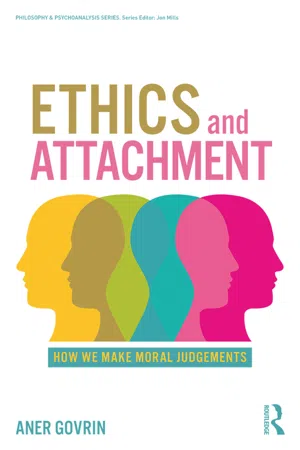
In Ethics and Attachment: How We Make Moral Judgments, psychoanalyst and philosopher Aner Govrin offers the attachment approach to moral judgment, an innovative new model of the process involved in making such moral judgments.
Drawing on clinical findings from psychoanalysis, neuroscience and developmental psychology, the author argues that infants' experience in the first year of life provides them with the basic tools needed to reach complex moral judgments later in life. With reference to Winnicott and Bowlby, the author examines how attachments affect our abilities to apply to make moral decisions.
With its wholly new ideas about moral judgments, Ethics and Attachment will be of great interest to ethics and moral philosophy scholars, law students, and psychoanalytic psychotherapists.
Frequently asked questions
- Essential is ideal for learners and professionals who enjoy exploring a wide range of subjects. Access the Essential Library with 800,000+ trusted titles and best-sellers across business, personal growth, and the humanities. Includes unlimited reading time and Standard Read Aloud voice.
- Complete: Perfect for advanced learners and researchers needing full, unrestricted access. Unlock 1.4M+ books across hundreds of subjects, including academic and specialized titles. The Complete Plan also includes advanced features like Premium Read Aloud and Research Assistant.
Please note we cannot support devices running on iOS 13 and Android 7 or earlier. Learn more about using the app.
Information
Table of contents
- Cover Page
- Praise
- Half Title
- Philosophy & Psychoanalysis Book Series
- Title
- Copyright
- Dedication
- Contents
- Preface
- Acknowledgments
- Part 1 Conceptual and Empirical Foundations
- Part 2 The Attachment Approach to Moral Judgment
- Epilogue
- References
- Index