eBook - ePub
Organization Teams
Building Continuous Quality Improvement Facilitator's Guide
- 120 pages
- English
- ePUB (mobile friendly)
- Available on iOS & Android
eBook - ePub
About this book
The facilitator's guide is a companion to Organization Teams: Building a Continuous Quality Improvement. This guide provides lesson plans, including suggested time allocation, masters that can be used to create your own transparencies, quality bucks photocopy masters, a method for randomly assigning participants to teams, a "little instructor" who will offer suggstions and share ideas.
Chapter 1
Teamwork and Synergy
Objective
To explain the concept of teams, assign students to teams, and get students to appreciate the diversity and knowledge of the various team members
Pages
Pages 1-14 in Organization Teams: Building Continuous Quality Improvement
Exercises
1 Knowing Your Team Members
Transparencies
- 1-1 Advantages of Teamwork
- 1-2 Major Elements of Synergy
- 1-3 Characteristics of an Effective Team (Part 1)
- 1-4 Characteristics of an Effective Team (Part 2)
- 1-5 What Have I Gotten Into?

After assigning each participant to a team, use the transparencies you created from the transparency masters to guide the review of the quality contributors. Let the teams “run over” on Exercise 1, but afterward remind them to gauge their completion time better.
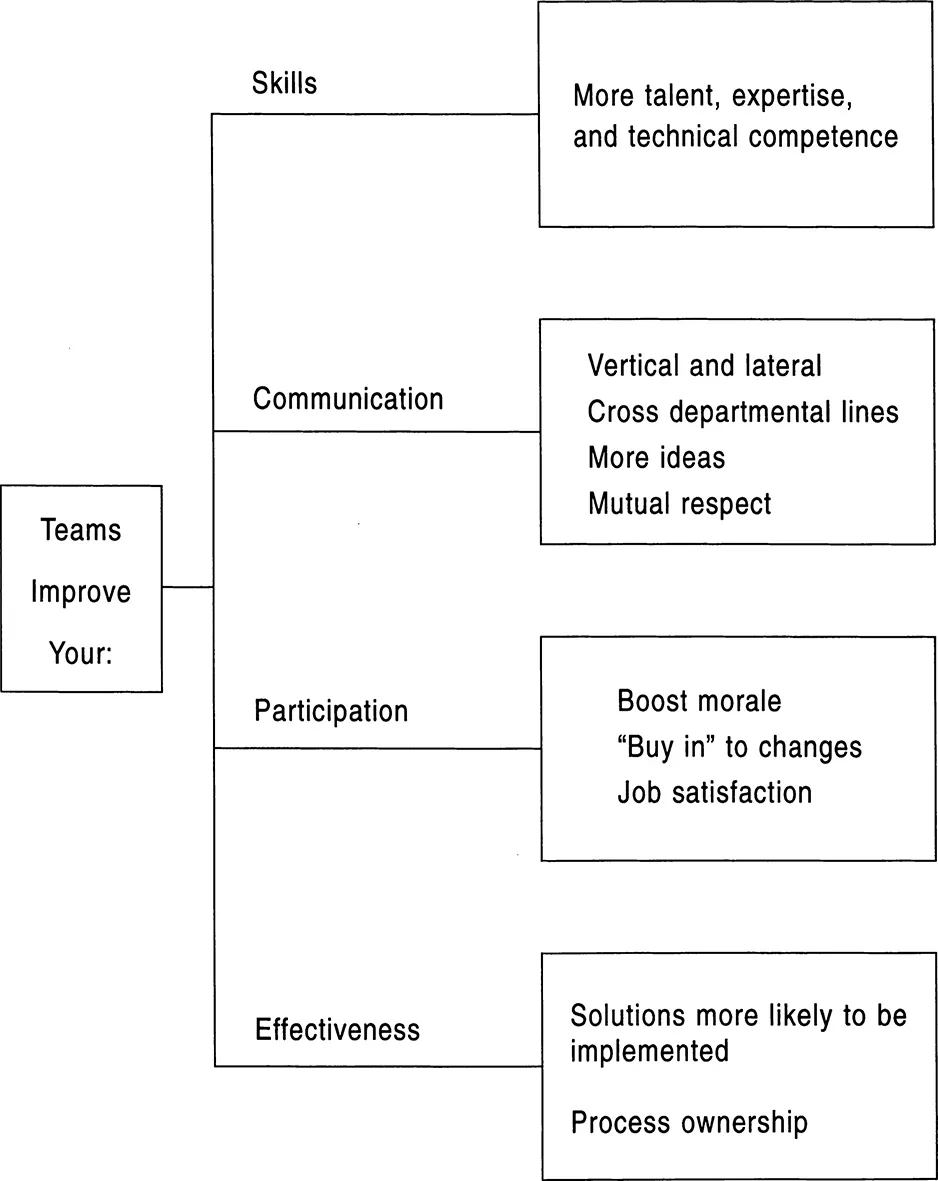
Advantages of Teamwork
Major Elements of Synergy
- Listening and clarifyingConcentrate on what is being said
- SupportingCreate a positive climate
- QualityMake a personal commitment to improve
- AcceptanceRespect other members’ viewpoints
- FeedbackHonest communication
Characteristics of an Effective Team (Part 1)
- The atmosphere is informal and relaxed, without obvious tension.
- There is much discussion in which everyone participates.Discussion is focused.
- The team’s task is understood and accepted by the members.
- Members listen to each other!Every idea is given a hearing.
- The team is comfortable with disagreement and does not avoid conflict simply to keep everything in agreement.
Characteristics of an Effective Team (Part 2)
- Decisions are reached by a consensus.
- Criticism is frequent, frank, and relatively comfortable.There are no personal attacks.
- People are free to express their feelings and ideas on the team’s problems.
- When action is taken, clear assignments are made and accepted.
- The leader does not dominate, nor does the team.
- The team is self-conscious about how it functions and examines how it is performing.
What Have I Gotten Into?
- FormingStage where the team is first formed.
- StormingStage where impatience with progress occurs.
- NormingTeam members start to help one another out.
- PerformingStage where the mature team understands its strengths and weaknesses.Members are satisfied with progress.
Chapter 2
Contributors to Continuous Quality Improvement
Objective
To begin the process of working as a team, while applying the thinking of the quality leaders to practical problems
Pages
Pages 15-60 in Organization Teams: Building Continuous Quality Improvement
Exercises
- 2 Deming’s Audit
- 3 Crosby’s Audit
- 4 Juran’s Audit
Transparencies
- 2-1 Continuous Quality Improvement
- 2-2 Continuous Quality Improvement Overview
- 2-3 Deming’s Guide to Quality (Part 1)
- 2-4 Deming’s Guide to Quality (Part 2)
- 2-5 Deming’s Audit: Assigned Teams (for Exercise 2)
- 2-6 Exerc...
Table of contents
- Cover
- Title Page
- Copyright Page
- Preface
- Contents
- Introduction
- 1 Teamwork and Synergy
- 2 Contributors to Continuous Quality Improvement
- 3 Empowerment
- 4 Supportive Team Cultures
- 5 Team-Building Phases
- 6 Understanding How We Think
- 7 Member Service Roles
- 8 Expanded Team Member Roles
- 9 Expanding Team Skills
- 10 Teams, Teams, and More Teams
- Appendix A Quality Bucks
- Appendix B Random Team Assignments
- Appendix C Hats Off Award
- Appendix D Team Presentations
Trusted by 375,005 students
Access to over 1.5 million titles for a fair monthly price.
Study more efficiently using our study tools.
Frequently asked questions
Yes, you can cancel anytime from the Subscription tab in your account settings on the Perlego website. Your subscription will stay active until the end of your current billing period. Learn how to cancel your subscription
No, books cannot be downloaded as external files, such as PDFs, for use outside of Perlego. However, you can download books within the Perlego app for offline reading on mobile or tablet. Learn how to download books offline
Perlego offers two plans: Essential and Complete
- Essential is ideal for learners and professionals who enjoy exploring a wide range of subjects. Access the Essential Library with 800,000+ trusted titles and best-sellers across business, personal growth, and the humanities. Includes unlimited reading time and Standard Read Aloud voice.
- Complete: Perfect for advanced learners and researchers needing full, unrestricted access. Unlock 1.5M+ books across hundreds of subjects, including academic and specialized titles. The Complete Plan also includes advanced features like Premium Read Aloud and Research Assistant.
We are an online textbook subscription service, where you can get access to an entire online library for less than the price of a single book per month. With over 1.5 million books across 990+ topics, we’ve got you covered! Learn about our mission
Look out for the read-aloud symbol on your next book to see if you can listen to it. The read-aloud tool reads text aloud for you, highlighting the text as it is being read. You can pause it, speed it up and slow it down. Learn more about Read Aloud
Yes! You can use the Perlego app on both iOS and Android devices to read anytime, anywhere — even offline. Perfect for commutes or when you’re on the go.
Please note we cannot support devices running on iOS 13 and Android 7 or earlier. Learn more about using the app
Please note we cannot support devices running on iOS 13 and Android 7 or earlier. Learn more about using the app
Yes, you can access Organization Teams by Peter Mears in PDF and/or ePUB format, as well as other popular books in Business & Human Resource Management. We have over 1.5 million books available in our catalogue for you to explore.