Improving Healthcare
eBook - ePub

Improving Healthcare

A Handbook for Practitioners

  1. 178 pages
  2. English
  3. ePUB (mobile friendly)
  4. Available on iOS & Android
eBook - ePub

Improving Healthcare

A Handbook for Practitioners

About this book

Good intentions to do our best in healthcare are not enough. Healthcare professionals need to know how to close the gap between best evidence and practice, by understanding and applying quality improvement principles and processes.

Improving Healthcare is a practical guide, providing healthcare staff with the knowledge and skills that enable them to implement, evaluate and disseminate a quality improvement project in their own workplace. With a comprehensive coverage, chapters cover the history, selection and application of quality improvement philosophies and methods in clinical healthcare at team, unit, organisational and system levels. The book also considers social processes of implementation as well as technical aspects of measuring and improving quality.

As an essential guide for healthcare practitioners at any level who are new to service improvement, Improving Healthcare includes practical examples and case studies of healthcare improvements that illustrate the concepts discussed.

Frequently asked questions

Yes, you can cancel anytime from the Subscription tab in your account settings on the Perlego website. Your subscription will stay active until the end of your current billing period. Learn how to cancel your subscription.
No, books cannot be downloaded as external files, such as PDFs, for use outside of Perlego. However, you can download books within the Perlego app for offline reading on mobile or tablet. Learn more here.
Perlego offers two plans: Essential and Complete
  • Essential is ideal for learners and professionals who enjoy exploring a wide range of subjects. Access the Essential Library with 800,000+ trusted titles and best-sellers across business, personal growth, and the humanities. Includes unlimited reading time and Standard Read Aloud voice.
  • Complete: Perfect for advanced learners and researchers needing full, unrestricted access. Unlock 1.4M+ books across hundreds of subjects, including academic and specialized titles. The Complete Plan also includes advanced features like Premium Read Aloud and Research Assistant.
Both plans are available with monthly, semester, or annual billing cycles.
We are an online textbook subscription service, where you can get access to an entire online library for less than the price of a single book per month. With over 1 million books across 1000+ topics, we’ve got you covered! Learn more here.
Look out for the read-aloud symbol on your next book to see if you can listen to it. The read-aloud tool reads text aloud for you, highlighting the text as it is being read. You can pause it, speed it up and slow it down. Learn more here.
Yes! You can use the Perlego app on both iOS or Android devices to read anytime, anywhere — even offline. Perfect for commutes or when you’re on the go.
Please note we cannot support devices running on iOS 13 and Android 7 or earlier. Learn more about using the app.
Yes, you can access Improving Healthcare by Lesley Baillie, Elaine Maxwell, Lesley Baillie,Elaine Maxwell in PDF and/or ePUB format, as well as other popular books in Medicine & Gynecology, Obstetrics & Midwifery. We have over one million books available in our catalogue for you to explore.

Information

1Introducing healthcare improvement

Elaine Maxwell

Introduction

Healthcare professionals choose their career out of a desire to do their best for other people and undertake rigorous training to ensure that they know what constitutes effective clinical care. The evidence threshold for clinical interventions is rightly set high, and most healthcare professions across the world these days require graduate-level preparation. However, the long acknowledged gap between theory and practice persists despite many people’s best efforts to close it. In addition, the gap between predicted and actual outcomes remains high. Every first-world country can point to examples of spectacular failures in healthcare, but perhaps less visible and more insidious are the variations in patient outcomes, and experiences within healthcare systems that are by and large performing acceptably. If we can get it right some of the time, why can’t we get it right all of the time?
The discipline of quality improvement in healthcare is relatively young and this chapter explores its history and how thinking has emerged over time, together with the different academic disciplines and the industries that improvement has drawn from. The field continues to evolve leading to a number of different approaches in contemporary practice.

Objectives

This chapter’s objectives are to:
  • Reflect on the history of quality in healthcare
  • Discuss different approaches and models to improving quality in healthcare
  • Describe the principles of quality improvement methodologies

A history of quality improvement

Hippocrates is generally considered to be the father of healthcare professions and is believed to have written an oath sometime between the fifth and third century b.c. In the oath, healthcare professionals are required to declare that they will:
devise and order for them [their patients] the best diet, according to my judgment and means; and I will take care that they suffer no hurt or damage.
(Edelstein 1943)
This twin responsibility to both improve patients’ health and avoid harm provides an ethical base for clinical practice which is still relevant today. For most of history, the delivery of this promise has been seen to be the responsibility of individual practitioners, as suggested by Hippocrates, rather than of professional organisations or the state. The public safeguard was therefore to ensure that this clinical autonomy was only given to those in possession of expert knowledge and these practitioners then applied that knowledge as they judged best in local circumstances. Determining what constituted ‘expert knowledge’ became the responsibility of collectives who defined the standards of education and ethics and subsequently issued a licence for practice.
In the United Kingdom, the keepers of knowledge standards were at first the Guilds and then the Royal Colleges who guarded their own technical standards and controlled their use through supervised apprenticeships. As these organisations gained power, they were able to restrict work jurisdictions to those whom they had trained and to whom the organisation’s membership had been granted. Maintenance of a continuing licence was dependent on adherence to collegiate standards and in return members were granted the privilege of autonomous practice. Quality was therefore assured by practitioners’ admission and continued membership of the Guild or College.
The emergence of colleges for medical practitioners in the United Kingdom from the 1500s onwards and the granting of royal charters effectively restricted the practice of healthcare to their members. The definition of quality and agreement about what constituted appropriate interventions was made by these self-regulating colleges, albeit a number of competing colleges. Their claim of legitimate authority to set best practice standards went largely unchallenged, as other health workers had no similar accrediting college or guild, so the medical colleges increasingly set standards for the whole of the healthcare system.

Move to systems-based improvements

The focus on efficacy of the licenced practitioners’ actions in relation to individual patients came under scrutiny with the scientific developments of the Enlightenment. The philosophical move from logical deduction to inductive reasoning through the collection of empirical data began to change the emphasis from the actions of individual practitioners to systems-based understanding of health. As early as 1546, Girolamo Fracastoro proposed that disease was transmitted through the air and therefore should be controlled by personal and environmental hygiene in addition to specific individual patient treatments (Nutton 1990). Developing this theme, in 1847, Ignaz Semmelweis collected data to understand why mortality rates differed between two different maternity clinics in one city. In an early example of using the study of variation to understand practice and reveal underlying factors that are not immediately apparent, Semmelweis collected empirical data that demonstrated that clinics run by medical practitioners and their students had higher death rates than those run by midwives and their students. Semmelweis proposed that medical staff were inadvertently cross infecting women following their anatomy dissection sessions. He introduced hand washing between cases which dramatically reduced mortality rates (see Box 1.1).
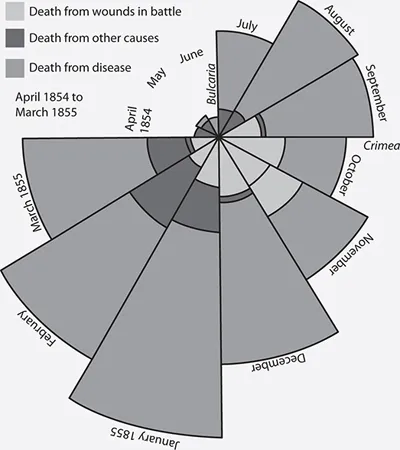
The central role of collecting data in understanding the causes of harm or quality failures was further demonstrated in 1854, when John Snow was able to demonstrate the importance of systems factors as well as individual patient factors when he methodically collected data about the location of the cholera cases (Shiode et al. 2015). Snow demonstrated that clusters of the disease were related to a contaminated water pump handle in Broad Street, London, and thus that environmental factors are as important as individual factors in improving health. Following quickly after this, Florence Nightingale (working with William Farr, Britain’s foremost statistician at the time) was able to show that soldiers were 10 times more likely to die from infectious illnesses such as typhus, typhoid, cholera and dysentery than from wounds acquired in battle (Nightingale 1858). Her creative use of data visualisation such as her coxcomb charts (see Figure 1.1) persuaded politicians to send the Sanitary Commission to the Crimea in March 1855. The resulting flushing of the sewers and improvement in the ventilation resulted in a sharp reduction in mortality rates. Florence Nightingale was honoured for her applied use of statistics by becoming the first woman elected to become a member of the Royal Statistical Society in 1858.
Box 1.1 Case study: Reducing the incidence of puerperal fever in Vienna
In the early 1840s, the people of Vienna widely believed that there was a significant difference in death rates between two maternity clinics, although they did not understand why this should be. In a rare example of patient involvement in quality improvement, Semmelweis collected patient opinions and described desperate women begging not to be admitted to one of the clinics, preferring to deliver in the street without any professional assistance. Semmelweis’s data suggested that even those who delivered without assistance had lower mortality rates than those who attended the other clinic, and he was puzzled that puerperal fever was rare among these women:
To me, it appeared logical that patients who experienced street births would become ill at least as frequently as those who delivered in the clinic. . . . What protected those who delivered outside the clinic from these destructive unknown endemic influences?
By collecting data on all deaths, Semmelweis uncovered a significant variation with one clinic having a maternal mortality rate of 10%, whilst the other clinic had a mortality rate that was significantly less at 4%. Having uncovered the variation, Semmelweis began to look at what the differences in practice between the two clinics were. The only major difference that he could ascertain was that the clinic with high mortality rates was used as a teaching clinic for medical students, whilst the other had been used exclusively for training midwives since 1841.
His realisation of this distinction was important. Changes to medical training meant that dissection had become an important part of teaching medical students anatomy during the 1800s but was not a part of midwifery training. Semmelweis began to consider whether there was some process associated with dissection that was the cause of the variation. Semmelweis knew that a medical student had recently died following a needle stick injury during a dissection and that his post-mortem had shown similar pathology to that of the women who were dying from puerperal fever. Whilst the pathology techniques available at the time could not empirically identify the causal factor, Semmelweis hypothesised that the (unknown) causal agent was somehow being transmitted from the corpses being dissected to the labouring women.
Although Semmelweis did not understand how dissection and puerperal fever were linked, he noted that there was a putrid smell associated with infected autopsy tissue that was removed by hand washing. To test this logic, Semmelweis undertook a period of observation and noted that at the first clinic, doctors and medical students routinely moved from dissecting corpses to examining women without first washing their hands. He proposed that the practice of hand washing with chlorinated lime solutions destroyed the causal ‘poisonous’ or contaminating ‘cadaveric’ agent at the same time as removing the smell.
Semmelweis collected data before and after his improvement and showed dramatic reductions in mortality after hand washing was introduced, with maternal mortality at the first clinic dropping from 10% to 1%.
Despite very clear data to support his improvement, Semmelweis’s observations conflicted with the established scientific and medical opinions of the time, and his ideas were rejected by the medical community. Semmelweis thus encountered the problem that persists today – evidence alone is not sufficient to sustain and spread even dramatic quality improvements.
Source: Semmelweis, I. The Cause, Concept, and Prophylaxis of Childbed Fever (translated by Carter, K., 1983), University of Wisconsin Press, London, 1861.

images
Figure 1.1 A coxcomb chart displaying causes of mortality among soldiers in the Crimea. (From Nightingale, F., Notes on Matters Affecting the Health, Efficiency, and Hospital Administration of the British Army: Founded Chiefly on the Experience of the Late War, Presented by Request to the Secretary of State for War, Harrison and Sons London, 1858.)

Using data for quality control

Advances in the use of data to explore the causes of adverse events led to increasing interest in its use to measure the degree of control of quality of healthcare processes. Previously, the state had played no role in defining the competency of healthcare practitioners, but the emergence of tools to assess the quality of care (or more precisely, its absence) and the growth of empirical research or ‘evidence’ for interventions led to the statutory regulation of healthcare practitioners (as opposed to the voluntary registration with professional colleges), making it illegal to practise without having demonstrated achievement of national standards of education and competence.
The Medical Act of 1858, an Act of the United Kingdom Parliament, created (for the first time in the world) a register of ‘qualified’ medical practitioners. This was followed by the creation of statutory registers in the United Kingdom for midwives in 1902, nurses in 1919 (despite vigorous opposition from Florence Nightingale) and dentists in 1948. Currently, internationally most health professions are either subject to statutory registration or professional accreditation, indeed in some cases, a combination of the two. In recent years, the dynamic aspect of practice has been recognised, and there has been a move from single point licensing to periodic revalidation which requires demonstration of ongoing competence. This was introduced in the United Kingdom for medical practitioners in 2012 and for nurses and midwives in 2016.

Clinical audit

The move to statutory registration was followed by a move to using data to assure compliance with professional standards through the process of audit. In 1912, Ernest Codman asserted that every patient should be followed up after surgery to identify what he called ‘the end results’, which would now be called outcomes (Neuhauser 1990). He went on to establish the American College of Surgeons’ systematic study of the outcomes for all the individual patients of each surgeon leading to the establishment of their Hospital Standardization ...

Table of contents

  1. Cover
  2. Half Title
  3. Title Page
  4. Copyright Page
  5. Table of Contents
  6. Preface
  7. Editors
  8. Contributors
  9.   1 Introducing Healthcare Improvement
  10.   2 Understanding the Context for Healthcare Improvement
  11.   3 System Improvement
  12.   4 Service User Involvement in Healthcare Improvement
  13.   5 Ethics and Governance in Healthcare Improvement
  14.   6 Measuring for Healthcare Improvement
  15.   7 High Reliability Organisations: Making Care Safer through Reliability and Resilience
  16.   8 Implementing Healthcare Improvement
  17.   9 Sharing Healthcare Improvements: Presenting and Communicating Improvement Results
  18. 10 Evaluating Healthcare Improvements
  19. Index