eBook - ePub
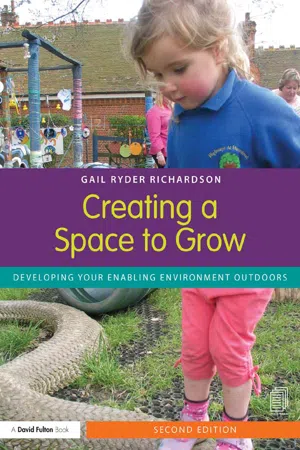
Creating a Space to Grow
Developing your enabling environment outdoors
- 144 pages
- English
- ePUB (mobile friendly)
- Available on iOS & Android
eBook - ePub
About this book
Is your outdoor area working? Do you want to make changes but are not sure where to start?Creating a Space to Grow guides you through the process of changing and developing the outdoor environment of your early years setting to maximise the learning potential that these areas can offer. Packed full of strategies and ideas for enhancing outdoor area
Information
Topic
EducationSubtopic
Urban Planning & Landscaping | Why do children need to be outdoors? |
The special nature of outdoors
The outdoor environment has features that are either different from indoors or cannot be offered on the same scale, or in the same way, indoors. Early years practitioners who recognise the special nature of outdoors acknowledge that it provides a significantly different and complementary environment for nurturing children's well-being and supporting their learning. Learning through Landscapes identifies nine features that contribute to the special nature of outdoors as a learning and play environment for children.
Freedom
The outdoors offers children many freedoms, which may extend or be different from the freedoms they can experience indoors.
• Freedom to move around in a bigger space — vigorous activity, larger-scale play, or just ‘feel’ the space around them.
• Freedom to be more relaxed and inventive about exploring and using materials and resources — transporting, mixing, making a mess.
• Freedom to be boisterous and to make noise without disrupting others.
• Freedom to explore different ways of being, feeling, behaving and interacting — from active super-hero play to cloud watching.
Space
Outdoors offers children additional space, upwards as well as sideways. The children can be at different levels, see things from a range of perspectives and have the sky as their ‘roof’.
• Outdoor space feels very different from indoors and includes light effects, air movements and temperature changes.
• Outdoors offers added space that encourages children to be more active and work on a larger scale across all areas of learning, and supports collaborative activity.
• Outdoors offers children a different mental and emotional space from that which exists indoors — it just feels different!
Contact with the natural world
• The outdoors offers children direct, extended and deeply engaging experiences with plants, mini-beasts, other animals such as birds, soil, sand and many other natural materials. The four ‘elements’ of earth, air, water and even fire (through outdoor cooking or role-play barbeques) need to be experienced directly.


Whole-body, multi-sensory experiences
• Young children use their body to learn, by moving, doing and using all their senses. All babies and young children, and particularly those with sensory impairments, benefit from a multisensory environment.
• Children can be vigorous, boisterous and active for long periods.They can use their upper body and limbs, developing health, strength and co-ordination and enjoying and learning about what their bodies can do.
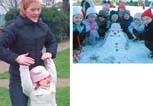
Real experiences
• Real and direct experiences are easily offered outdoors through growing, experimenting with natural materials such as sand (on a large scale), running water and elements of the weather — rain, snow, frost, sunshine and so on. The sounds and sights of the locality and community can be experienced then explored through outdoor play, especially in pretend and role-play. Children can gain real understanding of concepts such as volume and weight when transporting a barrow-full of sand, and distance or height when using the physical play apparatus.
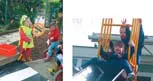
Variety of spaces, places and perspectives
• In addition to open space, outdoors can offer nooks and crannies among plants, climbing frames, playhouses and dens. Children can be enclosed (under or inside) or high up with a new perspective of looking down on their world.
• Spaces can be active and provide largescale opportunities, or can be places for calm, reflection, one-to-one interaction or the chance to be by oneself.
• Spaces can be soft or hard or anything in between, giving a range of sensations through surfaces and planting.
Dynamic experiences
• Outdoors offers children the freedom to manipulate, change and be in control of their environment.Through the use of moveable, open-ended resources and materials, they can create new play environments. The daily changes in the quality of the air, temperature and rainfall and the gradual changes through the seasons offer huge potential for real and direct experience and exploration — every day is different! The uncertainty of daily changes and the surprise and excitement arising from spontaneous events, such as finding a ladybird or spotting a hot air balloon overhead, are all waiting to be captured and used to enrich children's experiences as they find out about their world.
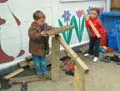
Relaxed relationships with adults and other children
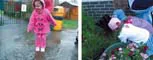
There is a different quality to the relationships a child can have outside with other children and with adults.
• Children can choose to interact on a variety of activity levels or group sizes.
• Working on a large scale or with bikes with trailers provides opportunities to co-operate, negotiate and collaborate.
• Adults can take time to sit and chat, get involved in play and exploration or simply stand back to observe and listen to children's play.Many adults find they are happy to tolerate higher levels of noise, mess and activity in the bigger, unrestricted space with no ceiling and have less concern about spillages or collision with obstacles.
• Children respond differently to adults outside. For example, some children who talk little inside are less inhibited outdoors. It is often possible to engage children in activities outdoors that they are reluctant to participate in inside, for example mark-making or counting.
Challenges and risky experiences
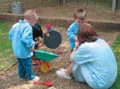
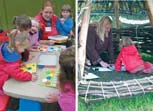
• Outdoors provides experiences through which children can learn how to keep themselves safe and how to be aware of the safety of others.
• It offers children many ways to be adventurous and to challenge their own limits within a framework of safety provided by adults and the environment they have prepared.
A shared vision and core values for outdoor play
In Kent, all early years settings within the county have support from early years advisors.Through their ongoing contact wi...
Table of contents
- Cover
- Half Title
- Title Page
- Copyright Page
- Table of Contents
- Foreword by Marjorie Ouvry
- Gail Ryder Richardson — Outdoor Matters!
- Learning through Landscapes (LTL)
- Space to Grow
- Acknowledgements
- Introduction
- 1 Why do children need to be outdoors?
- 2 Getting started
- 3 Thinking and planning
- 4 Making it happen
- 5 Evaluating and enjoying
- 6 The legacy of the Space to Grow project
- Further reading
Trusted by 375,005 students
Access to over 1.5 million titles for a fair monthly price.
Study more efficiently using our study tools.
Frequently asked questions
Yes, you can cancel anytime from the Subscription tab in your account settings on the Perlego website. Your subscription will stay active until the end of your current billing period. Learn how to cancel your subscription
No, books cannot be downloaded as external files, such as PDFs, for use outside of Perlego. However, you can download books within the Perlego app for offline reading on mobile or tablet. Learn how to download books offline
Perlego offers two plans: Essential and Complete
- Essential is ideal for learners and professionals who enjoy exploring a wide range of subjects. Access the Essential Library with 800,000+ trusted titles and best-sellers across business, personal growth, and the humanities. Includes unlimited reading time and Standard Read Aloud voice.
- Complete: Perfect for advanced learners and researchers needing full, unrestricted access. Unlock 1.5M+ books across hundreds of subjects, including academic and specialized titles. The Complete Plan also includes advanced features like Premium Read Aloud and Research Assistant.
We are an online textbook subscription service, where you can get access to an entire online library for less than the price of a single book per month. With over 1.5 million books across 990+ topics, we’ve got you covered! Learn about our mission
Look out for the read-aloud symbol on your next book to see if you can listen to it. The read-aloud tool reads text aloud for you, highlighting the text as it is being read. You can pause it, speed it up and slow it down. Learn more about Read Aloud
Yes! You can use the Perlego app on both iOS and Android devices to read anytime, anywhere — even offline. Perfect for commutes or when you’re on the go.
Please note we cannot support devices running on iOS 13 and Android 7 or earlier. Learn more about using the app
Please note we cannot support devices running on iOS 13 and Android 7 or earlier. Learn more about using the app
Yes, you can access Creating a Space to Grow by Gail Ryder Richardson in PDF and/or ePUB format, as well as other popular books in Education & Urban Planning & Landscaping. We have over 1.5 million books available in our catalogue for you to explore.