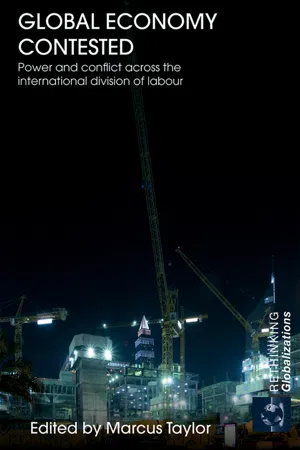
eBook - ePub
Global Economy Contested
Power and Conflict across the International Division of Labour
- 272 pages
- English
- ePUB (mobile friendly)
- Available on iOS & Android
eBook - ePub
Global Economy Contested
Power and Conflict across the International Division of Labour
About this book
Although much has been written on the topic of economic globalization, few volumes examine the social foundations of the global economy in a way that puts power and contestation at the forefront of the analysis. This book addresses this gap by emphasizing the contested social processes that underpin global production chains and financial structures
Part I
Reworking the international division of labour
1 Power, conflict and the production of the global economy
Marcus Taylor
One of the most remarkable aspects of the global capitalist economy is that it rests on a continuously evolving and ever-more complex international division of labour. While the consumption of finished products remains concentrated in the West, the production of this increasing range of commodities is increasingly conducted by workers located across the far reaches of global capitalism. For example, while Apple design and market the iPod, they outsource the entire manufacturing process for each of the 451 components across a wide network of companies spanning North America and Asia. These companies range from multinationals such as Toshiba, who produce the hard drive, through to small producers based in countries such as China and the Philippines whose workforces either make or assemble small, yet essential, components of the final product (Linden et al. 2007). What we are faced with in the case of the iPod is an enormously complex division of labour across social space that collectively orchestrates the production of one of the prominent consumption icons of the current decade. This division of labour incorporates a great number of diverse and spatially separated workforces who undertake specific compartmentalised tasks and who are connected to the larger process through various forms of social organisation—ranging from the bureaucratic control of multinational firms, to market exchanges, social networks of subcontracting firms, and intricate webs of financing—that facilitate complex flows of goods, money and information.
Faced with the complexity of this contemporary international division of labour, the chapter introduces a series of analytical perspectives that help to shed light on the social foundations that underpin this global economic edifice. Following a brief critique of how mainstream economics conceptualises the global economy, I examine two contemporary approaches that attempt to transcend the limitations of the former. First, the chapter surveys the global commodity chains approach, which has sought to blend political-economy perspectives with insights drawn from economic sociology to explain how the international division of labour functions. Second, it examines the canon of critical institutional economics, which has stressed the importance of social institutions in determining the processes and outcomes of a range of economic activities within the global economy. These two perspectives have gained considerable influence over contemporary debates outside of the mainstream and their importance can be discerned in the chapters that follow. Used together, I argue, the global commodity chains and institutional economics literature provide useful analytical tools for understanding how economic activities such as production are socially embedded in specific institutional contexts that rest on distinct relations of power and contestation. In so doing, these approaches are valuable for opening empirical research agendas that can draw out the dynamics of power and conflict that shape the global economy and account for its profoundly uneven nature. I elaborate this point through an examination of the institutions and social processes through which labour forces are produced, reproduced and utilised.
In spite of the insights that these perspectives provide, however, the chapter identifies some important limitations in their analytical frameworks. To fully appreciate how the global economy is produced and reproduced, including the relationship between power and contestation that runs through the international division of labour, it is necessary to integrate the former approaches with the theory of ‘social abstraction’ developed by Karl Marx. I argue that Marx’s notion of social abstraction helps puts the concept of social embedding in motion by forcing us to consider how the embedded activities of production and social reproduction are simultaneously subsumed under the abstract dynamics of global capitalism. Fluctuations in the price system, which acts as the nerve centre of the global economy, force producers across the international division of labour to continually disembed, restructure and re-embed their productive activities in an ongoing process that repeatedly generates social struggles. Focusing on the dynamic interplay between social embedding and social abstraction, moreover, allows us not only to understand how social conflict is endemic to the capitalist global economy, but also how the outcomes of such struggles serve to reshape the social foundations of productive activities across the international division of labour.
The global economy in mainstream economics
The terms in which the global economy is discussed in mainstream economics tend to follow the agenda set by the classical political economists who correlated the onset of capitalist modernity with dramatic increases in the productivity of human labour (cf. Cowen and Shenton 1996). Adam Smith’s foundational exposition, for example, tied the essence of modernity to an extended and ever-more specialised division of labour that was driven by the growth of the market. This process was seen as a virtuous circle wherein specialisation induces greater productivity, higher national income and, therein, the further enlargement of the market: a formulation that parallels the current neoclassical orthodoxy For Smith, the increasing productivity of labour constituted the material basis of what is now termed ‘development’. Becoming part of an expanded division of labour, according to Smith, allowed an ‘industrious and frugal peasant’ to accommodate his needs in a manner that exceeded ‘many an African king, the absolute master of the lives and liberties of ten thousand naked savages’ (Smith 1990).
Smith’s focus on market expansion and an expanding division of labour remains central to contemporary mainstream discourses on economic development. The World Bank, for example, celebrated the expansion of the international division of labour that would draw some 90 per cent of global workers into the ‘economic mainstream’ of global market relations, a process which they see as raising incomes and contributing to global prosperity (World Bank 1995: 50). As in Smith’s time, the expanding productivity of labour is matched by the expanding production of labourers as proletarianisation accelerates apace through rural to urban migration, aided by the aggressive commodification and private ownership of land and other resources in rural areas (cf. Harvey 2004, and Chapter 3 in this volume). It is also matched with expanding inequality on a global level and the reproduction of vast levels of absolute and relative poverty (cf. Wade 2004). Such workers—and by extension the familial and community support systems that help to socially reproduce them—have indeed become cogs in a system of global production that is able to churn out ever greater numbers of commodities. However, the productive potentiality that appears innate to capitalism remains closely tied to uneven development, vast inequalities, and the poverty of an expanding global working class.
Although the substantive irrationalities of capitalist development were discussed by the classical political economists, they tended to be seen as a tangential and temporary evil that would be overcome by the productive revolution through which growing numbers of socially useful items (usevalues) could be produced and hence expand the limits of social wealth. In so doing, capitalist development offered a potential solution to scarcity and therefore paved the way for social, cultural and political progress, a formulation that remains the implicit basis for liberal theories of development (Weisband 1989). In the contemporary era, institutions such as the IMF and the World Bank have deployed mainstream neoclassical economics to present development as the result of a transhistorical spread and growing efficiency of markets innate to humankind’s assumed need to ‘truck, barter and trade’. 1 For contemporary neoliberals, ensuring liberalised markets for all goods—including labour itself—and supplemented by a streamlined yet efficient state apparatus to uphold property rights, remains the only manner of providing for the material needs of humanity and ending global poverty. By integrating productive activities into a global division of labour, the expansion of a global market society is seen as a purely beneficial force that allows market forces to distribute resources into the areas of highest productivity and returns. Using simplifying microfoundations, the approach proclaims that, under proper macroeconomic management including trade liberalisation and fiscal responsibility, global productive structures naturally take shape through rational and mutually beneficial market exchanges in a manner that reflects national comparative advantages, leading to long run complementarities, income convergence and global equilibrium (Weeks 2001; Chang and Grabel 2004; Dunkley 2004). This conclusion, moreover, has been forcibly deployed to legitimate the rapid liberalisation of trade and capital markets on a global level since the 1980s.
Not only do these models fly against the history of profoundly uneven development across the capitalist world economy, they offer a pointedly incomplete understanding of the social dynamics that underpin the organisation of material life within global capitalism. On an analytical level, the focus on idealised models of exchange and market expansion wilfully erases any appreciation of the important qualitative differences between the social relationships though which production, distribution and the consumption of material items occurs (cf. Clarke 1991; Sayer 1995; Hodgson 2002; Reinert 2004). In particular, the abstract model of individuals and firms voluntarily exchanging goods in idealised market settings gives little room for understanding how power and conflict are integral to the functioning of economic activities; vary greatly between different social contexts; and are driving forces within global capitalism. As two critics put it in a blistering critique of the neoclassical mainstream:
It leaves out almost everything social about the division of labour and modern production: the great varieties of people at work, the social integument that binds together their activities, and the social context in which production and circulation proceed. In effect, this shorthand denies the exigencies of power and domination, coordination and conflict, economic development and social change.
(Sayer and Walker 1992: 3)
Without doubt, the methodological assumptions of neoclassical economics have been sharply critiqued from across the social sciences. The following sections focus on two specific contributions: (1) the ‘global commodity chains approach’; and (2) critical institutional economics. These two approaches are particularly important due to the influence they have in setting the terms of contemporary debates on the global political economy.
Global commodity chains and the organisation of production
In recent years, the ‘global commodity chains’ (GCC) approach has become an increasingly fashionable method of analysing the organisation of production in contemporary capitalism (cf. Bernstein and Campling 2006b). In distinction to the abstractions of neoclassical economics, GCC analysis aims to take seriously the social dimensions of global production in a way that combines theoretical rigour with detailed case studies. Although it is possible to distinguish different trends within GCC analysis—including a variant that draws more strongly upon the business literature concerning transaction costs—they nonetheless share several central features including: (1) a sensitivity to the multiple ways of organising the production and distribution of commodities in a globalised economy; (2) the forms of power that permeate these different types of economic organisation, and (3) the implications for socio-economic development entailed in different types of commodity chains (cf. Bair 2008, for a concise history of the GCC approach).
Whereas the original theorists of the division of labour—from Weber to Durkheim and Marx—tended to focus on the increasing specialisation of labour tasks within the firm and between firms across society, the global commodity chains approach argues that the most important contemporary trend is the way that the assorted processes for producing a single commodity are divided up (modularised) and distributed across a network of firms. While the iPod example used in the introduction to this chapter is an excellent example of this process, such processes have been undertaken for the manufacture of an encompassing range of commodities—from bicycles and refrigerators through to blue jeans and tennis shoes. GCC analysis therefore focuses upon, first, the modularisation of the varied labour processes necessary for the creation of such commodities and, second, the subsequent distribution of these tasks between a network of firms. The metaphor of the ‘commodity chain’ is used to capture the technical and administrative methods by which firms are able to coordinate the various interlinked labour processes across the network. Central to GCC studies, therefore, is the question of how these distinct production processes performed by diverse companies in numerous locations can be effectively integrated and coordinated across a network of formally independent firms despite important logistical and organisational challenges, not to mention questions of power regarding the relative valuation of different modules of the production and distribution process.
This leads us to the second key aspect of GCC approaches, which is a focus on the economic, political and social ties that permit networks to function despite these constraints. GCC analysts are particularly interested in the governance structures that allow control to be exercised and efficiency maintained across the network without lead firms requiring direct ownership of the chain. To do so, they draw upon the notion of ‘social embedding’ as developed in economic sociology For the GCC approach, the concept of social embedding is used to examine how a broad range of social relations affects economic behaviour. While mainstream economics assumes that market actors operate in a universally rational manner in terms of pursuing self-maximising exchanges, economic sociology rejects this assumption by asking how the social context and the social values held by economic agents affect various types of economic activities. For GCC analysis, this is reflected in the emphasis on how production networks rely on the ‘embedded’ nature of their relationships in order to achieve control, stability, and efficiency. In a manner that escapes mainstream economic theory, GCC emphasises how the pursuit of efficiency relies not simply on economic rationality but on a wide range of social relationships through which business is done:
Network actors in many instances control opportunism through the effects of repeat transactions, reputation, and social norms that are embedded in particular geographic locations or social groups … trust, reputation, and mutual dependence dampen opportunistic behavior, and in so doing they make possible more complex inter-firm divisions of labor and interdependence than would be predicted by transaction costs theory
(Gereffi et al. 2005: 81)
Owing to their embedded nature, network relationships can lead to the formation of trust between firms and therefore facilitate mutual coordination for joint problem-solving activities. However, while embedded relationships may be ones of relative equality, longevity, mutual dependence and trust, they can also reinforce hierarchy, power asymmetries, and the uneven appropriation of rents and, ultimately, profit.
As part of its analysis of social embedding, GCC analysis interrogates the power relations that pervade such networks and mediate the vertical and, to a lesser degree, horizontal linkages that compose commodity chains. Commodity chains are consequently identified according to the governance structure and power relationships that bind the network together. The particular depth of social embedding and types of power relations differentiate network types. They range from un-embedded ‘arm’s-length’ market relations that function through formal market exchanges, to modular, relational and captive value chains that operate through gradations of social embedding and levels of power between networked firms (Gereffi et al. 2005).2 For example, the governance structures of ‘captive value chains’ are characterised by lead firms that use their financial and technological advantages to institutionalise dominant relationships with suppliers. The latter are left dependent in terms of technology, information and market access and are rendered more vulnerable to market shifts.
Commodity chains are therefore structured around significant power imbalances through which lead firms seek to control market access, shape the technical organisation of production and influence the distribution of costs associated with relative production stages so as to maximise their control over the appropriation of value across the chain as a whole. Within these relationships, the exercise of power is shaped by the way in which information about market opportunities, quality standards and production technologies is centralised, codified and controlled (Ponte and Gibbon 2005; Heintz 2006). Access to and control of such knowledge help define the relative capacity of firms across the commodity chain to upgrade their technological capabilities and produce directly for markets (Gereffi et al. 2005). Moreover, the exercise of power affects the geographical distribution of productive activities—with the technology and branding functions held by companies in the advanced industrial countries and low-cost, labour-intensive processing peripheralised to the developing world—thereby feeding into the uneven development of global capitalism.
This leads to the third concern of GCC analysis, which is to analyse the consequences of commodity chains on the socio-economic development of regions or nations. In particular, GCC authors are interested in the possibilities for firms in lesser-developed countries to upgrade their role in the production process by assuming more technologically advanced functions that allow for a greater value appropriation and further horizontal and vertical linkages with local firms (Gibbon 2001; Bair and Gereffi 2003). Technological upgrading is recognised to play a central—although not straightforward—ro...
Table of contents
- Cover Page
- Title Page
- Copyright Page
- List of illustrations
- Notes on contributors
- Acknowledgements
- List of abbreviations
- Introduction: global economy contested
- PART I Reworking the international division of labour
- PART II Commodity chains, labour standards and corporate social responsibility
- PART III Global finance and socially responsible investing
- PART IV New directions in labour organising
Trusted by 375,005 students
Access to over 1.5 million titles for a fair monthly price.
Study more efficiently using our study tools.
Frequently asked questions
Yes, you can cancel anytime from the Subscription tab in your account settings on the Perlego website. Your subscription will stay active until the end of your current billing period. Learn how to cancel your subscription
No, books cannot be downloaded as external files, such as PDFs, for use outside of Perlego. However, you can download books within the Perlego app for offline reading on mobile or tablet. Learn how to download books offline
Perlego offers two plans: Essential and Complete
- Essential is ideal for learners and professionals who enjoy exploring a wide range of subjects. Access the Essential Library with 800,000+ trusted titles and best-sellers across business, personal growth, and the humanities. Includes unlimited reading time and Standard Read Aloud voice.
- Complete: Perfect for advanced learners and researchers needing full, unrestricted access. Unlock 1.5M+ books across hundreds of subjects, including academic and specialized titles. The Complete Plan also includes advanced features like Premium Read Aloud and Research Assistant.
We are an online textbook subscription service, where you can get access to an entire online library for less than the price of a single book per month. With over 1.5 million books across 990+ topics, we’ve got you covered! Learn about our mission
Look out for the read-aloud symbol on your next book to see if you can listen to it. The read-aloud tool reads text aloud for you, highlighting the text as it is being read. You can pause it, speed it up and slow it down. Learn more about Read Aloud
Yes! You can use the Perlego app on both iOS and Android devices to read anytime, anywhere — even offline. Perfect for commutes or when you’re on the go.
Please note we cannot support devices running on iOS 13 and Android 7 or earlier. Learn more about using the app
Please note we cannot support devices running on iOS 13 and Android 7 or earlier. Learn more about using the app
Yes, you can access Global Economy Contested by Marcus Taylor in PDF and/or ePUB format, as well as other popular books in Economics & Business General. We have over 1.5 million books available in our catalogue for you to explore.