- 208 pages
- English
- ePUB (mobile friendly)
- Available on iOS & Android
eBook - ePub
Singing and the Actor
About this book
Singing and the Actor takes the reader step by step through a practical training programme relevant to the modern singing actor and dancer. A variety of contemporary voice qualities including Belting and Twang are explained, with excercises for each topic.
Information
SECTION 1
How the Voice Works
Chapters 1–4 deal with the how and why of your voice. Our instrument is inside us, and this makes our voice both exciting and mysterious. This might account for a residual fear among some trainers and performers of thinking ‘too much’ about what is happening when we sing and speak. Until relatively recently in our artistic history vocal trainers have had to rely on an empirical understanding of the voice. Both voice and medical science have made enormous strides in the last century and we are now beginning to understand more about how the muscles work during singing and speaking, and how singers achieve some of the sounds they are able to make.
Singing is a physical skill, so you will find that most topics in the book are accompanied by something practical to do. The awareness exercises in Chapters 1–4 are particularly important, laying a foundation for work in the rest of the book. These exercises will help beginners to ‘find’ the muscles of their voice and more experienced singers to gain finer control. Both groups will benefit from the greater understanding that, in my experience, leads to a more confident performer.
Vowels used in the vocal exercises throughout the book are from simple vowels of General British. This has been a conscious decision on my part to avoid confusion between vowel placement and vocal production that might be dependent on Italian vowels. The intention is that the remaining simple and compound vowels can be included as and when needed. Those coming from different language bases may wish to adapt the exercises to include vowels more standard to their own speech. However, it is worth bearing in mind that, if you plan to sing Musical Theatre repertoire in the original language, then, for the most part, you will need to consider mastering the vowels of General British English and American.
Phonetic symbols are used for the first time in Chapter 4. This is for the sake of clarity in making some of the sounds used in the exercises. Whenever a phonetic symbol is used in the book, it appears with an interpretive spelling. You will find a list of these spellings alongside their IPA symbols at the beginning of Chapter 5 on pages 42–4. Thereafter phonetics feature regularly in the text.
Chapter 1
How do I make the notes?
Recently I gave a first lesson to a bright, intelligent, professional actress who had trained for three years at a Drama College. ‘I really don't know how to sing,’ she told me. ‘I think I've got a voice and I can read music, but I don't know how to make the notes.’
So how do you make the notes? In this chapter we shall be looking at the nature of the vocal instrument: its physical and acoustic properties and what these mean for the singer who ‘plays’ the instrument. The topics for discussion will include the tube of the vocal tract, the larynx and the vocal folds. There are also awareness exercises to put you in touch with the different parts of the mechanism, so that you can feel as well as understand what is being discussed.
THE VOCAL MECHANISM
The vocal tract
Look at Diagram 1. Your voice, or vocal tract, is a kind of pipe. At the bottom end, inside the neck, it is relatively narrow. At the top end it opens out into the mouth and nasal cavity.
The whole vocal tract is a resonator. You can test this by holding your breath and flicking your finger against the side of your neck near the larynx. The sound will be hollow. If you then mouth vowel sounds you can hear how the vocal tract shapes itself differently for each one, even without you introducing any voicing.
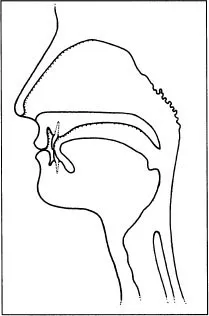
Diagram 1: the vocal mechanism
The larynx and vocal folds
The larynx is at the top of the windpipe, and forms the housing of the vocal folds. This is where sound is initiated. The larynx is a vibrator. This is important because a resonator on its own cannot generate sound; it can only amplify and shape it. Just as some wind instruments have a reed, your voice has two vocal folds that vibrate to produce sound. The vocal folds must move closer together to generate sound. A rapid closing and opening of the vocal folds produces the ’sound signal’. Here is an exercise to give you a sense of what is meant by vocal fold vibration.
Awareness exercise 1: THE VIBRATING MECHANISM
1.Blow breath gently through your lips; they should be almost closed. You will get an airy sound without pitch.
2.Start to blow a little harder and regulate the pressure until you produce a ‘lip trill’. This is similar to the sound signal produced by the vocal folds at the level of the larynx before it is shaped by the resonator. Notice what you needed for this task:
i.You needed breath to excite the vibration of the lips;
ii.You needed to regulate the breath pressure for efficient vibrations – in singing and speaking we call this sub-glottic pressure;
iii.You needed something that could vibrate: the lips or vocal folds.
Now explore what happens if we introduce vibrations at the larynx, using the vocal tract as a sound shaper.
3.Make the lip-trill again. This time, introduce voicing as you do it. You can do this by thinking of humming behind the lip trill. If you place your fingers on your larynx you will feel vibration there as you start the ‘hum’.
Notice that for this task, both the lips and the vocal folds are vibrating, and the vocal tract is shaping the sound.
MAKING THE NOTES
For good singing, you need airflow, vocal fold closure, and effective use of the resonators:
Function of the instrument: | Power | Source | Filter |
Where it happens: | Lungs | Larynx | Vocal tract |
Singing terminology: | Breath | Tone | Resonance |
Diagram 2 shows where these are in the vocal tract. Later we will look at these structures and the muscle groups involved.
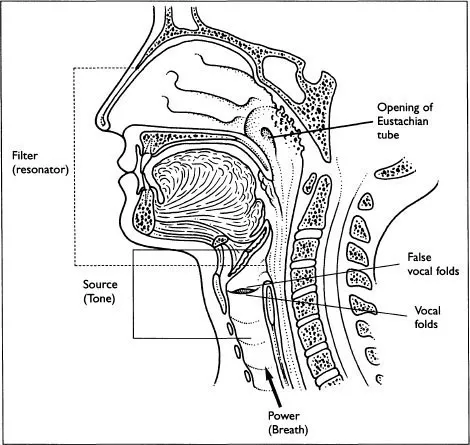
Diagram 2: the vocal tract; breath, tone and resonator
When you sing middle C, the vocal folds are closing and opening approximately 262 times a second. Various complex forces enable this to happen: aerodynamic, muscular and elastic forces in the larynx. Your vocal folds are not ‘passive’ in the act of phonation (making sound). They are actively chopping up the breath stream to form little pulses of air. A train of these small puffs of air pressure makes up the sound source. The sound source is then picked up by the tube of the vocal tract and modified according to its size and shape. A unique feature of the voice is that the shape of the vocal tract can be varied to produce different sound qualities. No other acoustic instrument can do this at will. Each vocalist is blessed with a personal graphic equaliser!
Sound production: the basics
The pitch (the note that you sing) is determined by the number of times your vocal folds close and open per second. This is called the fundamental frequency. When you sing a note, the vocal folds also produce a range of other frequencies above the fundamental. These other frequencies are called overtones or harmonics. Let's look at the harmonics that occur when you sing the fundamental frequency on the note C two octaves below middle C (65 Hertz or vibrations per second.)
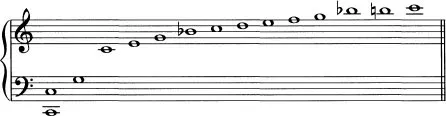
You'll hear other harmonics as part of the individual note that is being made. They contribute to sound quality. All acoustic instruments are recognisable by their individual sound quality, due to the groups of harmonics favoured by their shape. (Listen to a violin, a flute, a clarinet and trumpet playing the same note; they all sound different). Knowing how the voice works as an acoustic instrument is of positive benefit to you as a singer. As an actor you already have an instinctive awareness of acoustics because you are used to changing your vocal production for working in different acoustic spaces. You are also used to thinking about resonance and projection. We do not always stop to think about our voice as an instrumentalist does – from inside.
Here is a summary of the basics of sound production. You need:
1.Efficient vocal fold closure to produce a strong fundamental frequency. This contributes to the sense of ease in the sound.
2.Balanced energy in the harmonics. This will give your voice depth of quality and contribute to projection.
3.Breath pressure for the vocal folds to sustain vibrations.
Each voice has the same component parts; that is why we can all sing. However, shapes and sizes of the vocal tract vary as much as our body shapes, so each voice will be unique.
‘Head’ and ‘chest’ voice: myth or fact?
You may be looking at the power-source-filter diagram (Diagram 2) and wondering about head and chest voice. These are terms that I do not use except in relation to a student's previous training. They are ancient terms relating to physical sensations, which can lead inexperienced singers into thinking that they have somehow to ‘join’ two separate voices. These physical sensations of the sound being made or placed in the head and chest arise from sympathetic vibrations, from bone conduction and sometimes from muscular effort. It is more accurate to refer to head and chest ’registers’. Rather like the patches on an electronic keyboard, your voice has definable registers. These are usually different in sound quality and may be associated with different parts of your range. Hence we talk about register changes and register ‘breaks’. We will be looking at why and how these happen in later chapters, as well as how to manage them. For now, I would like you take the idea of ‘head and chest voice’, wrap it beautifully and put it to one side. You will discover more helpful ways of dealing with these mechanical changes in your voice, as well as with changes of quality, as we go along.
Practice exercises
Here are a series of exercises to put you in touch with your instrument: how it feels and sounds...
Table of contents
- Cover Page
- Title Page
- Copyright Page
- Contents
- Acknowledments
- Foreword
- Section 1: How the Voice Works
- Section 2: Training your Voice
- Section 3: Working the Text
- Afterword
- Glossary
- List of exercises and song assignments
- Index
- Index of song titles
Trusted by 375,005 students
Access to over 1.5 million titles for a fair monthly price.
Study more efficiently using our study tools.
Frequently asked questions
Yes, you can cancel anytime from the Subscription tab in your account settings on the Perlego website. Your subscription will stay active until the end of your current billing period. Learn how to cancel your subscription
No, books cannot be downloaded as external files, such as PDFs, for use outside of Perlego. However, you can download books within the Perlego app for offline reading on mobile or tablet. Learn how to download books offline
We are an online textbook subscription service, where you can get access to an entire online library for less than the price of a single book per month. With over 1.5 million books across 990+ topics, we’ve got you covered! Learn about our mission
Look out for the read-aloud symbol on your next book to see if you can listen to it. The read-aloud tool reads text aloud for you, highlighting the text as it is being read. You can pause it, speed it up and slow it down. Learn more about Read Aloud
Yes! You can use the Perlego app on both iOS and Android devices to read anytime, anywhere — even offline. Perfect for commutes or when you’re on the go.
Please note we cannot support devices running on iOS 13 and Android 7 or earlier. Learn more about using the app
Please note we cannot support devices running on iOS 13 and Android 7 or earlier. Learn more about using the app
Yes, you can access Singing and the Actor by Gillyanne Kayes in PDF and/or ePUB format, as well as other popular books in Media & Performing Arts & Music. We have over 1.5 million books available in our catalogue for you to explore.