Design of Guidance and Control Systems for Tactical Missiles presents a modern, comprehensive study of the latest design methods for tactical missile guidance and control. It analyzes autopilot designs, seeker system designs, guidance laws and theories, and the internal and external disturbances affecting the performance factors of missile guidance control systems. The text combines detailed examination of key theories with practical coverage of methods for advanced missile guidance control systems. It is valuable content for professors and graduate-level students in missile guidance and control, as well as engineers and researchers who work in the area of tactical missile guidance and control.
- 240 pages
- English
- ePUB (mobile friendly)
- Available on iOS & Android
eBook - ePub
Design of Guidance and Control Systems for Tactical Missiles
About this book
Information
1
The Basics of Missile Guidance Control
CONTENTS
1.1Overview
1.2Missile Control Methods
1.1 Overview
The purpose of missile control is to make the missile hit the target at the end of its flight. In order to achieve this goal, it is essential for the missile to constantly acquire the motion information of the target and of the missile itself in the course of the flight and adopt a tactic (that is a guidance law) to decide how to change the missile’s velocity direction based on the current missile and target relative motion, allowing the missile to finally hit the target. The relationship between the angular velocity of the missile velocity vector and its normal acceleration a of the missile, is as follows:
(1.1) |
|---|
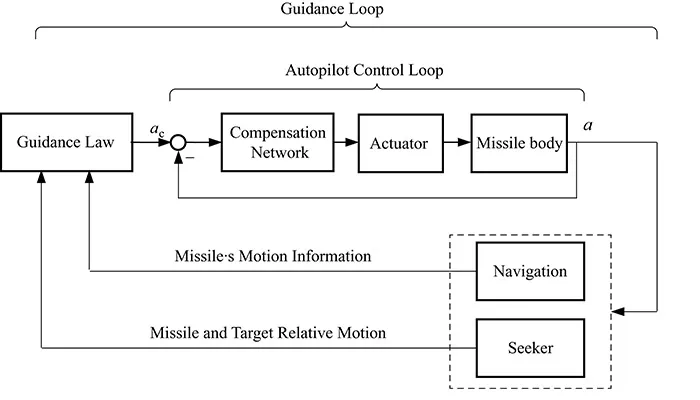
Therefore, the command of a guidance law that is generated to change the missile velocity vector direction is usually the normal acceleration ac of the missile. This missile and target interception control loop is quite different from the conventional tracking control loop; the former is a time-varying control system, and its analysis method is completely different from the general linear time-invariant time-domain and frequency-domain analysis method. So a special term (guidance loop) has historically been given to this particular missile control outer loop.
With the help of autopilots, the missile output acceleration a will follow the above guidance acceleration command ac. Under the assumptions of small perturbation, linearization and constant system parameter value, this autopilot loop is a linear time-invariant system and so different traditional control theory design methods can all be applied. Therefore, the autopilot loop that acts as the guidance inner loop historically is still referred to as the control loop.
The missile position and velocity information needed in the guidance process are obtained by an inertial navigation or integrated inertial navigation system. The process of obtaining the missile position and orientation information is called navigation. It is noteworthy that the term navigation here does not refer to the historical definition of directing the course of a ship or an aircraft. Fig. 1.1 shows the relationships between the terms navigation, guidance and control in missile control loops.
1.2 Missile Control Methods
It has been stated before that the task of a missile control system is to use missile normal acceleration to change the missile’s velocity direction according to the guidance law command. For tactical missiles flying in the atmosphere, this normal acceleration is generated by normal aerodynamic forces. As we know, when the missile has an angle of attack with respect to its velocity vector, the corresponding lift will produce a normal acceleration. However, for the missile to maintain a steady angle of attack, this angle of attack induced aerodynamic moment must be balanced by the control surface deflection induced control moment.
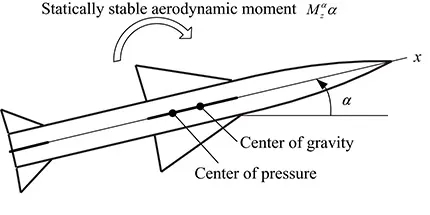
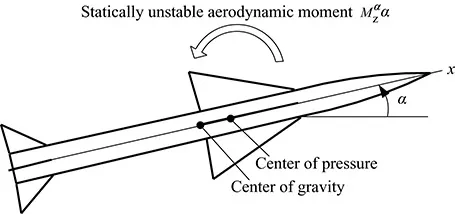
When the center of gravity of the missile is located in front of the center of pressure, the angle of attack generated aerodynamic moment will decrease the existing angle of attack and meanwhile, the x-axis of the missile body will try to coincide with the missile velocity axis. This type of aerodynamic layout is known as a statically stable aerodynamic configuration (Fig. 1.2). However, when the center of pressure of the missile is in front of its center of gravity, the existing angle of attack will continuously increase under the action of its corresponding destabilizing aerodynamic moment. Therefore, the missile is in a divergent state. This aerodynamic layout is called a statically unstable aerodynamic configuration (Fig. 1.3).
In general, there are three types of aerodynamic configurations for the generation of a missile control moment:
(1) Normal aerodynamic configuration
In this aerodynamic configuration, the missile actuator is arranged at the tail of the missile (Fig. 1.4). The benefit of this configuration is that when the control moment is balanced by the angle of attack produced moment, the control surface incident angle is the difference between the control surface deflection angle and the angle of attack, which is the most efficient way of using the control deflection angle, thus allowing the use of a larger control surface deflection and larger angle of attack for maneuvering. But the drawback is that the position of the actuator in this configuration coincides with the rear end motor, which places certain restrictions on the size of the actuator. In addition, when the missile is to maneuver, the control surface force is in the opposite direction to the angle of attack produced normal force, which will cause some total normal force loss. However, taking these advantages and disadvantages into account, this configuration is still the most commonly used aerodynamic configuration for tactical missiles.
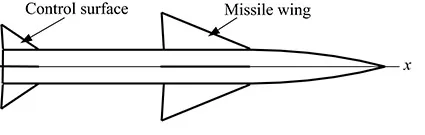
(2) Canard aerodynamic configuration
In this aerodynam...
Table of contents
- Cover
- Half Title
- Title Page
- Copyright Page
- Dedication
- Contents
- Preface
- Authors
- 1. The Basics of Missile Guidance Control
- 2. Missile Trajectory Models, Aerodynamic Derivatives, Dynamic Coefficients and Missile Transfer Functions
- 3. Basic Missile Control Component Mathematical Models
- 4. Autopilot Design
- 5. Guidance Radar
- 6. Line of Sight Guidance
- 7. Seekers
- 8. Proportional Navigation and Extended Proportional Navigation Guidance Laws
- Appendices
- Bibliography
- Index
Trusted by 375,005 students
Access to over 1.5 million titles for a fair monthly price.
Study more efficiently using our study tools.
Frequently asked questions
Yes, you can cancel anytime from the Subscription tab in your account settings on the Perlego website. Your subscription will stay active until the end of your current billing period. Learn how to cancel your subscription
No, books cannot be downloaded as external files, such as PDFs, for use outside of Perlego. However, you can download books within the Perlego app for offline reading on mobile or tablet. Learn how to download books offline
Perlego offers two plans: Essential and Complete
- Essential is ideal for learners and professionals who enjoy exploring a wide range of subjects. Access the Essential Library with 800,000+ trusted titles and best-sellers across business, personal growth, and the humanities. Includes unlimited reading time and Standard Read Aloud voice.
- Complete: Perfect for advanced learners and researchers needing full, unrestricted access. Unlock 1.5M+ books across hundreds of subjects, including academic and specialized titles. The Complete Plan also includes advanced features like Premium Read Aloud and Research Assistant.
We are an online textbook subscription service, where you can get access to an entire online library for less than the price of a single book per month. With over 1.5 million books across 990+ topics, we’ve got you covered! Learn about our mission
Look out for the read-aloud symbol on your next book to see if you can listen to it. The read-aloud tool reads text aloud for you, highlighting the text as it is being read. You can pause it, speed it up and slow it down. Learn more about Read Aloud
Yes! You can use the Perlego app on both iOS and Android devices to read anytime, anywhere — even offline. Perfect for commutes or when you’re on the go.
Please note we cannot support devices running on iOS 13 and Android 7 or earlier. Learn more about using the app
Please note we cannot support devices running on iOS 13 and Android 7 or earlier. Learn more about using the app
Yes, you can access Design of Guidance and Control Systems for Tactical Missiles by Qi Zaikang,Lin Defu in PDF and/or ePUB format, as well as other popular books in Technology & Engineering & Aeronautic & Astronautic Engineering. We have over 1.5 million books available in our catalogue for you to explore.