![]()
CHAPTER 1
Personal relationships and values
BULLYING
Each year there is an Anti-Bullying Week. This assembly can form part of a school’s focus on bullying during Anti-Bullying Week.
Aim
To understand what it feels like to be bullied and that there are different types of bullying, and to explore ways of dealing with bullying.
Preparation
Obtain photos of Batman, Kate Winslet, Tiger Woods and Justin Timberlake from the internet to put on the screen.
Two songs which you could prepare for the children to listen to and sing during the assembly are ‘Mean’ by Taylor Swift and ‘Beautiful’ by Christina Aguilera.
Introduction
Read the poem ‘Four O’clock Friday’.
Four O’clock Friday
Four o’clock Friday, I’m home at last.
Time to forget the week that’s past.
On Monday, in break they stole my ball
And threw it over the playground wall.
On Tuesday afternoon, in games
They threw mud at me and called me names.
On Wednesday, they trampled my books on the floor,
So Miss kept me in because I swore.
On Thursday, they laughed after the test
’Cause my marks were lower than the rest.
Four o’clock Friday, at last I’m free,
For two whole days they can’t get at me.
Ask: How does the person in the poem feel? How does it feel to be bullied? Then put the four photographs on the board and ask: What do these four people have in common? Answer: They were all bullied at school.
Justin Timberlake was called a sissy because he didn’t like sports, and bullies made fun of his love of acting.
Batman star Christian Bale was punched and kicked.
Golfer Tiger Woods was picked on and racially abused.
Actress Kate Winslet was bullied because of her appearance. She was called ‘Blubber’ and was locked in a cupboard.
Main focus
Point out that there are different types of bullying: mental and physical. Mental bullying includes name-calling, ignoring and excluding someone, threatening them and putting hurtful comments about them on social media.
Read the scenario ‘Gemma’s story’ and ask: What should Gemma do? Should she try to deal with the situation herself? Should she talk to an adult? If so, should she talk to a teacher or her parents?
Gemma’s story
Conclusion
List their suggestions about what they think Gemma should do on the screen. Encourage them to add to the list by asking: What is the best way to deal with bullies? Stress that involving an adult is better than getting into a fight and that it is not telling tales to do so, because everyone has the right not to be bullied.
End with this short prayer:
Let us remember that when we poke fun at someone they may feel pain.
Let us remember that when we pick on someone they feel angry and afraid.
Let us remember that when we see someone being bullied they are alone.
Give us the courage to confront the bullies and to comfort and befriend those who are being bullied.
Thoughts for the day
Traditional saying
Barack Obama
Manwar Khan
Follow-up activity
Encourage the children to do the Bullying Dilemmas quiz from the Kidscape website.
FRIENDS AND FRIENDSHIPS
Aim
To think about what makes a person a good friend and how you expect friends to behave towards each other.
Preparation
As preparation for the assembly, classes can play a version of the Friendship Game by making a board with 36 squares on it and putting details of positive behaviour that will cement a friendship (e.g. You agree to do what your friend wants, even though you’d prefer to do something else) on eight randomly chosen squares and details of negative behaviour (e.g. You make jokes about your friend behind their back) on eight randomly chosen squares. Two or more people can play the game, taking it in turns to throw a dice. If they land on a positive statement they go forward two spaces. If they land on a negative space they go back two spaces. The person who reaches the finish first is the winner. After they have played the game, hold a discussion about what they learned from the game about how to behave towards friends.
Download the song ‘The Friendship Shuffle’ from www.songspun.com.
Other songs you can prepare for the children to listen to and sing include ‘You’ve Got a Friend in Me’ by Randy Newman and ‘You’ve Got a Friend’ by Carole King.
Ask one of the classes to prepare a reading of the poem ‘A Friend Is . . .’
Introduction
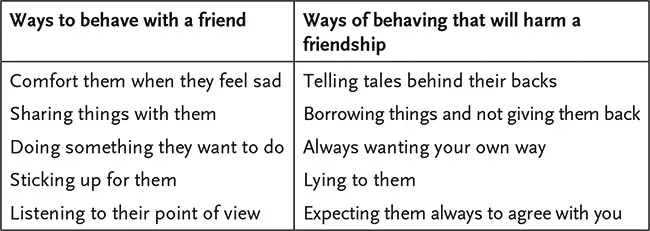
Ask the children each to think about how they behave towards a friend. What kinds of behaviour are likely to help a friendship to develop? What kinds of behaviour are likely to damage a friendship?
Write these two headings on the board and build up two lists like the ones below:
When you have completed the lists, ask the children to decide which ways of behaving they think are the most important in helping to make friendships, and to say what they think is the most important of all.
Main focus: How should friends behave?
Read this poem:
I Told My Friend a Secret
I told my friend a secret.
She promised not to tell.
My friend told her friend.
She told her friend as well.
Now everyone knows my secret.
I think that it’s unfair.
I told my friend I trusted her.
That’s why I pulled her hair.
Talk about the two children and how they behaved. Who do they think behaved worse – the girl who didn’t keep the secret or the girl who pulled her friend’s hair? How could the girl who pulled her friend’s hair have reacted differently?
Discuss keeping secrets. Is it always right to promise to keep a secret? What if keeping the secret will endanger your friend in some way? Are there some occasions in which you should break your promise?
Put up the poem ‘A Friend Is . . .’ on the board and ask a class which has prepared a reading of it to present their reading.
A Friend Is . . .
A friend is someone you can rely on
A shoulder to cry on
A friend is someone who cares.
A friend is someone who shares.
A friend is someone who won’t let you down
Someone who sticks by your side
A friend is someone who listens to you
And in whom you can confide.
A friend is someone who won’t force you
To do things you don’t want to do
A friend is someone who will always
Keep their promises to you.
A friend is someone you can trust
A friend is loyal and true
Someone you can depend on
Who is always there for you.
Conclusion
Play the song ‘The Friendship Shuffle’, encouraging everyone to join in by putting the words up on the screen.
End with the thoughts for the day.
Thoughts for the day