1
An encounter with John Bowlby
The call came from Skye. It was the voice of John Bowlby’s younger daughter, Pia Durán, with the news I had been dreading. Earlier in the day, her father had died peacefully at the age of 83 following two strokes. He was surrounded by his widow, Ursula, with eight close family members. I felt hugely sad; but also experienced a powerful sense of closeness with him. I had a strange thought that, in dying, he had given me a gentle push to grow as a full professional adult. I felt increasingly able to explore uncharted territory in a foreign land and, soon after his death, I became a consultant psychiatrist in psychotherapy, working in the National Health Service (NHS) – the largest provider of healthcare in Europe.
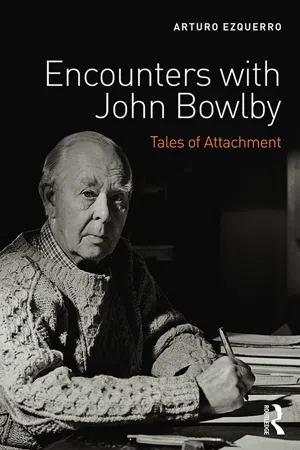
Bowlby died on 2 September 1990, but he still is very much alive in my mind. I held my first one-to-one meeting with him in his office at the Tavistock Clinic on 17 January 1985. We arranged hour-long individual supervision on a fortnightly basis, which he provided until he died. I had met him at the beginning of October 1984 at the seminar on attachment theory that he conducted at the Tavistock. This was attended by some twelve trainees in child and adolescent psychiatry.
Despite my appalling English and my poor knowledge of the theory, I took an active part in the seminar; I sometimes asked silly questions, which exposed my ignorance. Quite a few times I saw him smiling spontaneously after my questions. However, he never made me feel stupid or inadequate. Being the only foreign student in this group, I was able to have the naturalness or impudence that my British peers felt unable to display. They were all senior registrars on their way to becoming consultants and could not really afford the luxury of formulating silly questions in public. Anyway, they appeared to be more knowledgeable than I was.
Bowlby was going through his very creative, late golden years. At the seminar, I was haunted by the strangely precise and transparent nature of his thinking, as well as his gentleness and encouragement to us all in the group to develop our own ideas. The way he formulated the concept of a secure base, and its link to the quality of exploration, had a strong impact on me: it made a lot of sense. When the seminar came to an end, just before Christmas, I approached him in the group room and said that I wanted to know more about attachment theory. I was expecting that he would provide me with a reading list. But he gave me the gift of an appointment to meet him in the New Year, he said: “For a chat”.
Retrospectively, I realise that my rather bold approach and his more than positive response were to make one of the most significant happenings in my life; certainly the most important of my professional life. As his mentorship developed, he gradually became a secure base for me. Now that, in retiring from the NHS I have started my own golden years, I feel able to tell a story about Bowlby’s life and work, and about the impact he had on me and many other people. I hope to involve you, the reader, in this journey of exploration.
At a mentoring session, in April 1990, Bowlby told me that he would soon need to have bowel cancer surgery. He was reasonably relaxed and added that he was hoping to resume our supervision shortly after. During his hospital stay, I sent him a bunch of flowers with a message: “John, I hope you score one hundred”. This was the first and only time I addressed him by his forename. During the brief separation, I was sensing his mentorship might soon come to an end. Part of me was anxious about it, but a larger part of me was feeling confident that no one could take away what I had learned from him in the previous six years. Our relationship had become a big part of my world. Bowlby belonged to my grandparents’ generation; my relationship with him was frank, painless and conflict-free.
At the Tavistock’s book launch of Charles Darwin: A New Biography, Bowlby’s (1990) last book, he was in a wheelchair recovering from his recent operation. It was May 1990. I looked for him and smiled into his eyes; he smiled back with warmth and pleasure, while saying: “Thank you, Arturo, for the beautiful flowers”. He was physically frail and pallid, though full of contagious vitality. Paradoxically, I could still perceive him as stronger, wiser and more able to cope with the world; a firm and caring secure base, which would stay with me after his departure. From this base, I was able to safely explore and navigate through feelings of frustration, even anger, and love towards both my patients and colleagues.
I knew his time would come at one point in the not-so-distant future, but I could also see that he was larger than life. In the next couple of months he continued supervising me at his London home until his last trip to Skye.
The supra-vision of supervision
An encounter between one of the most creative thinkers of the twentieth century and a rather undeveloped, although eager, foreign student was an unlikely occurrence. Why it did happen and how it was sustained open-ended, I do not know. At first, I thought that the calibre and breadth of Bowlby’s work would intimidate me. But I was surprised by his warmth and naturalness. I felt at home.
I was interested to learn that, in the last few years of his life, Bowlby was very enthusiastic about teaching and supervision. He gave many papers, lectures and seminars to a large number of professional audiences, in many different settings. Indeed, he was not in retirement. He was especially pleased to be the 1981 Freud Memorial Visiting Professor of Psychoanalysis at University College London; a place that brought back memories of his own time there as a student.
Bowlby made clear his devotion to new generations of trainees: “Invitations from students’ societies always got priority since students are likely to be less committed to traditional ideas than their elders and, in any case, theirs is the future” (Bowlby, 1991a, p. 30). Domenico Di Ceglie (a consultant child and adolescent psychiatrist who came from Italy and trained at the Tavistock some 10 years earlier than I) recently told me that Bowlby was inclusive and welcoming, with a contagious enthusiasm for teaching, which made him feel at home. That I can strongly identify with.
At our first individual supervision, Bowlby gave me a present: a paperback copy of the first popular edition of Child Care and the Growth of Love (Bowlby, 1953a). I understood that he wanted to start his teaching with a basic, very readable book. I also wondered if his choice might have been conditioned by the naive questions that I had asked at the seminar the previous academic term. I must confess that reading the book was a disturbing experience. It pushed me to think about the quality of care I may have received during my early life in La Rioja, deep at the heart of unknown Spain (except for the wine), where the provincial greyness of the post-Civil War years was atrocious and oppression was at its peak.
I was the first-born child of my parents. During my early childhood, the family suffered a number of major losses in short succession. I was one year old when my mother gave birth to my brother, but his twin died. That coincided with my maternal grandfather being diagnosed with terminal cancer. He passed away within a year. Ten months later my sister was severely brain damaged at birth. The following year my mother had a stillborn baby. I do not know how my parents were able to survive. Coping with the loss of a parent is hard enough but, at least, the grieving process can be a natural one. Losing a child is something for which our minds are not and cannot be fully prepared; children are supposed to survive their parents, which makes it much harder for the parents to grieve the loss.
In the case of a stillborn baby, birth and death are fused – which brings bewildering contradictions. When one twin dies and the other survives, the parents face very difficult clashing tasks: celebrating and nurturing the newborn living baby, whilst needing to grieve the loss of their dead baby. Bowlby’s expertise on childhood mourning gradually helped me understand the complexity of these traumatic experiences. In the following years, I was also fortunate to work at the Tavistock with Sandy Bourne – a Kleinian psychoanalyst who supervised a number of psychotherapy groups for bereaved parents that I co-conducted with Jenni Thomas (Officer of the Order of the British Empire for her work on neonatal bereavement). Bourne pioneered analytic understanding of perinatal grief, in which thinking can be disturbed or hindered: a ‘stillborn thought’ (Bourne & Lewis, 1984, 1991a, 1991b).
I can imagine the pain and sadness my parents went through. Mourning must have been extremely difficult for them, surely, overwhelming at times. My brother and I must have been confused and bewildered. I can now understand better the nervous and fluctuating quality of the attachment with my mother. But in the circumstances I cannot blame her for not being optimally available.
I never talked to Bowlby about this, nor did he talk to me about personal matters. Of course not – he and I were mindful of professional boundaries. I was grateful to him for the book. Indirectly, I gained new awareness about my childhood trauma. I knew I had to do something about it in my own personal therapy: the best way of protecting my patients from the risk that their trauma would become mixed with my own pain. My past trauma did not belong to the supervision space; this territory was protected for the benefit of the patients I cared for.
Only on one occasion in the nearly six years of our work together, Bowlby extended the professional boundary beyond the full 60-minute hour of his supervision. On 15 December 1988, my brother telephoned me to break the sad news: our father had been diagnosed with terminal cancer. The doctors had said that his life expectancy was less than one year. That was cruel on him: he had just retired the previous month and was going to be deprived of his golden years. I was shocked and wanted to travel to Spain immediately to be with Dad.
But I had a psychotherapy patient waiting and another booked straight after the customary 10-minute break in between analytic therapy sessions. This tradition had started with Freud, as he had felt more comfortable seeing his patients for 50 minutes on the clock, rather than a full hour, so he could spend the remaining 10 minutes writing some clinical notes. This timing became a norm for psychoanalysts across the world; except the French, who offer 45 minutes to their patients.
María, my wife, had given birth to Arturo, our first son, a couple of months earlier. I was distressed by contradictory, confusing feelings. I did not want to abandon María and the baby, but I felt most concerned about losing my father and said to my brother that I would travel home as soon as possible. After the telephone call, I was in pain and my mind was clouded: I could not think clearly and just followed my instincts. I decided to see the two patients in succession. That was not easy. I could hardly talk during the sessions. My minimum goal was making an effort to be able to listen to each patient as sensitively as possible, while containing my distress.
I do not know how, but I managed to keep my emotions to myself. During the 10-minute break in between the two patients I had to go to the toilet, where I could contain my tears no longer. It was a time when quite a few psychotherapists were having their mini break. Some six or seven colleagues came in and out while I was trying to recompose myself in the mirror. They clearly saw me and I saw them. No one paid much attention, and each one of them turned their eyes away quite rapidly. This was a culture shock for me, despite the fact that I had already been in London for more than four years.
I think that in Spain this might not have occurred. At the very least, someone would have asked me if I was alright and, quite likely, would have tapped me on the shoulder for warm comfort. Here, I had to survive with the cold comfort of an emotionally empty toilet. I lost my appetite and could not eat any lunch. Early in the afternoon, I held the last supervision with Bowlby prior to the Christmas break. I was feeling internally restless but, I thought, I presented myself with reasonable external composure. I started reporting on one of my patients. Within less than one minute, Bowlby said: “You do not seem to be your usual self today, what’s the matter?” I briefly shared my preoccupation with him, to which he spontaneously responded: “I am very sorry to hear the painful news”.
Bowlby was kind and especially attentive. I explained that I would be travelling to Spain on my own the following evening, and added that I would return to be with María and our baby son Arturo for Christmas. At the end of the session he gave me a warm and long handshake while saying: “I feel for you. I hope that things do not turn out to be as bad as you fear”. The next day, I was surprised to receive a telephone call at home from Carlos Durán (Bowlby’s Spanish son-in-law) to invite María, the baby and I for supper with him and his wife Pia, on Christmas Eve. It was a lovely gesture. I was deeply touched by it.
My mentorship arrangement with Bowlby was unusual: it remained independent from the Tavistock Clinic’s statutory training structure. Anton Obholzer (Chairman of the Tavistock) was my boss and clinical tutor. Peter Bruggen was my research tutor, a family therapy expert (Bruggen & O’Brian, 1986, 1987), and consultant in charge at Hill End Adolescent Unit – which I shall describe in Chapter 8. Near the end of his prolific career, Bruggen was appointed medical director in one of a new wave of NHS Trusts, when major reforms were introduced in 1991. He thought that public health services needed a good shaking, tougher management, proper costing and better accountability structures. Things turned out differently from what he had expected and he retired in 1994. At the point of his retirement, I asked Bruggen to be my mentor and we agreed to meet monthly. I enjoyed his wisdom until my own retirement from the NHS three years ago, after 33 years work in the public sector.
But, hang on a minute! As a matter of fact, I am not in total retirement and, like Bowlby, Bruggen and Obholzer, I may never quit: I currently enjoy teaching, researching, supervising, writing and helping patients. Since I became a consultant in the early 1990s, I had no formal need for mentorship. However, Bowlby had taught me that learning is an open-ended task and that in looking after myself I was also working for the benefit of my patients. Bruggen made creative use of his own golden years. Earlier in his career, he had been inspired by Bowlby’s (1949) landmark paper “The Study and Reduction of Group Tensions in the Family” – a pioneering publication on family therapy.
Following his retirement from the public sector, Bruggen continued teaching and supervising junior colleagues. He also reported many stories of the NHS reforms in a book (Bruggen, 1997). This is a cathartic testimony of about 100 health professionals and managers caught up in the dehumanising culture change of the NHS: a species that used to be the jewel in the crown of British healthcare, but which now appears to be facing extinction. Over the last 20 or so years, public health services in England have been insidiously privatised by the back door. I believe that neoliberalism is gradually eroding the welfare system: the rich can have good access to private medical services, while the needs of the poor and disadvantaged are neglected – and the middle classes are not sure about where they should go.
I suspect that if Bowlby were alive today, he would have felt disappointed by the new health economy inequalities and would have made his voice heard. Very loudly.
Real Madrid: the ups and downs of life
At the age of 59, I can now reflect on personal development with more mature confidence. I was 27 when I arrived in London from Madrid to undergo training at the Tavistock, but felt I was not yet a full adult. My self-esteem was reasonable. I had been told that I was intelligent, good at sports and handsome. I held a good record of honours and distinctions at school and university. I was a thriving junior psychiatrist. But, emotionally, I was largely undeveloped: yes, my personal growth had been arrested under General Francisco Franco’s dictatorship.
As a child, I had learned that the General had put many people in jail for so-called indecent behaviour. Every matter seemed to be externally watched and controlled. There was no unanimity, but the uniformity and colourlessness in the country were simply atrocious. There was not even black and white; everything came across as grey, the colour of the dictator’s paramilitary forces. Against that background, at the tender age of eight or nine, my imagination was captured by Real Madrid yé-yé: a group of young football players, who wore immaculate white shirts and longer hair than was normally accepted in Spain at the time. To my young mind, the whiteness of their shirt was as colourful as that of bright stars in the firmament. It was an antidote to the greyness of Franco’s oppressed Big Brother society. The name yé-yé came from the yeah, yeah, yeah chorus in the Beatles’ song She Loves You.
As an adolescent, maybe, I unconsciously sublimated my developing sexual urges by playing football and trying to score as many goals as possible. It was not as thrilling as a good orgasm but it became a more than stimulating enough experience. I did identify with Bob Marley’s public statement that football was an important part of himself, and that when he played the world woke up around him. And I was reassured by Albert Camus (1996) who confessed that he owed to football much of what he knew about morality and obligations. On the other hand, Franco did not really give a damn about football; his real interests were fishing and hunting. Tragically, he did not seem to distinguish between the human species and other animal species: many people were drowned or buried in mass graves, in a most brutal manner, just for daring to think differently.
I still feel passionately for Real Madrid, so far the most successful sports club in football history across the world. This is a loyalty of five decades. Considering that I did not have the chance to choose my family of origin, Real Madrid is the longest love for which I have made a choice. This relationship (based on role modelling, hard work and achievement) has been a relaxing and motivating experience for me – often mitigating the pain of traumatic events. In fact, Real Madrid was one of the very few secure attachments I had when I left Spain for the British Isles in December 1983. In the early years in London, Real helped me to be connected with my country of birth.
For those interested in a deeper un...