- 126 pages
- English
- ePUB (mobile friendly)
- Available on iOS & Android
eBook - ePub
Venous Access Made Easy
About this book
This book provides simple and practical instructions on how to perform safe and easy venous cannulation, and how to insert midlines and PICC lines using ultrasound. It aidsunderstanding of the relevant anatomy, shows how to use the ultrasound machine, and how to insert such lines using ultrasound guidance. Readers will feel confident and well prepared to deal with patients requiring difficult venous access, giving them simple solutions that can be learned very quickly. These skills will also be globally beneficial for patients and healthcare institutions alike.
- Follows the trends of the NHS and riding the wave of the midline/PICC line revolution
- Compact and affordable
- highly relevant to daily practice
- Useful for specialists and generalists alike, truly multi-disciplinary
Frequently asked questions
Yes, you can cancel anytime from the Subscription tab in your account settings on the Perlego website. Your subscription will stay active until the end of your current billing period. Learn how to cancel your subscription.
No, books cannot be downloaded as external files, such as PDFs, for use outside of Perlego. However, you can download books within the Perlego app for offline reading on mobile or tablet. Learn more here.
Perlego offers two plans: Essential and Complete
- Essential is ideal for learners and professionals who enjoy exploring a wide range of subjects. Access the Essential Library with 800,000+ trusted titles and best-sellers across business, personal growth, and the humanities. Includes unlimited reading time and Standard Read Aloud voice.
- Complete: Perfect for advanced learners and researchers needing full, unrestricted access. Unlock 1.4M+ books across hundreds of subjects, including academic and specialized titles. The Complete Plan also includes advanced features like Premium Read Aloud and Research Assistant.
We are an online textbook subscription service, where you can get access to an entire online library for less than the price of a single book per month. With over 1 million books across 1000+ topics, weโve got you covered! Learn more here.
Look out for the read-aloud symbol on your next book to see if you can listen to it. The read-aloud tool reads text aloud for you, highlighting the text as it is being read. You can pause it, speed it up and slow it down. Learn more here.
Yes! You can use the Perlego app on both iOS or Android devices to read anytime, anywhere โ even offline. Perfect for commutes or when youโre on the go.
Please note we cannot support devices running on iOS 13 and Android 7 or earlier. Learn more about using the app.
Yes, you can access Venous Access Made Easy by James Forsyth,Ahmed Shalan,Andrew Thompson in PDF and/or ePUB format, as well as other popular books in Medicine & Medical Theory, Practice & Reference. We have over one million books available in our catalogue for you to explore.
Information
Part 1
Venous Access Planning
Chapter 1
Venous Access Glossary
Cannulas
Midline
Peripherally Inserted Central Catheter (PICC) Line
Central Line
Tunnelled Catheter
Renal Dialysis Catheters
Totally Implanted Port
Cannulas
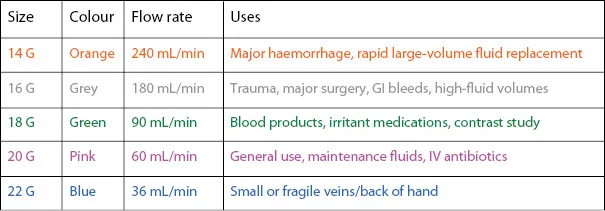
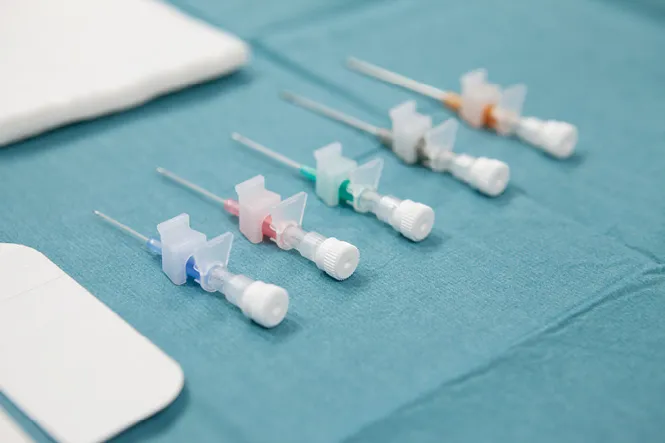
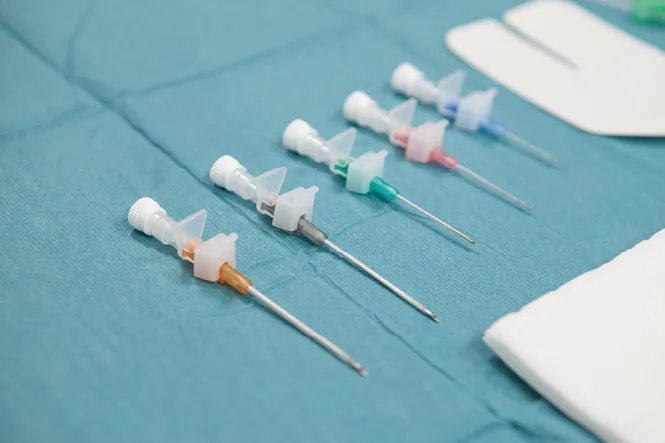
Cannulas are short peripheral access devices that are intended for short periods of use, i.e., <96 hours. In adult use, they range in size from the smallest (blue) up to the largest (orange). They are typically inserted via the back of the hand or in the forearm/antecubital fossa. Cannulas can be inserted under direct vision; however, the use of ultrasound is helpful in cases of difficult cannulation (Figures 1.1 to 1.3).

Figure 1.1 Cannula gauges and indications.

Figure 1.2 Blue and pink cannulas.

Figure 1.3 Larger cannulas (green, grey and orange).
Midline
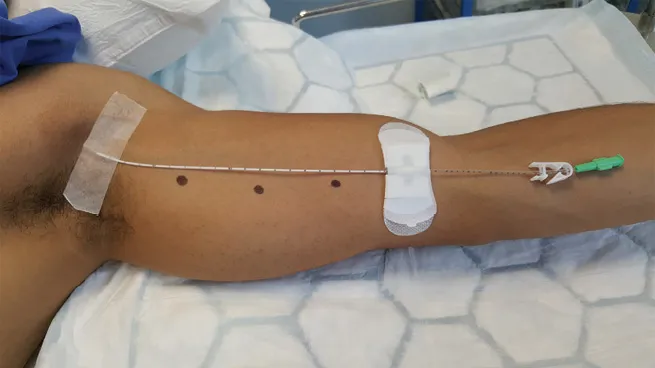
The midline is inserted under ultrasound guidance, traditionally via the upper arm basilic vein. It has to be inserted under strict aseptic conditions. Midlines can be used for both short-term and long-term venous access (i.e., weeks to months). The most common indication for a midline insertion in our unit is for long-term intravenous antibiotics. However, they can be used for the same indications as a peripheral cannula. If peripheral access is needed for over 4 days, then a midline should be considered instead of repeated peripheral cannula insertions (Figure 1.4).

Figure 1.4 Midline with black dots representing the basilic vein marked with ultrasound.
Peripherally Inserted Central Catheter (PICC) Line
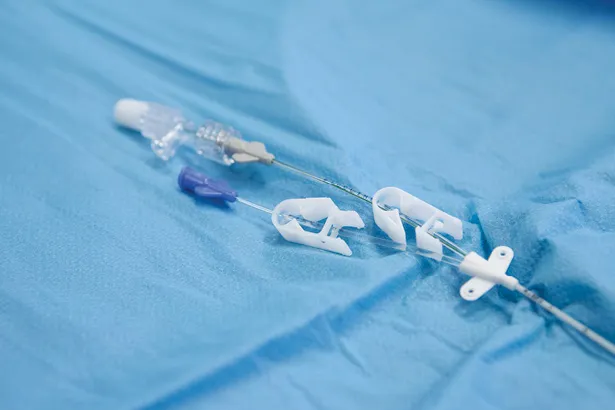
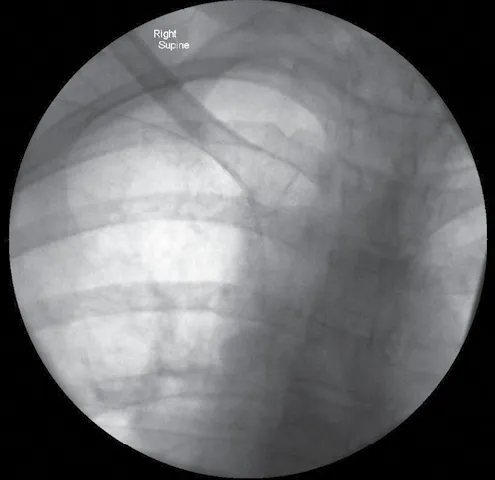
The PICC line is of a similar design to a midline. It is inserted in the same way, but because of its extra length, the tip is placed in the central venous system, i.e., in the super vena cava/cavo-atrial junction. It is usually inserted under x-ray or electrocardiogram (ECG) guidance. It is recommended for use in cases when medium-/long-term central access is required, e.g., for chemotherapy, total parenteral nutrition, etc. PICC lines can last up to 12 months or more if they are well cared for (Figures 1.5 and 1.6).

Figure 1.5 Double-lumen PICC line.

Figure 1.6 Right-sided PICC x-ray confirmation with the tip approaching the cavo-atrial junction.
Central Line
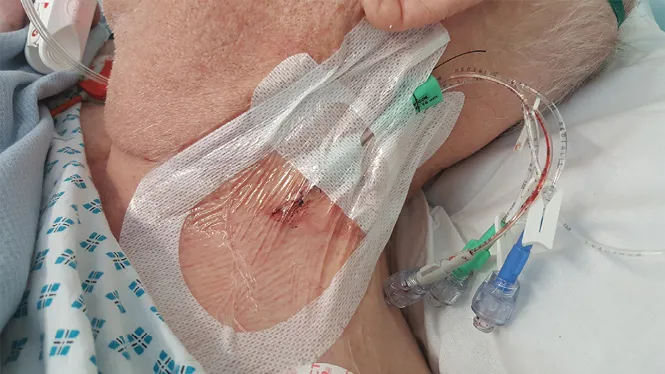
Central lines are predominantly inserted into the neck via the internal jugular vein. They can also be inserted via the subclavian vein just below the clavicle, or, as a last resort, via the common femoral vein in the groin. They are used when short-term central access is required (<10 days). They come in either single-lumen or multi-lumen forms. They can be used for the administration of all intravenous solutions, including antibiotics, fluids, medications, parenteral nutrition and chemotherapy. They are excellent for resuscitation and haemodynamic monitoring. Patients having major surgery often have them inserted in theatre (Figure 1.7).

Figure 1.7 Central line โ left internal jugular vein (IJV).
Tunnelled Catheter
These lines are used in cases when long-term central access is required. They are inserted via the subclavian or internal jugular veins and the line is tunnelled out onto the skin of the chest wall. The line typically has a cuff that creates...
Table of contents
- Cover
- Half Title
- Title Page
- Copyright Page
- Dedication
- List of Videos
- Contents
- Introduction
- Acknowledgments
- About the Authors
- Part 1: Venous Access Planning
- Part 2: Venous Access Procedures
- Part 3: Venous Access Aftercare/Overview
- Index