eBook - ePub
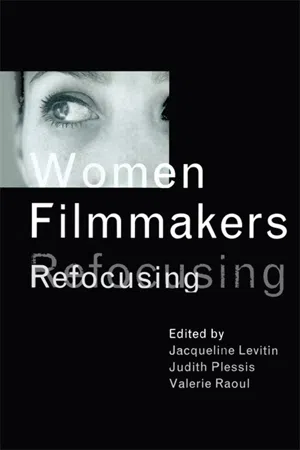
Women Filmmakers
Refocusing
- 510 pages
- English
- ePUB (mobile friendly)
- Available on iOS & Android
eBook - ePub
Women Filmmakers
Refocusing
About this book
This wide-ranging volume of new work brings together women filmmakers and critics who speak about what has changed over the past twenty years. Including such filmmakers as Margarethe von Trotta, Deepa Mehta, and Pratibha Parmar, and such critics as E. Ann Kaplan, this comprehensive volume addresses political, artistic, and economic questions vital
Information
Part 1
Women Filmmakers: Refocusing History and Theory
Part 1 begins with an overview by Ann Kaplan of the history of women in filmmaking – a topic her work has addressed from several perspectives over a number of years. She begins with the first phase (1906-30) and with pioneers like Alice Guy Blaché in Paris and Lois Weber in Hollywood. It is in the second “classical” phase (1930-60) that American cinema becomes dominant and women are largely silenced, apart from exceptions like Dorothy Arzner and Ida Lupino. The third phase (1960-90) saw the emergence of a number of successful women directors in both North America and Europe, accompanied by an increasingly impressive body of feminist film criticism and theory. The fourth phase, which began in 1990, has been characterized by a variety of films made by minority women in Europe and North America, as well as by women in other parts of the world. The films of this latter phase place a new focus on old questions, such as what difference it may make if a woman is behind the camera, and whether gender has now become eclipsed by concerns about race, class, and other hierarchies. This issue becomes central in later parts of this book.
Angela Martin approaches the history of women in film from a different angle as she examines the reasons why prominent women filmmakers may not be considered “auteur(e)s.” In addition to problems of recognition dependent on distribution, the individual genius model associated with the term “auteur” is conflated with virility and excludes by its definition some aspects of women’s films that may be ascribed to the author’s being a woman, or to her feminism. It also runs counter to postmodern concepts of the “death of the author.” Many women filmmakers are very conscious of how their films diverge from both mainstream male models and politically engaged feminist ones. Using Kathryn Bigelow as an example, Martin discusses how the concept of “auteur” would need to be modified in order to account for and include such great women filmmakers as Weber, Arzner, and Germaine Dulac. Reclaiming the term, some other women directors who may be considered to be auteures are interviewed in Part 2.
Dulac is central to the chapter by Donia Mounsef, which is devoted to the French tradition of avant-garde, experimental film. Women have been significantly present in this field, from Dulac in the 1920s to Duras in the 1970s. Their work raises questions about film in relation to wider artistic and literary movements, as well how issues of gender affect the reception of controversial films by women. Mounsef asks if the controversy surrounding Dulac has not been misunderstood. Are these directors’ contributions and originality underestimated because of their sex? Duras, for example, drew on the transgressive possibilities of film to create aesthetic effects that challenge the conventions of filmic representation. How does her experimentation in film relate to her writing and to her ideas about femininity?
The last chapter in Part 1 concentrates on Potter, Akerman, and Rainer as three prominent women directors, often the focus of early feminist film theory, who have now reached a certain point in their Lives and in their films. Catherine Fowler reflects on how their current work corresponds to the evolution of a body of theory that is also in its “middle ages.” Looking at their treatment of the female body, Fowler emphasizes a shift to a “visual pleasure” that is directed by a female rather than a male gaze. Potter’s auto-biographical presence in The Tango Lesson is a notable example of this, and it led to accusations of “female narcissism” – a topic treated in more detail hv Corinn Columnar in Part 2.
1 Women, Film, Resistance: Changing Paradigms
This chapter reflects the recent evolution of my research on women and film, which is moving away from North American hegemony and White filmmakers and towards the presence and work of minority filmmakers in the United States and other parts of the world. The conference “Women Filmmakers: Refocusing” provided an opportunity for me to share my perspectives with a wide range of filmmakers from diverse nations and, especially; for me to find out more about the work of contemporary Canadian women directors.
One of the aims of this book is to celebrate the achievements of women filmmakers, and there is, indeed, a lot to celebrate. In fact, the changes in the relation of women to film over the past three decades are such that many no longer consider it necessary to single out female artists for special consideration. One of our tasks is, therefore, to ponder how we can justify maintaining a focus on women filmmakers, and, even more provocatively, whether we still need to single out minority film directors for special attention. In addressing these questions I will review four main phases in the relation of women to film from 1900 to the present, primarily in the United States but in later sections in other contexts. I will look at the specific constraints confronting women and minorities in these four phases and then return to two phenomena. The first concerns the ideological stance in the films women direct; the second concerns issues pertaining to women’s relation to technology. The latter is crucial since gendered and raced constructions of technology present it as White and masculine, thus inhibiting women’s involvement in directing films.
With regard to feminist ideology, what “feminism” can mean in any historical period depends upon the specific constraints within which women lived and worked. Varying constraints require different strategies of resistance, and later generations are able to build on challenges made by those preceding them. Like a kaleidoscope, the ideological landscape changes with each feminist intervention as new ways of seeing open up in the wake of prior resistances. While the feminine has been cut off from technology in the past, I will argue that our future may well lie in accommodating our-selves to its challenges. Over the four stages, themes in women directors’ films have changed: first, topics were chosen for them, but it slowly became possible for them to choose their own. Consideration of how these topics are treated raises the final question: is the gender of the filmmaker more significant than the values or political perspectives a film espouses?
Phase One: Women Pioneers in America, 1906-30
The Victorian era was a period during which major technological explosions reinforced the middle-class Victorian separation of male and female spheres, with women confined to the home as private objects of desire and males free to dominate the world outside the home, which was Linked to science and technology. It also produced distinct class differences.1 Since a culture’s myths and fantasies follow closely upon its social organization (and interact within it in a circular fashion), we would expect, in early cinema, to find women in front of the camera being made into objects and represented in traditional roles. Indeed, many early male filmmakers enjoyed photographing women dancing, Laying the groundwork for what feminist film critics in the 1980s called “the male gaze”2 In early as well as classic cinema (1906-60), we mainly find women imaged as wives and mothers, or, before marriage, as virgins and whores. A little Later, male filmmakers produced the vamp genre: von Stroheim’s famous film, A Fool There Was (1914), established the female prototype that would become the notorious femme fatale. We find few working women in silent film narratives before the 1920s, and even in the so-called Jazz Age, when many more women entered the workforce,3 working women on the screen were always single so that they could be married off at the end.
Despite Victorian stances towards women, and cultural fantasies that included a cultural prohibition regarding women and technology, scholars have unearthed a large number of women working in film studios from as early as 1906 (when Alice Guy Blaché started directing in Paris) up until the mid 1920s (when Hollywood became fully institutionalized). These early women filmmakers evidently adapted quite easily to the new technology and were skilled at mastering its mysteries. Yet Blaché and Lois Weber, the two early women directors whom I will briefly discuss, still worked within very specific historical and institutional constraints. Given the continuing severe separation of male and female spheres, it was an achievement simply to get oneself behind the camera, let alone produce films that resisted the dominant ideology. Often, until very recently, the women who managed to wield the camera did so with the aid of men already active in Hollywood. Hollywood was at the time still a scorned and fledgling industry, so having women directors did not offend anyone. By 1915 the heady atmosphere of the suffragette movement gave women the courage and confidence to be active within the film industry.
However, did the filmmaker’s female gender produce a different genre of film, or a different perspective on film genre? The answer is yes and no, and this is too large an issue to address fully here.4 Suffice it to say that by 1914 Blaché had directed hundreds of pictures and owned her own studio, the Solax Company, an astounding and solitary achievement at that time.5 What evidence we have of Blaché’s ideas about women in film shows her acceptance of Victorian ideas of the female as emotional, religious, and well versed in “matters of the heart,” although her heroines often have pluck and creativity. For instance, in Blaché’s 1913 short film Matrimony, the heroine is clearly in charge of things and finds an ingenious way to bring about the marriage she wants. Blaché’s labour relations films supported management rather than labour, yet feminist awareness emerges in her plea for more women to participate in making films: “There is nothing connected with the staging of a motion picture that a woman cannot do as easily as a man, and there is no reason why she cannot completely master every technicality of the art.”6
Lois Weber at first worked by helping her husband, Philip Smiley, but it soon became clear that she was the smarter and more talented of the two. She too made hundreds of films, most of them lost, but enough remain to indicate that Weber also made films with strong heroines. In her 1913 How Men Propose, in the service of “research” the heroine plays a joke on three men. Weber pioneered a brave 1914 film about abortion, called Where Are My Children? Although it seems to be a plea from the husband’s point of view (which opposes the wife having an abortion), Weber nevertheless intended to make the case for access to legal abortion. This plea emerges when a young working-class girl dies from an abortion. Meanwhile, the film also condemns the middle-class married woman for trying to avoid being a wife and mother. In another acclaimed film, The Blot (1921), Weber is very much concerned with presenting the narrative in terms of her heroine’s feelings, anxieties, and suffering, while clearly depicting the frustrations of her social role as a mother and as the wife of a poor professor. Such ambivalence is typical of this first period.
Phase Two: The Classical Hollywood Years and the Silencing of Women, 1930-60
For complex socio-political reasons (having to do with the Depression, the Second World War, the growth of Hollywood studios into powerful male bastions, and post-Second World War gender conservatism) women were rarely able to direct films during the classical period, when famous male auteurs such as Alfred Hitchcock, John Ford, Fritz Lang, and Nicholas Ray accomplished some of their most brilliant work. Only two women, Dorothy Arzner and Ida Lupino, managed to make a significant body of films in the US at that time, and then each only for short periods. Arzner, a complicated director, became an icon for 1980s feminist film theorists, who viewed films such as Christopher Strong (1932), Craig’...
Table of contents
- Front Cover
- Half Title
- Title Page
- Copyright
- Contents
- Illustrations
- Acknowledgments
- Introduction
- Part 1: Women Filmmakers: Refocusing History and Theory
- Part 2: Close-up on the Life and Works of Auteures from Europe
- Part 3: Women in the Mainstrearn: Using Popular Genres In Europe
- Part 4: Focus on Conditions of Production: Training, Funding, Distribution
- Part 5: Women’s Films through a Postcolonial Lens
- Part 6: National and Cultural Montages: Crossing Boundaries
- Part 7: Representations of and by Minority Women
- Part 8: Revisioning Gender and Diversity in Canada
- Selected Film Sources
- Select Bibliography
- Notes on Contributors
- About the Editors
- Index
Trusted by 375,005 students
Access to over 1.5 million titles for a fair monthly price.
Study more efficiently using our study tools.
Frequently asked questions
Yes, you can cancel anytime from the Subscription tab in your account settings on the Perlego website. Your subscription will stay active until the end of your current billing period. Learn how to cancel your subscription
No, books cannot be downloaded as external files, such as PDFs, for use outside of Perlego. However, you can download books within the Perlego app for offline reading on mobile or tablet. Learn how to download books offline
Perlego offers two plans: Essential and Complete
- Essential is ideal for learners and professionals who enjoy exploring a wide range of subjects. Access the Essential Library with 800,000+ trusted titles and best-sellers across business, personal growth, and the humanities. Includes unlimited reading time and Standard Read Aloud voice.
- Complete: Perfect for advanced learners and researchers needing full, unrestricted access. Unlock 1.5M+ books across hundreds of subjects, including academic and specialized titles. The Complete Plan also includes advanced features like Premium Read Aloud and Research Assistant.
We are an online textbook subscription service, where you can get access to an entire online library for less than the price of a single book per month. With over 1.5 million books across 990+ topics, we’ve got you covered! Learn about our mission
Look out for the read-aloud symbol on your next book to see if you can listen to it. The read-aloud tool reads text aloud for you, highlighting the text as it is being read. You can pause it, speed it up and slow it down. Learn more about Read Aloud
Yes! You can use the Perlego app on both iOS and Android devices to read anytime, anywhere — even offline. Perfect for commutes or when you’re on the go.
Please note we cannot support devices running on iOS 13 and Android 7 or earlier. Learn more about using the app
Please note we cannot support devices running on iOS 13 and Android 7 or earlier. Learn more about using the app
Yes, you can access Women Filmmakers by Jacqueline Levitin, Judith Plessis, Valerie Raoul, Jacqueline Levitin,Judith Plessis,Valerie Raoul in PDF and/or ePUB format, as well as other popular books in Media & Performing Arts & Film History & Criticism. We have over 1.5 million books available in our catalogue for you to explore.