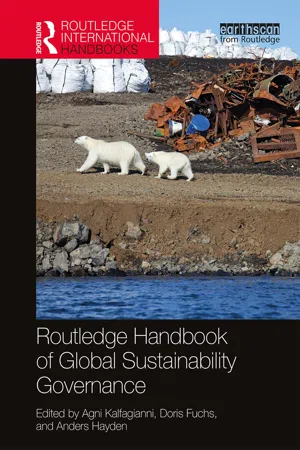
Routledge Handbook of Global Sustainability Governance
eBook - ePub

Routledge Handbook of Global Sustainability Governance

  1. 390 pages
  2. English
  3. ePUB (mobile friendly)
  4. Available on iOS & Android
eBook - ePub

Routledge Handbook of Global Sustainability Governance

About this book

The Routledge Handbook of Global Sustainability Governance provides a state-of-the-art review of core debates and contributions that offer a more normative, critical, and transformatively aspirational view on global sustainability governance.

In this landmark text, an international group of acclaimed scholars provides an overview of key analytical and normative perspectives, material and ideational structural barriers to sustainability transformation, and transformative strategies. Drawing on pivotal new and contemporary research, the volume highlights aspects to be considered and blind spots to be avoided when trying to understand and implement global sustainability governance. In this context, the authors of this book debunk many myths about all-too optimistic accounts of progress towards a sustainability transition. Simultaneously, they suggest approaches that have the potential for real sustainability transformation and systemic change, while acknowledging existing hurdles. The wide-ranging chapters in the collection are organised into four key parts:

• Part 1: Conceptual lenses

• Part 2: Ethics, principles, and debates

• Part 3: Key challenges

• Part 4: Transformative approaches

This handbook will serve as an important resource for academics and practitioners working in the fields of sustainability governance and environmental politics.

Frequently asked questions

Yes, you can cancel anytime from the Subscription tab in your account settings on the Perlego website. Your subscription will stay active until the end of your current billing period. Learn how to cancel your subscription.
No, books cannot be downloaded as external files, such as PDFs, for use outside of Perlego. However, you can download books within the Perlego app for offline reading on mobile or tablet. Learn more here.
Perlego offers two plans: Essential and Complete
  • Essential is ideal for learners and professionals who enjoy exploring a wide range of subjects. Access the Essential Library with 800,000+ trusted titles and best-sellers across business, personal growth, and the humanities. Includes unlimited reading time and Standard Read Aloud voice.
  • Complete: Perfect for advanced learners and researchers needing full, unrestricted access. Unlock 1.4M+ books across hundreds of subjects, including academic and specialized titles. The Complete Plan also includes advanced features like Premium Read Aloud and Research Assistant.
Both plans are available with monthly, semester, or annual billing cycles.
We are an online textbook subscription service, where you can get access to an entire online library for less than the price of a single book per month. With over 1 million books across 1000+ topics, we’ve got you covered! Learn more here.
Look out for the read-aloud symbol on your next book to see if you can listen to it. The read-aloud tool reads text aloud for you, highlighting the text as it is being read. You can pause it, speed it up and slow it down. Learn more here.
Yes! You can use the Perlego app on both iOS or Android devices to read anytime, anywhere — even offline. Perfect for commutes or when you’re on the go.
Please note we cannot support devices running on iOS 13 and Android 7 or earlier. Learn more about using the app.
Yes, you can access Routledge Handbook of Global Sustainability Governance by Agni Kalfagianni, Doris Fuchs, Anders Hayden, Agni Kalfagianni,Doris Fuchs,Anders Hayden in PDF and/or ePUB format, as well as other popular books in Economics & Sustainable Development. We have over one million books available in our catalogue for you to explore.

Information

Part 1
Conceptual lenses

1

Power and legitimacy

Magdalena Bexell

Introduction

Global sustainability governance involves the exercise of political power through rule-setting and policy-making in issue domains where domestic rules have proven insufficient. Political legitimacy means that such exercise of power and authority conforms to one or several sources of appropriate rule. Such sources are, for instance, democracy, effective problem-solving, moral authority, or expert-based knowledge. The decision on whether or not power exercise is indeed legitimate can be made by researchers or by those subject to an institution’s political authority. Among researchers, normative debates on the (lack of) democratic qualities of global governance have earlier predominated the study of such governance. Today, the empirical study of legitimacy perceptions and processes of legitimation is rapidly evolving. Studying legitimacy is important for several reasons. Legitimacy is required for global sustainability governance to be effective in addressing cross-border sustainability challenges. Without legitimacy, governance attempts are either likely to have less impact or to depend on coercive measures. In the absence of enforcement measures, legitimacy is central to strengthening compliance with globally agreed rules on sustainability. Moreover, studying political legitimacy allows researchers to provide critical and constructive insights into broader societal debates on power, authority, and rule beyond the nation state.
This chapter aims to show in what ways legitimacy is a useful conceptual lens for envisioning transformative approaches to the study of global sustainability governance (see the volume’s Introduction). While the chapter does not in itself provide a substantive proposal for such an approach (see instead Part IV of the volume), it contributes conceptual groundwork on which such approaches can build. The chapter proceeds as follows. In the next section, in order to ground the ensuing discussion in explicit attention to power, I identify critical questions for legitimacy research based on two different understandings of power in global governance. Second, I distinguish between normative and empirical-sociological approaches to the study of political legitimacy with regard to concerns those approaches raise for the study of global sustainability governance. The first approach revolves around standards of assessment of such governance. The latter is preoccupied with studying legitimacy perceptions, sources, and processes. Finally, I shall argue that transformative approaches to the study of global sustainability governance ought to employ a combination of both lenses. Such a combination can result in visions that are aspirational yet grounded in systematic empirical knowledge on power relations and legitimacy perceptions. I briefly refer to the consultations on the United Nations’ (UN) Sustainable Development Goals (SDGs) in order to illustrate steps involved in combining the two lenses.

Power and legitimacy

The relationship between power and political legitimacy is intriguing. Legitimacy is the glue that links authority and power while it also reflects and might even reinforce power relationships (Hurd 2007). At the same time as legitimacy is a desired attribute of a governing body, already Inis Claude (1966) pointed out that legitimacy may reinforce existing power relationships. This means that by making power appropriate in the eyes of those who are governed by it, legitimacy makes rulers more secure in their possession of power. Legitimacy is, in brief, both a source of power and a constraint on power. Institutional arrangements for the organisation of power embody legitimating principles that establish how power is obtained and the limits within which it can be exercised (Beetham 2012: 123). Arguably, the power-legitimacy relationship is further complicated by the recognition that power works in and through many forms in global governance (see e.g. Barnett and Duvall 2004; Brassett and Tsingou 2011). This section identifies critical topics for legitimacy research based on contrasting understandings of power in global governance.

An agent-centred view of power

A first view of power conceptualises it as an asset or attribute that actors can possess more or less of in relation to other actors or in relation to affecting outcomes. Such agent-centred power can reside with individuals as well as with political institutions. It can be based on material resources, formal positions, moral credibility, expertise, coercive measures, or on several other sources. While those sources can be studied empirically, it remains methodologically challenging to assess the relative power of different actors. From this agent-centred view follows questions on the legitimacy of specific governance arrangements in light of power relations between their members. This view of power draws attention to inequality between powerful and less powerful states in intergovernmental organisations, asking questions on participation, accountability, and representation. It also asks who is impacted and whose interests are supported by decisions taken in the organisations of global governance. Such institutions are not neutral problem-solving arenas but sites of power and struggle between rule-makers and rule-takers, with ensuing legitimacy deficits and delegitimation attempts. The agent-centred view also directs interest towards those who are subject to the political authority of global governance institutions. Asking about those groups’ legitimacy beliefs is key to better knowledge on the dynamics of (de)legitimation processes (Bexell and Jƶnsson 2018).
Along this understanding, a key concern for research on sustainability governance is how processes of globalisation impact the distribution of power across actors. Power is broadly dispersed across actors in the realm of sustainable development, making it harder than before for policy-makers and governments to impact outcomes (Meadowcroft 2007). Instead, global sustainability governance is characterised by fragmented regulative power. This steers research questions towards the relative influence of state and nonstate actors on sustainability regulations beyond the nation state, asking what interests are promoted when nonstate actors gain more rule-setting power (Brulle and Aronczyk this volume; Fuchs et al. 2010). Such nonstate actors range from private companies to philanthropic foundations to large civil society organisations. In particular, the political power of global companies has increased in global governance compared to that of labour organisations and civil society (Fuchs 2013). Debates on global public-private partnerships such as the UN Global Compact have been lively in this field. Partnerships are subject to critique stating that companies have obtained too much influence on UN affairs and that partnerships do not deliver on their promises (e.g. Sethi and Schepers 2014).
Finally, an agent-centred view of power also underpins debates on the role of legitimacy for compliance by those subject to sustainability rules in global governance. In contrast to domestic political institutions, global governance organisations have few coercive measures available to obtain compliance with their rules and policy decisions (Hurd 1999). Legitimacy is presumed to generate compliance that is not dependent on monitoring or on coercion by hegemonic states. Beliefs in the legitimacy of a political rule increase the likelihood of rule compliance without coercive measures involved. In the case of global sustainability governance where strong enforcement measures are usually lacking, legitimacy is therefore key to rule compliance by states and nonstate actors.

A structural view of power

In a structurally oriented understanding, power is not reducible to an attribute of specific actors but considered constitutive of the subjects of global governance (Barnett and Duvall 2004). This understanding of power raises other questions for legitimacy research on global sustainability governance than mentioned earlier. It is less concerned with pinpointing legitimacy beliefs of particular actors or legitimation strategies of governing bodies. A view of power as structural emphasises either material circumstances (e.g. capitalist accumulation) or discursive-ideational conditions (e.g. gender norms). Those allocate different privileges to different actor positions (cf. Fuchs 2013). In a materialist-oriented critical vein, neo-Gramscian theories of world politics focus on how ideological knowledge works to legitimate a capitalist order and its embedded neoliberal institutions and dominant powers (Mittelman 2016). Critical political economy accounts pay particular interest to scrutinising governance attempts at solving environmental problems through a market-based logic. For example, Matthew Paterson (2010) points to tensions between a search for legitimacy and a search for capitalist accumulation in the case of private climate governance. Their increased structural material power has allowed global companies to expand their rule-setting impact in global governance (Fuchs 2013). Key research questions in this vein concern how capitalism legitimates certain approaches to sustainability, how profit motives influence public-private partnerships, and how ā€œconsumer powerā€ impacts market-based sustainability schemes.
Approaches that conceptualise power in ā€œproductiveā€ terms contain a more diffuse view of where power resides and do not regard power as zero-sum. How power and knowledge interact is at the heart of study in such approaches. They explore how certain domains of truth become predominant and how those, in turn, enable certain practices and modes of governance. Ideational structures of meaning and knowledge define what becomes viewed as possible and impossible fields of governance. These structures thereby set the limits of thought and action. What is it that should be sustained? For whose benefit and how? Studies in this vein explore, for instance, how gender norms are constructed in global sustainable development discourses. Emma A. Foster argues that the Agenda 21, adopted at the UN Rio Earth Summit in 1992, reproduced binary gender categories and privileged heterosexual norms in a way that still influences the UN Environment Programme (Foster 2011). Others identify processes of ā€œresponsibilisationā€ through which responsibility for environmental matters is assigned to individuals rather than societal institutions. This is legitimised through subtle forms of ideational power like ideas on ā€œgreen consumption.ā€ Researchers caution that individualised responsibility might reduce attention to political solutions to institutional problems of collective action (Soneryd and Uggla 2015).
In conclusion, material and ideational structures of power set the parameters within which legitimation processes play out. Those structures shape (de)legitimation strategies as well as legitimacy perceptions of individuals. The agent-centred and structural views of power are not necessarily mutually exclusive but, as demonstrated earlier, give rise to different concerns related to political legitimacy. In practice, researchers can be informed by a combined agent-structure approach to power in the study of legitimacy. Mark Suchman’s influential definition of legitimacy emphasises that perceptions on the appropriateness of a given entity are shaped within a system of norms, values, beliefs, and definitions (1995: 574). Likewise, Jan Aart Scholte (2018) and Steven Bernstein (2011) underline that prevailing norms of contemporary world politics exert structural power in the sense that they shape legitimacy claims of global governance organisations. The next section goes further into different ways of employing legitimacy as a conceptual lens.

Legitimacy as conceptual lens

Legitimacy is a useful conceptual lens for the study of global sustainability governance in two main ways, one being normative and the other empirical-sociological. I below introduce these two analytical uses of the concept and point to their respective promises for sustainability research.

A normative lens

Through a normative lens, political legitimacy means that the exercise of political authority lives up to a standard of appropriateness theoretically defined by the scholar. This line of research debates what principles are most appropriate in scholarly assessments of governing bodies. The outcome of such assessment does not necessarily correspond to the beliefs of those subject to the authority of the governing body at hand. Much scholarly debate in this vein has revolved around how to theoretically conceive of democracy beyond the nation state. To what extent ought democratic theory be revised in light of the lack of a global ā€œdemosā€? What model of democracy beyond the nation state is most convincing in the realm of sustainability governance? Answers are provided in normative theories of global democracy. Those range from cosmopolitan democracy to democratic intergovernmentalism with deliberative democracy and global stakeholder democracy in between (see BƤckstrand 2011 for further detail). They end up in very different assessments of how democracy fares in global governance. Clearly, the choice of normative ā€œyardstickā€ determines to what extent global sustainability governance is perceived to suffer from a lack of democratic legitimacy. Yet, there is hardly any yardstick according to which contemporary global sustainability governance can be deemed democratic in terms of a holistic system of political rule. Both public and private forms of environmental governance display great weaknesses regarding democratic legitimacy, reinforced by large resources asymmetries among their participants (Fuchs et al. 2010).
On the other hand, literature that engages with individual democratic values sometimes ends up in more positive assessments, finding settings where such values are at play. Such literature often concerns new hybrid forms of governance. For instance, BƤckstrand et al. (2010) argue that new modes of deliberative governance have in some instances strengthened representation and deliberation in environmental politics. Yet they should best be understood as a piecemeal complement to state-based representative democracy, the authors posit. With regard to accountability, Kuyper and BƤckstrand (2016) map how focal points of nonstate constituency groups of the United Nations Framework Convention on Climate Change (UNFCCC) created mechanisms to remain accountable to the organisations they rep...

Table of contents

  1. Cover
  2. Half Title
  3. Title Page
  4. Copyright Page
  5. Table of Contents
  6. List of figures
  7. List of tables
  8. Acknowledgements
  9. List of abbreviations
  10. List of contributors
  11. Introduction: critical and transformative perspectives on global sustainability governance
  12. PART 1 Conceptual lenses
  13. PART 2 Ethics, principles, and debates
  14. PART 3 Key challenges
  15. PART 4 Transformative approaches
  16. Conclusion: global sustainability governance – really?
  17. Index