- 239 pages
- English
- ePUB (mobile friendly)
- Available on iOS & Android
eBook - ePub
About this book
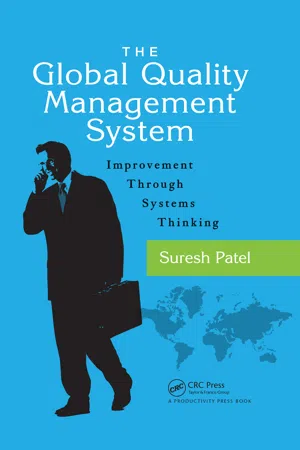
The Global Quality Management System: Improvement Through Systems Thinking shows you how to understand and implement a global quality management system (GQMS) to achieve world-class business excellence. It illustrates the business excellence pyramid with the foundation of management systems at the system level, Lean System at the operational level,
Information
1
Homage to Quality and Lean Six Sigma Gurus
Origins of Quality
The structures made in India and Egypt BCE show evidence of measurement and inspection in the process of cutting and sculpting the stones to construct idols, forts, and pyramids. The quality improvement movement traces its roots back to thirteenth century Europe, where craftsmen began organizing into unions called guilds. Until the early nineteenth century, manufacturing in the industrialized world would follow this craftsman-ship model. The factory system, with its emphasis on product inspection, started in Great Britain in the mid-1750s and grew into the Industrial Revolution in the early 1800s. In the early twentieth century, manufacturers began to include quality processes and practices.
After the United States entered World War II, quality became a critical component of the war effort. Bullets manufactured in one part of the United States had to perfectly match the rifles made in another part. The armed forces initially inspected almost every unit of product. Then, to simplify and speed up this process without compromising safety, the military began to use statistical sampling techniques for inspection, which ended in the publication of military-specification standards.
The honor and full credit go to many “quality gurus” who have changed the quality world forever.
The following are brief profiles of leading quality/Lean Six Sigma gurus.

Carl Friedrich Gauss (1777–1855)
The letter sigma (σ) (uppercase Σ), as a measurement standard, can be traced back to Carl Friedrich Gauss, who introduced the concept of the “normal curve.”
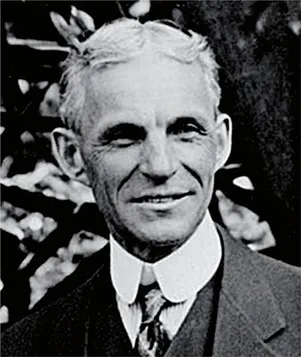
Henry Ford (1863–1947)
Henry Ford defined the Lean concept in one sentence: “We will not put into our establishment anything that is useless.” In 1913 he introduced interchangeable parts with standard work and moving conveyors to create what he called “flow production.” Thus “waste” elimination and “speed” became hallmarks of Lean production.
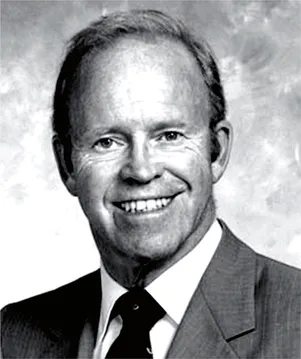
Philip B. Crosby (1926–2001)
Philip B. Crosby entered the quality world in 1952, after his military service in Korea. In the nearly five decades that followed, he became widely renowned in business circles as a guru of quality management. He stressed the importance of “doing it right the first time.” Crosby is perhaps best known for promoting a standard of excellence based on nothing—the concept of zero defects (ZD). In his own words:
- “Quality is free. It’s not a gift, but it’s free. What costs money are all the unquality things—all the actions that involve not doing jobs right the first time.”
- “Why spend all this time finding, fixing and fighting when you could have prevented the problem in the first place?”
- “It isn’t what you find; it’s what you do about what you find.”
- “Quality management is needed because nothing is simple anymore, if indeed it ever was.”
- “Good things only happen when planned; bad things happen on their own.”
- “The customer deserves to receive exactly what we have promised to produce—a clean room, a hot cup of coffee, a nonporous casing, a trip to the moon on gossamer wings.”
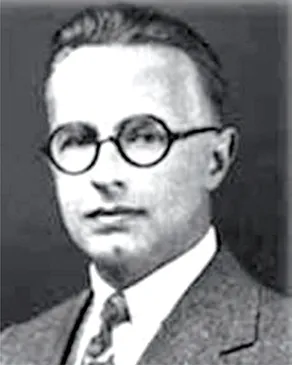
Walter A. Shewhart (1891–1967)
Six Sigma, as a measurement standard for variation in processes, can be traced back to the 1920s when Walter Shewhart showed how three sigma from the mean is the point where a process requires correction and, at six sigma from the mean, the process runs at 3.4 defects per million (DPM).

W. Edwards Deming (1900–1993)
There is no greater example of W. Edwards Deming’s belief in and devotion to quality than his contributions during and after World War II. In 1942, along with Walter Shewhart, he crafted the foundation for statistical quality control. This gave the United States a valuable edge during the war. But he was quickly forgotten in peacetime because, as Deming saw it, his knowledge rested with engineers rather than the management that drove the decision-making process. Five years after the war, in June 1950, Deming traveled to Tokyo to teach statistical methods at the behest of the Union of Japanese Scientists and Engineers (JUSE). Japan soon became the world leader in quality, leaving the United States far behind. Deming’s cycle and Deming’s 14 points are his most valuable contributions.
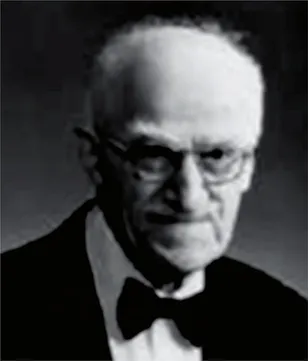
Joseph M. Juran (1904–2008)
In Juran’s words:
- “In the USA, about a third of what we do consists of redoing.”
- “Quality is fitness for use.”
- “For quality in the sense of freedom from deficiencies, the long range goal is perfection.”
- “Without a standard, there is no logical basis for making a decision or taking action.”
- “Observing many companies in action, I am unable to point to a single instance in which stunning results were gotten without the active and personal leadership of the upper managers.”
- “All managerial activity is directed at either breakthrough or control. Managers are busy doing both of these things, and nothing else.”
In 1951, the first edition of Juran’s landmark quality treatise, Quality Control Handbook, was published, cementing Juran’s reputation as the authority on quality. Shortly after W. Edwards Deming’s visit to Japan, Juran also made visits to Japan to share his knowledge of quality control. These visits were pivotal in world history because of how the two q...
Table of contents
- Cover
- Half Title
- Title Page
- Copyright Page
- Dedication
- Table of Contents
- List of Figures
- Foreword
- Preface
- Acknowledgments
- Introduction
- Chapter 1 Homage to Quality and Lean Six Sigma Gurus
- Chapter 2 Quality Management System as a Management Strategy
- Chapter 3 Quality Management System
- Chapter 4 Identification and Improvement of Processes
- Chapter 5 Global Quality Audit Processes
- Chapter 6 Global Quality Management System Processes
- Chapter 7 Fast Customer Response
- Chapter 8 Problem Solving
- Chapter 9 Drill Deep/Drill Wide Method for Permanent Corrective Action
- Chapter 10 Quality Operating System: The Engine That Perpetuates Continuous Improvement
- Chapter 11 Conclusion
- Appendix: Quality Manual
- Glossary
- Bibliography
- Index
- About the Author
Trusted by 375,005 students
Access to over 1.5 million titles for a fair monthly price.
Study more efficiently using our study tools.
Frequently asked questions
Yes, you can cancel anytime from the Subscription tab in your account settings on the Perlego website. Your subscription will stay active until the end of your current billing period. Learn how to cancel your subscription
No, books cannot be downloaded as external files, such as PDFs, for use outside of Perlego. However, you can download books within the Perlego app for offline reading on mobile or tablet. Learn how to download books offline
Perlego offers two plans: Essential and Complete
- Essential is ideal for learners and professionals who enjoy exploring a wide range of subjects. Access the Essential Library with 800,000+ trusted titles and best-sellers across business, personal growth, and the humanities. Includes unlimited reading time and Standard Read Aloud voice.
- Complete: Perfect for advanced learners and researchers needing full, unrestricted access. Unlock 1.5M+ books across hundreds of subjects, including academic and specialized titles. The Complete Plan also includes advanced features like Premium Read Aloud and Research Assistant.
We are an online textbook subscription service, where you can get access to an entire online library for less than the price of a single book per month. With over 1.5 million books across 990+ topics, we’ve got you covered! Learn about our mission
Look out for the read-aloud symbol on your next book to see if you can listen to it. The read-aloud tool reads text aloud for you, highlighting the text as it is being read. You can pause it, speed it up and slow it down. Learn more about Read Aloud
Yes! You can use the Perlego app on both iOS and Android devices to read anytime, anywhere — even offline. Perfect for commutes or when you’re on the go.
Please note we cannot support devices running on iOS 13 and Android 7 or earlier. Learn more about using the app
Please note we cannot support devices running on iOS 13 and Android 7 or earlier. Learn more about using the app
Yes, you can access The Global Quality Management System by Suresh Patel in PDF and/or ePUB format, as well as other popular books in Business & Business General. We have over 1.5 million books available in our catalogue for you to explore.