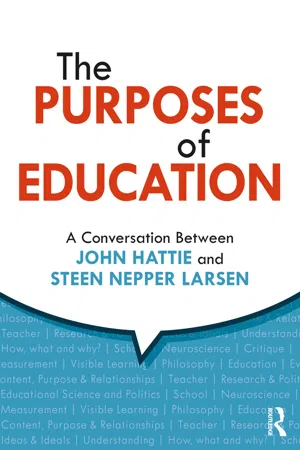
The Purposes of Education
eBook - ePub

The Purposes of Education

A Conversation Between John Hattie and Steen Nepper Larsen

  1. 330 pages
  2. English
  3. ePUB (mobile friendly)
  4. Available on iOS & Android
eBook - ePub

The Purposes of Education

A Conversation Between John Hattie and Steen Nepper Larsen

About this book

What are the purposes of education and what is the relationship between educational research and policy? Using the twin lenses of Visible Learning and educational philosophy, these are among the many fascinating topics discussed in extended conversations between John Hattie and Steen Nepper Larsen. This wide-ranging and informative book offers fundamental propositions about the nature of education. It maps out in fascinating detail a coming together of Hattie's empirical data and world-famous Visible Learning paradigm with the rich heritage of educational philosophy. Additionally, it explores the inevitable questions of the purpose of education and the development of students in a learning society.

Part clash of cultures, part meeting of minds, always fascinating and illuminating, this intriguing book will inspire teachers, students, and parents at all levels of the educational system – from kindergarten through school to university.

Conversations include:

What are the purposes of education?

Does educational data speak for itself?

What is the role of the teacher?

Is learning a visible phenomenon?

Is it important to teach and learn specific subjects?

What is the role of neuroscience research?

What is the relationship between educational research and educational politics?

What is the role of the state in education?

Frequently asked questions

Yes, you can cancel anytime from the Subscription tab in your account settings on the Perlego website. Your subscription will stay active until the end of your current billing period. Learn how to cancel your subscription.
No, books cannot be downloaded as external files, such as PDFs, for use outside of Perlego. However, you can download books within the Perlego app for offline reading on mobile or tablet. Learn more here.
Perlego offers two plans: Essential and Complete
  • Essential is ideal for learners and professionals who enjoy exploring a wide range of subjects. Access the Essential Library with 800,000+ trusted titles and best-sellers across business, personal growth, and the humanities. Includes unlimited reading time and Standard Read Aloud voice.
  • Complete: Perfect for advanced learners and researchers needing full, unrestricted access. Unlock 1.4M+ books across hundreds of subjects, including academic and specialized titles. The Complete Plan also includes advanced features like Premium Read Aloud and Research Assistant.
Both plans are available with monthly, semester, or annual billing cycles.
We are an online textbook subscription service, where you can get access to an entire online library for less than the price of a single book per month. With over 1 million books across 1000+ topics, we’ve got you covered! Learn more here.
Look out for the read-aloud symbol on your next book to see if you can listen to it. The read-aloud tool reads text aloud for you, highlighting the text as it is being read. You can pause it, speed it up and slow it down. Learn more here.
Yes! You can use the Perlego app on both iOS or Android devices to read anytime, anywhere — even offline. Perfect for commutes or when you’re on the go.
Please note we cannot support devices running on iOS 13 and Android 7 or earlier. Learn more about using the app.
Yes, you can access The Purposes of Education by John Hattie,Steen Nepper Larsen in PDF and/or ePUB format, as well as other popular books in Education & Education General. We have over one million books available in our catalogue for you to explore.

Information

Publisher
Routledge
Year
2020
eBook ISBN
9781000066029
Edition
1

Index

Note: Page numbers in italic indicate a figure and page numbers in bold indicate a table on the corresponding page
10 Mindframes for Visible Learning (Hattie) 58, 161, 198, 251, 258259
21st-Century Skills 76, 195
abduction 6870
Abrichtung 77, 320
academic achievement see achievement
academics seeking security 288298
achievement 2223, 55, 152
Adorno, T.W. 88, 290, 321, 324
‘aha’ moment 37, 126127
AITSL see Australian Institute for Teachers and School Leaders (AITSL)
Alexander, P. 44, 212
amateurization of education 249
Anderson, C. 14
Antorini, C. 165, 232
apps for teaching 144
Arendt, H. 88, 321
article writing and submission for publication 289291
Augustine, S. 223
Australian Institute for Teachers and School Leaders (AITSL) 249
Balkanization of academia 201
Barber, M. 183
Barenboim, D. 2
Batchelor, D. 109, 169
Beck, U. 296
Begriffsgeschichte 262
Benedict, T. 239240
Berckley, J. 37
Bernstein, B. 123
Biesta, G. 51, 52, 53, 8690, 114115, 119127, 133, 135, 142, 172, 190194, 238, 320
Biggs, J. 76, 190, 265, 279
Bildung 2, 90, 92, 129, 135137, 142, 176, 183, 203207, 219, 229, 232235, 242243, 251252, 306; need of 194196; non-neutrality of 183186
Blatchford, P. 232
blindness in seeing 6465, 66, 251
Bloch, Ernst 88, 203, 221, 271, 321
Bloom, B.S. 190
Bloom’s taxonomy 264265
bottom-up learning 52
Caplan, B. 212
Carroll, L....

Table of contents

  1. Cover
  2. Half Title
  3. Title
  4. Copyright
  5. Contents
  6. Introduction
  7. I The encounter
  8. II Does educational data speak for itself?
  9. III Is learning a visible phenomenon?
  10. IV Is it important to teach and learn specific subjects?
  11. V How not to objectify the students and pupils you are studying
  12. VI What is the role of the teacher?
  13. VII What is the relation between educational research and educational politics?
  14. VIII Is it possible to revitalize the German concept of Bildung (i.e., the formation of character and the higher ideas and ideals of education)?
  15. IX How to differentiate between the how, what, and why of education
  16. X Is there a purpose of education?
  17. XI Is it possible to understand pedagogy as an art of decentering?
  18. XII How to deal with neuroscience
  19. XIII How to deal with critique
  20. XIV If schools didn’t exist – would we miss them?
  21. XV Why are we longing for predictability and security?
  22. XVI The conversation stops but must continue
  23. References
  24. List of abbreviations
  25. Glossary*
  26. Index