eBook - ePub
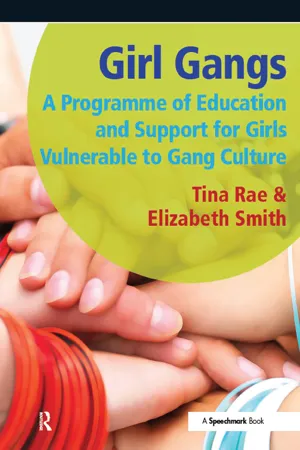
Girl Gangs
A Programme of Education and Support for Girls Vulnerable to Gang Culture
- 180 pages
- English
- ePUB (mobile friendly)
- Available on iOS & Android
eBook - ePub
Girl Gangs
A Programme of Education and Support for Girls Vulnerable to Gang Culture
About this book
This vital resource offers an intervention designed to help divert young women from engaging in girl gang culture by providing them with the opportunities to explore alternative options for themselves that ensure a sense of self-worth and belonging in a non-aggressive culture where crime in not integral to their self-definition. This unique resource will give your school access to tools and evidence-based solutions that educate students about the risks of gang culture and provide them with strategies to rationalise and reject anti-social and offending behaviours. This essential resource will enable you to: identify the existence of both girl and boy gangs in school; develop whole school curriculum offering effective teaching and learning about gang issues; adopt a holistic approach to tackling gang culture including parents, community groups and local agencies; secure help for the most vulnerable students; and, prepare staff to deal with the difficulties that arise in tackling these issues.
Information
Topic
EducationSubtopic
Education GeneralPart One
Introduction
Chapter 1: The Nature and Background to Gang Culture
Chapter 2: Using the Programme
References
Chapter 1: The Nature and Background to Gang Culture
Recent media coverage of teenage murders has heightened public awareness as to the extent of youth gang culture in the UK. Although definitive statistics regarding the level of involvement in gangs/gang culture are difficult to ascertain, it is estimated that the number of gang members aged 16 and under has more than doubled in the last five to ten years (London Councils [2003] London Bulletin: Teenage Warning [online] http://www.londoncouncils.gov.uk/doc.asp?doc=20340&cat=2562).
The Nature of ‘Gangs’
Becoming part of a friendship group is a normal part of growing up but under pressure of conflict or specific events, some such groups can take action that can be labelled as criminal or anti-social. For such groups, crime, nuisance and violence become an intrinsic part of their identity on a daily basis. It is, however, important to distinguish between such groups and the so-called ‘normal’ groups of young people who simply hang out together. For groups of young people for whom crime and violence are an integral part of their identity, the label of ‘gang’ is used to promote both affiliation and identity. Many of the young people involved in such gangs will join them for one or more of the following reasons:
• Out of fear and intimidation.
• To develop their sense of identity.
• For friendship.
• For food and shelter.
• To harness ‘street family’ support.
• For notoriety.
• For social recognition.
• To gain an alternative source of status and ‘success’.
• Due to family precedent.
• For personal protection.
• To ensure lifestyle ‘brand’ linked to culture.
• To access visible wealth.
A study into gang issues undertaken in 2008 (NASUWT) highlighted the fact that the term ‘gang’ was rarely used by gang members. The majority of young people described the groups they were involved in as ‘family’, ‘breddrin’, ‘crews’, ‘coz’ (cousins) or ‘the people I grew up with’.
Characteristics of Gangs/Offending Groups
DCSF (2008) Guidance for Schools on Gangs and Group Offending, highlights the characteristics of such groups and advises school-based staff to be very clear regarding what is actually happening in their local community. Making sure that a strategic multi-agency approach is adopted, should be able to ensure the right balance between safeguarding, prevention and interventions to divert young people from gang involvement and legal enforcement. The characteristics of such groups are described as follows:
• “Prevalence: There are few organised crime gangs involving young people (YJB research, 2007) but in a number of cities and some rural areas, there may be groups of young people who use the label gang to promote affiliation or notoriety.
• Territories: Gangs are usually territorially based, with a particular postcode or group of streets which may define the name or the tag (graphic marker) used. A report by NASUWT on gangs and schools (April, 2008) noted that:
‘It may well be that a school finds itself located within a particular gang’s turf. As such, it may become a symbol of the territory and therefore a site of contention between rival gangs. Similarly, it may be viewed as a fruitful recruitment site for new members.’
• Colours: A sign of group identification might be wearing a specific colour or particular item of clothing or jewellery.
• Ethnicity: Sometimes based on a particular ethnicity, though that may reflect the predominance of a particular ethnic group in the particular geographical area where the gang is based.
• Religion: In some cases, membership may appear to be based on religion but the cultural and political drivers to criminal behaviour usually dominate over issues of observance of faith.
• Transience: Young people may be involved in more than one ‘gang’, with some cross border movement and may not stay in a ‘gang’ for significant periods of time. In other areas, fear drives much more exclusive and sustained membership.
• Gender: Predominantly male. There are a few female gangs, but more often girls are subservient in the male gangs and even submissive, sometimes used to carry weapons or drugs, sometimes using their sexuality as a passport or being sexually exploited, for example, in initiation rituals, in revenge by rival gangs or where a younger group of girls sexually service older male gang members. Safeguarding principles are a priority in such cases.
• Age: There is local evidence of some young children (including primary age) being engaged in gang activities. In some areas the groups may be relatively formalised into age groups, for example, ‘tinys’ who can progress to ‘youngers’ then ‘elders’ usually through symbolic acts of crime. The terms vary around the country.
• Weapons: Most young people who admit to carrying a weapon say they do so for self-protection, though there is also a perception that others carry weapons for reasons of fashion. Evidence shows that those carrying weapons are more likely to be a victim of weapon attacks. Commercially available weapons can include apparently harmless plastic items that may include blades – the message is to be suspicious and cautious.”
(DCSF, 2008)
Looking for Signs In and Around the School Site
The DCSF (2008) guidance further highlights the type and nature of signs that staff and parents/carers should look out for in and around the school site. These are as follows:
What might school staff see? | What might school staff hear? | What might school staff identify? |
Tags (graffiti symbols), for example, of postcodes, neighbourhood street names on schoolbooks, clothing or building surfaces. Tags crossed out. | Threats of actual or verbal violence. | Internet sites including social networking sites. |
Wearing standard colours or particular items of jewellery or clothing such as bandanas. | Use of terms and nicknames to exclude others including pupils from other schools. | Rise in individual absence, sometimes coordinated with other pupils. |
Wearing clothes for protection against weapons. | Extortion of money or goods, robbery. | Overly sexualised behaviour or assault. |
Use of hand or other signals. | Pupils being given detailed instructions by other pupils/outsiders. | Suspicious use of mobile phones, internet, Bluetooth. |
Use of extremist language or materials. | Trading of illegal substances. | Use of extremist language or materials. |
Sudden change in friendship groups’ behaviour or secretive behaviours. | ||
Sudden acquisition of expensive possessions, for example, designer clothes and top of the range mobile phones and trainers. | ||
Carrying weapons including replicas or items that can be used as weapons. |
(DCSF, 2008)
How Might a School Respond to These Signs?
It is clearly vital that school-based staff develop their capacity to identify and respond to such signs by developing protocols with partnerships of schools and with local authority child...
Table of contents
- Cover
- Half Title
- Title Page
- Copyright Page
- Table of Contents
- Part One: Introduction
- Part Two: Staff Training: PowerPoint Presentation
- Part Three: The Student Programme
- Appendices
Trusted by 375,005 students
Access to over 1.5 million titles for a fair monthly price.
Study more efficiently using our study tools.
Frequently asked questions
Yes, you can cancel anytime from the Subscription tab in your account settings on the Perlego website. Your subscription will stay active until the end of your current billing period. Learn how to cancel your subscription
No, books cannot be downloaded as external files, such as PDFs, for use outside of Perlego. However, you can download books within the Perlego app for offline reading on mobile or tablet. Learn how to download books offline
Perlego offers two plans: Essential and Complete
- Essential is ideal for learners and professionals who enjoy exploring a wide range of subjects. Access the Essential Library with 800,000+ trusted titles and best-sellers across business, personal growth, and the humanities. Includes unlimited reading time and Standard Read Aloud voice.
- Complete: Perfect for advanced learners and researchers needing full, unrestricted access. Unlock 1.5M+ books across hundreds of subjects, including academic and specialized titles. The Complete Plan also includes advanced features like Premium Read Aloud and Research Assistant.
We are an online textbook subscription service, where you can get access to an entire online library for less than the price of a single book per month. With over 1.5 million books across 990+ topics, we’ve got you covered! Learn about our mission
Look out for the read-aloud symbol on your next book to see if you can listen to it. The read-aloud tool reads text aloud for you, highlighting the text as it is being read. You can pause it, speed it up and slow it down. Learn more about Read Aloud
Yes! You can use the Perlego app on both iOS and Android devices to read anytime, anywhere — even offline. Perfect for commutes or when you’re on the go.
Please note we cannot support devices running on iOS 13 and Android 7 or earlier. Learn more about using the app
Please note we cannot support devices running on iOS 13 and Android 7 or earlier. Learn more about using the app
Yes, you can access Girl Gangs by Tina Rae,Elizabeth Smith in PDF and/or ePUB format, as well as other popular books in Education & Education General. We have over 1.5 million books available in our catalogue for you to explore.