- 372 pages
- English
- ePUB (mobile friendly)
- Available on iOS & Android
eBook - ePub
About this book
Shingo Prize-winning author Steve Bell and other thought leaders show you how guiding you to more effectively align people and purpose, promote enterprise agility, and leverage transformative IT capabilities to create market-differentiating value for your customers. Combining research and insight with practical examples and in-depth case studies that can be put to immediate use, Run Grow Transform: Integrating Business and Lean IT is a must read for leaders and senior managers from all disciplines.
Information
Publisher
Productivity PressYear
2017Print ISBN
9781466504493
9781138440340
Edition
1eBook ISBN
9781466581081
CREATING A FRAMEWORK FOR BUSINESS AND LEAN IT INTEGRATION | I |
In Part I we’ll explore the foundations of a collaborative learning culture focused on customer value. We begin by gaining an understanding of why information technology is essential to the enterprise-wide effort to improve operational performance (run), expand market presence and volume (grow), and innovate—creating exceptional value for existing and new customers in new ways (transform).
With that understanding, we’ll establish a framework for alignment to ensure that every person within the enterprise sees and understands how their work creates customer value so that they are engaged and empowered to improve performance. In Lean terms, this framework is known as a value stream.
We’ll then learn how to integrate resources from throughout the enterprise into value streams to enable collaboration (Chapter 3). We’ll address resource constraints, discovering ways to leverage and expand knowledge and capability (Chapter 4). We’ll explore ways to speed new ideas to market through the cooperation of Lean-Agile software development and IT service management (Chapter 5). And we’ll learn how to measure performance in a way that enables us to continuously improve the value we deliver (Chapter 6).
Chapter 7 takes us to the heart of Lean leadership and Lean management systems, helping us to improve our effectiveness as leaders and managers to create a learning, growing, integrated, and agile enterprise.
Part I concludes with Chapter 8, an exploration of the force that lies within every great enterprise, a transformative energy capable of creating market-differentiating value, year after year, for customers and shareholders alike.
Chapter 1
In Pursuit of Growth and Innovation
Steve Bell
Knowledge is an unending adventure at the edge of uncertainty.Jacob BronowskiScientist and author of The Ascent of ManWHAT YOU’LL LEARN IN THIS CHAPTER▪ Why Lean IT plays an essential role in the ability of the enterprise to run, grow, and transform▪ Why sustained success requires a dynamic balance of operational excellence and innovation▪ Why a new approach to governance can help drive innovation and alleviate uncertainty across the IT portfolio▪ Why it’s more important to be a “learner” than a “knower”
The CIO is sitting in a large and well appointed but empty conference room, a cup of cold coffee beside him as he thumbs through his fifty-page project portfolio. Casually he says to me, “Ten percent of my annual $1 billion budget—over one hundred million dollars—is waste. It’s not adding value to our business or our customers.” Then he stops. He leans forward, lowering his voice: “You and I both know it’s probably much more than that—I just can’t say it openly.”
Do the math. If even 10% of the IT annual spend is waste, what is the value of discovering and permanently eliminating that waste? And what about the waste in the rest of the enterprise caused by an ineffective relationship between IT and “the business”? Ten percent? Fifteen? If you could capture that, how would you reinvest the gains?
The game has changed—with cloud computing, social media, mobile computing, big data analysis, software as a service, and more—suddenly we all want IT to drive innovation and growth. And we want it now. But many enterprises are mired in IT waste, complexity, and cost—which saps our energy, our creativity, and our speed. We all know the waste is there, but we are often unable to identify it, let alone do anything about it. We devise elaborate mechanisms to track and control spending yet have difficulty answering seemingly simple questions about what a new IT product or service will cost. How can we make effective investment decisions without such a fundamental understanding?
According to a 2007 survey by the MIT Sloan Center for Information Systems Research, the average for-profit company spent 72% of its IT budget on run-the-business/keep-the-lights-on activities.1 In 2009 PricewaterhouseCoopers reported this figure at 80%.2 However run-the-business spend is calculated, and whatever the figure happens to be within your enterprise, every dollar spent keeping the lights on is one less dollar available to support growth and innovation, an important consideration for any IT organization that aspires to be a catalyst for change.
The Big Shift
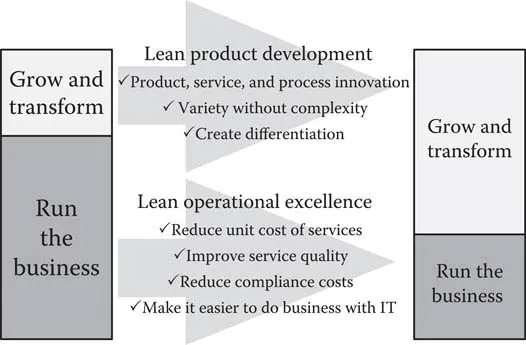
How do we shift our thinking and redirect our investment to get more business and customer value from our IT capabilities? It’s a two-step process (Figure 1.1). First, taking the Lean approach to operational excellence, we emphasize continuous improvement of speed, quality, cost, and customer satisfaction by aggressively reducing waste, unnecessary variation, and overburden. As operational performance improves, we can shift more effort, investment, and creative energy toward enabling and enhancing business strategy and innovation. This is where the second aspect of Lean comes into play: product development.*
Lean practices help business and IT stakeholders work together in rapid and continuous cycles of experimentation, improvement, and innovation to reach a balance of three complementary objectives:
1. Run the business: Providing consistent quality services and improving price-to-performance ratios while reducing cost and risk
2. Grow the business: Improving top-line revenue with existing business models through improvement and innovation of products and services, the processes that deliver them, and the IT services that enable them
3. Transform the business: Radical innovation of products and services, the processes that deliver them, the business models that drive them, and the new markets and customers they serve4
Run efficiencies free up resources for growth, and growth then funds transformation. But they are interdependent in another, less obvious way as well. You can develop a highly innovative product, but if you can’t quickly and effectively produce, deliver, and service it, you have not created value for the customer. Worse yet, a fast follower may come along and take your idea and your customers with it. So growth and transformation require operational excellence for effective commercialization. Although this relationship is obvious in the long run, it is in the day-to-day interdependence of operational activities and product development that most enterprises struggle, and nowhere is that struggle more challenging than with IT.
A Delicate Balancing Act
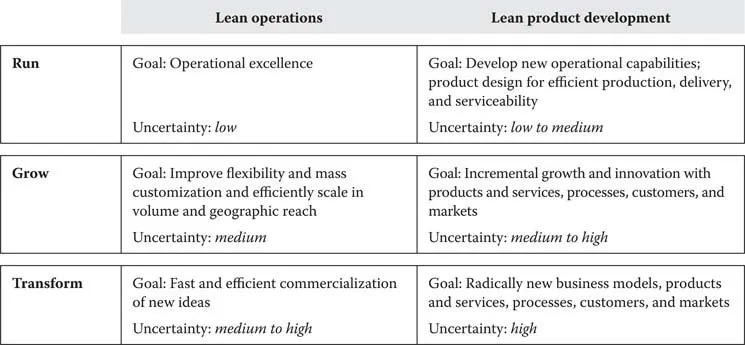
Run-the-business/operational activities are generally known—or are at least knowable. They are usually repeatable processes that can be standardized and continuously improved using Lean operational excellence techniques. In contrast, activities that enable enterprise growth and transformation often involve new and unknown situations, where variation and uncertainty produce the spark for innovation. These are the situations that we commonly associate with Lean product development, which includes software development.
However, software application development can also help to improve and automate many run-the-business activities, improving speed and service levels, reducing cost, and freeing capacity. In this way, Lean development and innovation can improve operational activities where occasional unknowns and disruptive events affect the existing standardized work.
Similarly, new products and services must also be designed with awareness for how they will be produced, delivered, and serviced in a standardized way as they are commercialized. Gaining an understanding of this requires input from those involved in run-the-business activities. So while they are subtly different, Lean operations and product/application/service development must cooperate if an enterprise is to grow and transform consistently (Figure 1.2).
Maintaining such a balance isn’t easy because of the inherent nature of these two forces: operations and development. In the realm of IT, for example, operations strive for more standardized processes and less variation, while product development requires variation, and rapid change is the key to agility. Many software developers now believe in the Lean-Agile approach, which means that small pieces of code should be rapidly designed and deployed to be most responsive to changing customer requirements. But the moment that code is ready for deployment, IT operations often put up roadblocks to rapid change, because in their experience each individual change can cause a harmful service interruption. Fortunately this mindset is beginning to change, as we will explore in Chapter 5.
To make matters even more challenging, traditional IT governance practices tend to resist rapid change, with annual budget controls, and laborious, often bureaucratic portfolio and change management processes. Historically, IT has been both risky and expensive, producing highly inconsistent outcomes, so governance practices often attempt to control the uncertainty rather than work with it. Although the intent is to ensure that investments are made wisely and with appropriate oversight and controls, the result can be a loss of speed and agility accompanied by increased cost and, paradoxically, risk.*
If we are to realize a vision of transforming our companies and our industries with innovative use of IT capabilities, we need to achieve this balance between production and creation. We need a new relationship with risk. And to do that we need to better understand the very nature of uncertainty so that we can work with it rather than simply trying to control it.
Embracing Uncertainty
The CIO of a global energy company recently reflected on the similarities between research and development (R&D) and IT projects. In both, there are many technical complexities, variables, and unknowns, causing uncertain outcomes with each new project. The chief difference, as this particular CIO observed, is that with R&D there is a natural expectation that outcomes are uncertain and that the cost and time to deliver a successful result are unknown. This is the very nature of scientific research.
But with IT projects there is usually an expectation for known outcomes along with predetermined budgets and timelines. Through rigorous planning and control, stakeholders try to eliminate uncertainty and the risks associated with each project. But IT development is often an act of learning, not of production, and uncertainty is not only necessary but sought. Companies that successfully drive innovation quickly into the market have learned to embrace and exploit uncertainty as a source of competitive advantage.
Researcher David Snowden has developed a sense-making framework that helps us understand degrees of order and uncertainty so that we can take the proper approach to a particular situation. He postulates that there are four situational contexts: simple, complicated, complex, and chaotic.6
1. Simple contexts are ordered, known, and deterministic, where strict adherence to a formula produces the same result each time (e.g., baking a cake). Such situations should be approached with a standardized best practice. The proper approach is to “sense, categorize, and respond”—to strive to categorize the situation into a known solution to be implemented.
2. Complicated contexts are ordered, knowable, and deterministic; there are “known unknowns” (e.g., sending a rocket to the moon). Because there is one best solution to be found among the many variables and potential solutions, this is typically the domain of experts and expert knowledge, but experts have their blind spots too. A single “best practice” is inappropriate here, but there should be a set of “good practices” that may be drawn upon to configure the proper solution. The proper approach is to “sense, analyze, and respond”—to explore the situation in a scientific manner to understand the cause-and-effect relationships before prescribing a solution and then experimenting to ensure that the solution produces the desired effect.
3. Complex contexts are unordered (not disordered, for there is an order of a higher degree) and dynamic (e.g., raising a child). Organic and human systems, including business organizations, are often complex; expertise is necessary but insufficient because systems are adaptive and respond to change in various ways, so rational assumptions do not always apply. With complex systems, patterns are emergent; we usually understand cause and effect only in retrospect, b...
Table of contents
- Cover
- Half Title
- Title Page
- Copyright Page
- Dedication
- Table of Contents
- Foreword
- Acknowledgments
- Author and Editor
- Contributors
- Introduction
- SECTION I CREATING A FRAMEWORK FOR BUSINESS AND LEAN IT INTEGRATION
- SECTION II NTEGRATING THE LEAN IT COMMUNITY
- Appendix A What Is Lean IT? A Working Definition
- Appendix B Additional Lean Resources
- Appendix C Case Study: Ci&T: Doing the Right Things
- Appendix D Case Study: ING Bank Netherlands: Our Lean IT Transformation Journey
- Appendix E Case Study: Netsis: An ERP Publisher’s Lean IT Journey
Trusted by 375,005 students
Access to over 1.5 million titles for a fair monthly price.
Study more efficiently using our study tools.
Frequently asked questions
Yes, you can cancel anytime from the Subscription tab in your account settings on the Perlego website. Your subscription will stay active until the end of your current billing period. Learn how to cancel your subscription
No, books cannot be downloaded as external files, such as PDFs, for use outside of Perlego. However, you can download books within the Perlego app for offline reading on mobile or tablet. Learn how to download books offline
Perlego offers two plans: Essential and Complete
- Essential is ideal for learners and professionals who enjoy exploring a wide range of subjects. Access the Essential Library with 800,000+ trusted titles and best-sellers across business, personal growth, and the humanities. Includes unlimited reading time and Standard Read Aloud voice.
- Complete: Perfect for advanced learners and researchers needing full, unrestricted access. Unlock 1.5M+ books across hundreds of subjects, including academic and specialized titles. The Complete Plan also includes advanced features like Premium Read Aloud and Research Assistant.
We are an online textbook subscription service, where you can get access to an entire online library for less than the price of a single book per month. With over 1.5 million books across 990+ topics, we’ve got you covered! Learn about our mission
Look out for the read-aloud symbol on your next book to see if you can listen to it. The read-aloud tool reads text aloud for you, highlighting the text as it is being read. You can pause it, speed it up and slow it down. Learn more about Read Aloud
Yes! You can use the Perlego app on both iOS and Android devices to read anytime, anywhere — even offline. Perfect for commutes or when you’re on the go.
Please note we cannot support devices running on iOS 13 and Android 7 or earlier. Learn more about using the app
Please note we cannot support devices running on iOS 13 and Android 7 or earlier. Learn more about using the app
Yes, you can access Run Grow Transform by Steven Bell in PDF and/or ePUB format, as well as other popular books in Business & Operations. We have over 1.5 million books available in our catalogue for you to explore.