- 556 pages
- English
- ePUB (mobile friendly)
- Available on iOS & Android
eBook - ePub
MicroMechatronics, Second Edition
About this book
After Uchino's introduction of a new terminology, 'Micromechatronics' in 1979 for describing the application area of 'piezoelectric actuators', the rapid advances in semiconductor chip technology have led to a new terminology MEMS
(micro-electro-mechanical-system) or even NEMS (nano-electro-mechanicalsystem) to describe mainly thin film sensor/actuator devices, a narrower area of micromechatronics coverage. New technologies, product developments and commercialization are providing the necessity of this major revision. In particular, the progresses in high power transducers, loss mechanisms in smart materials, energy harvesting and computer simulations are significant.
- New technologies, product developments and commercialization are providing
the updating requirement for the book contents, in parallel to the deletion of old
contents. - Various educational/instructional example problems have been accumulated, which were integrated in the new edition in order to facilitate the self-learning for the students, and the quiz/problem creation for the
instructors. - Heavily revised topics from the previous edition include: high power transducers, loss mechanisms in smart
materials, energy harvesting and computer simulations - New technologies, product developments and commercialization helped shape the updated contents of this book where all chapters have been updated and revised.
- This textbook is intended for graduate students and industrial engineers studying or
working in the fields of electronic materials, control system engineering, optical
communications, precision machinery, and robotics. The text is designed primarily
for a graduate course with the equivalent of thirty 75-minute lectures; however, it is
also suitable for self-study by individuals wishing to extend their knowledge in the
field.
Tools to learn more effectively

Saving Books

Keyword Search

Annotating Text

Listen to it instead
Information
1
Current Trends for Actuators and Micromechatronics
1.1 The Need for New Actuators
An actuator is a transducer that transforms drive energy into a mechanical displacement or force. The demand for new actuators increased significantly after the 1980s, especially for positioner, mechanical damper, and miniature motor applications. We started so-called micromechatronics to cover two different areas:
•The system is not “micro,” but can manipulate the object with micro- to nanometer accuracy.
•The system/device itself is actually micro scale.
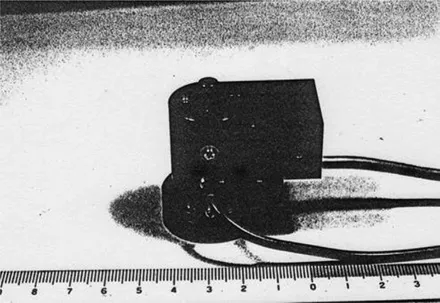
Submicrometer fabrication, common in the production of electronic chip elements, also became important in mechanical engineering. Though sensors utilizing lasers can easily detect nanometer-scale displacements, the fabrication of such precise accuracy requires submicron-meter machining equipment. In an actual machining apparatus composed of translational components (the joints) and rotating components (the gears and motor), error due to backlash will occur. Machine vibration will also lead to unavoidable position fluctuations. Furthermore, the deformations due to machining stress and thermal expansion cannot be ignored, either. The need for submicron displacement positioners to improve cutting accuracy is apparent. One example is a lathe machine that uses a ceramic multilayer actuator to adjust the cutting edge position and can achieve cutting accuracy of 2 nm, shown in Figure 1.1.1 We will handle this product in detail in Chapter 5.
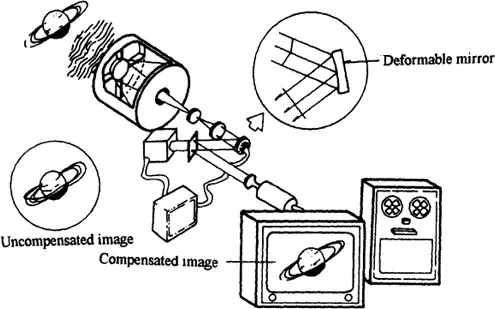
The concept of adaptive optics has been applied in the development of sophisticated optical systems. Earlier systems were generally designed such that parameters like position, angle, or the focal lengths of mirror and lens components remained essentially fixed during operation. Newer systems incorporating adaptive optical elements respond to a variety of conditions to essentially adjust the system parameters to maintain optimum operation. The original “lidar” system (a radar system utilizing light waves) was designed to be used on the NASA space shuttle for monitoring the shape of the galaxy.2 Even from the space shuttle, some distribution of thin air (i.e., wind) disturbs a sharp image of the galaxy, in addition to the vibration noise and temperature fluctuation of the shuttle, and the use of a responsive positioner was considered to compensate for the detrimental effects, as shown in Figure 1.2. This product will be discussed in detail in Chapter 8.
Active and passive vibration suppression by means of solid-state devices is also a promising technology for use in space structures and military and commercial vehicles. Mechanical vibration in a structure traveling through the vacuum of space is not readily damped, and a 10-m-long array of solar panels can be severely damaged simply by the repeated impact of space dust with the structure. Active dampers using shape memory alloys or piezoelectric ceramics are currently under investigation to remedy this type of problem. After the Big Earthquake incident in the northern part of Japan in 2011, research and development on antiearthquake building structures and structure health monitoring has become accelerated. Though the size of the whole structure is huge, the superelastic behavior of shape memory alloys (SMAs) is related to micron-scale atomic phase transformation, which has attracted the attention of civil engineers.3 A real-scale example of a superelastic SMA device is the earthquake-resistant retrofit of the Basilica San Francesco at Assisi, Italy (M. G. Castellano). The historic gable was connected with the main structure by devices using SMA rods, as shown in Figure 1.3. Regardless of the structure deformation, the SMA alloy keeps the same compressive force on the concrete and the gable.
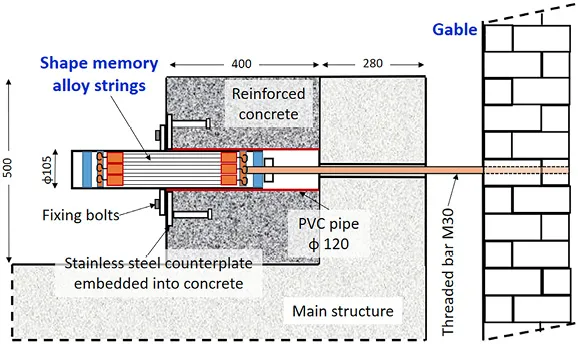
Table of contents
- Cover
- Half Title
- Title Page
- Copyright Page
- Contents
- Second Edition Preface
- First Edition Preface
- Author
- List of Symbols
- Suggested Teaching Schedule
- Prerequisite Knowledge Check
- Answers
- Chapter 1: Current Trends for Actuators and Micromechatronics
- Chapter 2: A Theoretical Description of Piezoelectricity
- Chapter 3: Actuator Materials
- Chapter 4: Ceramic Fabrication Methods and Actuator Designs
- Chapter 5: Drive/Control Techniques for Piezoelectric Actuators
- Chapter 6: Computer Simulation of Piezoelectric Devices
- Chapter 7: Piezoelectric Energy-Harvesting Systems
- Chapter 8: Servo Displacement Transducer Applications
- Chapter 9: Pulse Drive Motor Applications
- Chapter 10: Ultrasonic Motor Applications
- Chapter 11: The Future of Solid State Actuators in Micromechatronic Systems
- Index
Frequently asked questions
Yes, you can cancel anytime from the Subscription tab in your account settings on the Perlego website. Your subscription will stay active until the end of your current billing period. Learn how to cancel your subscription
No, books cannot be downloaded as external files, such as PDFs, for use outside of Perlego. However, you can download books within the Perlego app for offline reading on mobile or tablet. Learn how to download books offline
Perlego offers two plans: Essential and Complete
- Essential is ideal for learners and professionals who enjoy exploring a wide range of subjects. Access the Essential Library with 800,000+ trusted titles and best-sellers across business, personal growth, and the humanities. Includes unlimited reading time and Standard Read Aloud voice.
- Complete: Perfect for advanced learners and researchers needing full, unrestricted access. Unlock 1.4M+ books across hundreds of subjects, including academic and specialized titles. The Complete Plan also includes advanced features like Premium Read Aloud and Research Assistant.
We are an online textbook subscription service, where you can get access to an entire online library for less than the price of a single book per month. With over 1 million books across 990+ topics, we’ve got you covered! Learn about our mission
Look out for the read-aloud symbol on your next book to see if you can listen to it. The read-aloud tool reads text aloud for you, highlighting the text as it is being read. You can pause it, speed it up and slow it down. Learn more about Read Aloud
Yes! You can use the Perlego app on both iOS and Android devices to read anytime, anywhere — even offline. Perfect for commutes or when you’re on the go.
Please note we cannot support devices running on iOS 13 and Android 7 or earlier. Learn more about using the app
Please note we cannot support devices running on iOS 13 and Android 7 or earlier. Learn more about using the app
Yes, you can access MicroMechatronics, Second Edition by Kenji Uchino in PDF and/or ePUB format, as well as other popular books in Technology & Engineering & Automation in Engineering. We have over one million books available in our catalogue for you to explore.