- 186 pages
- English
- ePUB (mobile friendly)
- Available on iOS & Android
eBook - ePub
Atlas of Diagnostic Endoscopy, 3E
About this book
This book is a compilation of endoscopic images of the upper gastrointestinal tract. The 3rd edition is enriched with high-resolution digital images highlighting the classification and staging of endoscopically relevant diseases. Serial documentation of diseases and procedures like corrosive injury, variceal obliteration, peptic ulcer etc. provides a complete, informative and interesting perspective. Rare conditions like Dieulafoy's disease and Gastric antral vascular ectasia (GAVE) have been extensively discussed along with common diseases of the GI tract. This book outlines the technique and interpretation of endoscopic images proving to be a helpful guide to endoscopy practitioners.
Key Features
-
- Explores various GI tract diseases through coloured, high resolution clinical photographs.
-
- Serves as a useful reckoner for trainee endoscopists and practitioners pursuing gastroenterology or gastrointestinal endoscopy.
-
- The text is updated with tables, flowcharts, classifications and international treatment guidelines.
Frequently asked questions
Yes, you can cancel anytime from the Subscription tab in your account settings on the Perlego website. Your subscription will stay active until the end of your current billing period. Learn how to cancel your subscription.
At the moment all of our mobile-responsive ePub books are available to download via the app. Most of our PDFs are also available to download and we're working on making the final remaining ones downloadable now. Learn more here.
Perlego offers two plans: Essential and Complete
- Essential is ideal for learners and professionals who enjoy exploring a wide range of subjects. Access the Essential Library with 800,000+ trusted titles and best-sellers across business, personal growth, and the humanities. Includes unlimited reading time and Standard Read Aloud voice.
- Complete: Perfect for advanced learners and researchers needing full, unrestricted access. Unlock 1.4M+ books across hundreds of subjects, including academic and specialized titles. The Complete Plan also includes advanced features like Premium Read Aloud and Research Assistant.
We are an online textbook subscription service, where you can get access to an entire online library for less than the price of a single book per month. With over 1 million books across 1000+ topics, we’ve got you covered! Learn more here.
Look out for the read-aloud symbol on your next book to see if you can listen to it. The read-aloud tool reads text aloud for you, highlighting the text as it is being read. You can pause it, speed it up and slow it down. Learn more here.
Yes! You can use the Perlego app on both iOS or Android devices to read anytime, anywhere — even offline. Perfect for commutes or when you’re on the go.
Please note we cannot support devices running on iOS 13 and Android 7 or earlier. Learn more about using the app.
Yes, you can access Atlas of Diagnostic Endoscopy, 3E by Mohammad Ibrarullah in PDF and/or ePUB format, as well as other popular books in Medicine & Diagnostics Imaging. We have over one million books available in our catalogue for you to explore.
Information
1
Techniques of UGI endoscopy and normal anatomy
Preparation for endoscopy
Informed consent and counseling: The patient should be clearly informed about the procedure and the likely discomfort he may experience. It should be explained that his cooperation will make the procedure easier and quicker.
Overnight fasting: Routine endoscopy is usually performed in the morning hours after overnight fasting. Coating agents like antacids or colored medications should be clearly withheld. In case of obstructed stomach, prior nasogastric intubation and lavage should be performed to clear the gastric residue.
Sedation and anesthesia: For routine UGI endoscopy, we use only topical pharyngeal anesthetics such as lignocaine viscous or spray. Sedation, in the form of intravenous Midazolam, is occasionally used in children. For therapeutic endoscopy, such as foreign body removal, stent placement etc., it is our practice to use intravenous propofol anesthesia with or without endotracheal intubation.
Endotracheal intubation and monitoring: Endoscopy in a comatose or irritable patient is fraught with the risk of aspiration, hypoxia and “bite” damage to the endoscope. It is our practice to use prior endotracheal intubation and also monitor the vital parameters during the procedure.
Instrument check: Prior to endoscopy, it is good practice to check the instrument, including the light source, suction channel, airflow and display panel for any malfunction.
Position of the patient: Diagnostic endoscopy is always performed in the left lateral position. Occasionally, in a patient with upper GI bleeding, it may be necessary to examine the patient in the right lateral position. This is to displace the fundal blood pool that may obscure the bleeding lesion.
Antibiotic prophylaxis: Antibiotic prophylaxis is not indicated for diagnostic endoscopy. Current recommendations by the American Society for Gastrointestinal Endoscopy (ASGE) exclude even conditions such as valvular heart disease, prosthetic valves, synthetic vascular graft and prosthetic joints from the ambit of antibiotic prophylaxis. The few indications for antibiotic prophylaxis are therapeutic endoscopy for cirrhosis with acute variceal bleeding, cyst drainage and in patients with established GI tract infection who have the above listed cardiovascular status.
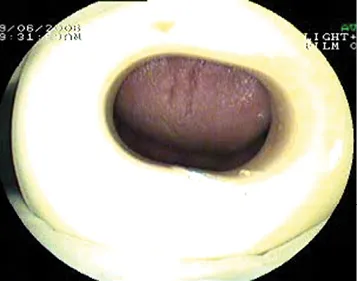
The mouth guard is held between the teeth. It is further supported by the index and middle finger of the endoscopy assistant. Alternatively, an elastic band attached to the mouth guard can be used to keep it steady.

Figure 1.1 The mouth guard.

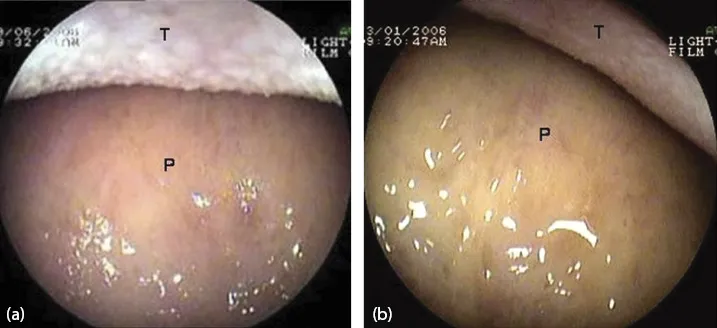
Figure 1.2 View as the endoscope enters the oral cavity. (a, b) Dorsum of the tongue (T) and hard palate (P).
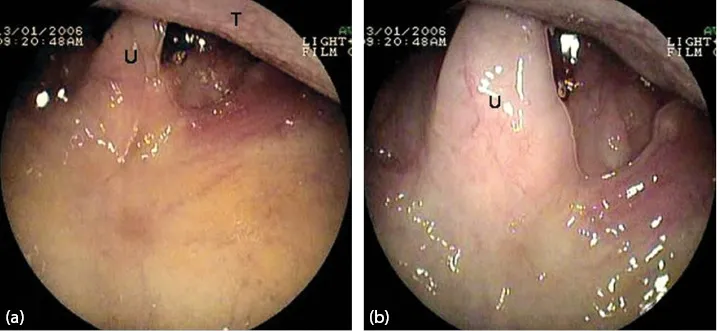
The tip of the endoscope is slightly bent to fit the contour of the tongue. It is gently advanced over the base of the tongue towards the pharynx.

Figure 1.3 (a, b) Uvula (U) and the base of the tongue (T).

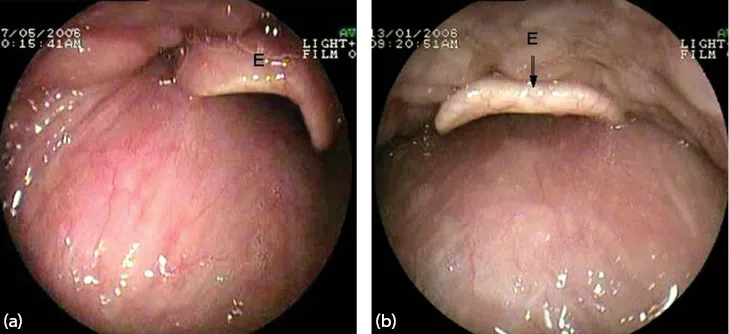
Figure 1.4 (a, b) Epiglottis (E).
The epiglottis (E) is seen as the pharynx is entered.

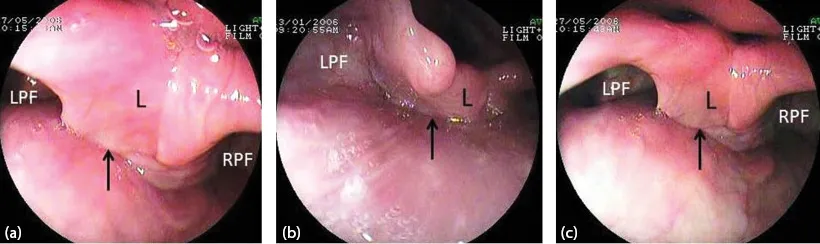
Figure 1.5 (a–c) The laryngo-pharynx. Larynx (L) and both pyriform fossae (RPF, LPF). The arrow points to the esophageal inlet.
As the scope passes below the epiglottis, the larynx and both pyrifo...

Table of contents
- Cover
- Half Title
- Title Page
- Copyright Page
- Contents
- List of abbreviations
- Preface
- Acknowledgments
- Author
- 1. Techniques of UGI endoscopy and normal anatomy
- 2. Esophageal webs, rings and strictures
- 3. Hiatal hernia and gastroesophageal reflux disease (GERD)
- 4. Motility disorders of the esophagus
- 5. Benign gastric ulcer
- 6. Chronic duodenal ulcer
- 7. Gastrojejunostomy
- 8. Benign tumors
- 9. Malignant tumors
- 10. Portal hypertension
- 11. Corrosive injury
- 12. Uncommon inflammatory lesions and tropical diseases of the UGI tract
- 13. Mallory–Weiss syndrome
- 14. Dieulafoy’s lesion
- 15. Gastric antral vascular ectasia (GAVE)
- 16. Foreign body
- 17. Tracheoesophageal fistula
- 18. Miscellaneous
- Index