Instant Notes in Analytical Chemistry provides students with a thorough comprehension of analytical chemistry and its applications. It supports the learning of principles and practice of analytical procedures and also covers the analytical techniques commonly used in laboratories today.
The electromagnetic spectrum covers a very large range of wavelengths, frequencies and energies, and many analytical spectrometric techniques involve electromagnetic radiation.
Energy levels in atoms are defined by quantum numbers, the atoms of each element possessing a characteristic set of discrete levels determined by its atomic and nuclear structure.
Every molecule has several sets of discrete energy levels, which are associated with particular structural and behavioral properties of molecules.
Related topics
Other topics in Section E.
Electromagnetic radiation
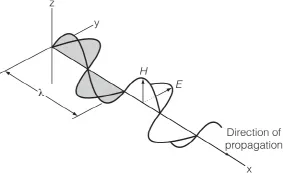
The nature of light and other radiation was the subject of much investigation since Newton’s experiments in the 17th Century. It is a form of energy and may be considered either as a continuous wave travelling through space, or as discrete photons of the same energy. For many spectrometric techniques, the wave approach is more useful. Figure 1shows a representation of an electromagnetic wave as an oscillating electric field of amplitude E and a magnetic field of amplitude H at right angles to each other.
Fig. 1. Plane-polarized electromagnetic radiation traveling along the x-axis.
In a vacuum, this wave travels at a fundamental constant speed, co
The wave is characterized in three ways, as shown in Figure 1.
The wavelength, λ, is the distance between equivalent points on the wave train, for example, between two consecutive positive crests, or two points where the wave increases through the zero value. The wavelength has been expressed in a variety of units, but these should now all be related to the metre, as shown in Table 1.
Table 1. Wavelength units
The frequency, ν, is the number of cycles of radiation passing a point in space per second. It is expressed as s-1, or hertz (Hz).
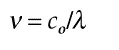
The above definitions show that the relation between these quantities is:
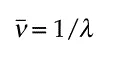
Sometimes the wavenumber,
is used where
The wavenumber is frequently given in cm-1, especially in infrared spectrometry, and it should be noted that 100 m-1 = 1 cm-1. (Note that if there are 100 per meter, there is 1 every centimeter.)
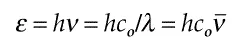
The energy, ɛ, of the radiation is most important, since it defines the molecular or atomic processes which are involved. For a single photon,
where h is the Planck constant, 6.62608 × 10⁻³⁴ J s-1.
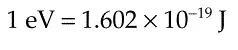
Occasionally, the electron-volt is used as a unit for energy, where
Thus, a wavelength of about 5.00 μm is equivalent to a frequency of 5.996 × 10¹³ Hz, a wavenumber of 2000 cm-1, and energy 3.973 × 10⁻²⁰ J. This corresponds to molecular vibrational energy. It is sometimes an advantage to consider 1 mole of photons. For the above example the molar energy will be:
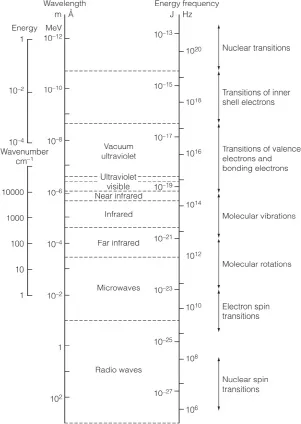
Table 2shows the very wide range of wavelengths and energies that relate to spectrometric techniques (see Topic A3) and Figure 2relates this to the electromagnetic spectrum.
When electromagnetic radiation is directed at an atom or molecule, the atom or molecule can absorb photons whose energy corresponds exactly to the difference between two energy levels of the atom or molecule. This gives rise to an absorption spectrum. It must be noted, however, that when a large change occurs (e.g. due to an alteration in the electronic structure of a molecule) the less energetic changes, such as the vibration of bonds and rotation of the molecule, will happen as well, leading to more complex spectra.
Table 2. The regions of the electromagnetic spectruma
Atomic energy levels
Quantum theory shows that atoms exist only in discrete states, each of which possesses a characteristic energy, defined by quantum numbers, which characterize the atomic state. Transitions may occur only between these levels, and even then some transitions are unfavorable. Electrons occupy atomic orbitals with characteristic spatial distributions around the nucleus.
The discrete energy levels arise naturally as the allowed solutions of the wave equations for the system under consideration. Electronic energy levels in atoms may be accounted for by solving the Schrödinger wave equation.
Atoms have electronic energy levels and atomic orbitals that are defined by three quantum numbers that can have integer values:
n principal quantum number,
l orbital angular momentum quantum number,
m magnetic quantum number, and
ms electronic spin quantum number which can be +1/2 or-1/2 only.
The energy of an orbital is mostly dependent on its principal quantum number n. In fact, for hydrogen, the energy depends only on n. There are only certain allowed values of the other quantum numbers. For example, l may take integer values from 0 to (n –1); m values from + l to-l and ms+1/2 or–1/2.
The different orbitals are described by symbols:
s (sharp) for l = 0
p (principal) for l = 1
d (diffuse) for l = 2
f ( fundamental) for l = 3
For atoms other than hydrogen, the other quantum numbers modify the energy slightly. For example, the 3p level where n = 3, l = 1 has a higher energy than the 3s with n = 3, l = 0. These are often referred to as subshells.
The atoms of the various elements are built up by adding electrons into the next empty level with the lowest energy, remembering that each level may contain two electrons with opposite spins (ms= ±1/2). This is called the Aufbau principle. An example may be used to illustrate this. The element lithium, atomic number 3, has 3 electrons. In the unexcited or ground state, these must occupy the lowest energy levels, which are the 1s and 2s levels. Two electrons fill the 1s level and one goes into the 2s.
Fig. 2. The electromagnetic spectrum from g-ray to radiowave.
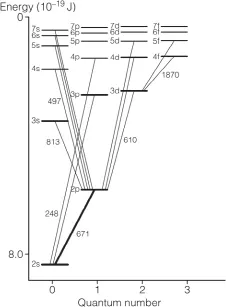
Figure 3shows the sets of atomic energy levels with n = 2, 3, 4, 5, 6 and 7 and l = 0, 1, 2 and 3. The diagram also shows that the most favorable transitions occur when l changes by ± 1. It is worth noting that the transition shown in bold is used to measure lithium in atomic emission spectrometry (see Topic E4). In an excited state, the electron population is altered. In transition elements there are many low-lying energy levels and excited states with similar energies.
Molecular energy levels
Molecules also possess energy levels defined by quantum numbers. When atoms combine into molecules, their orbitals are changed and combined into molecular orbitals. As an example, the atomic orbitals of carbon, hydrogen and oxygen combine in the molecule of propanone, C3H6O, so that the three carbons are linked in a chain by single (σ) bonds, the two outer carbons are each linked by σ bonds to three hydrogens, while the central carbon is linked by a double bond to the oxygen, that is by both a σ and a π bond. Additionally, the oxygen still has unpaired or nonbonded n electrons.
Fig. 3. Energy level diagram for the lithium atom showing the wavelength in nm for a number of transitions. Note: the transition at 671 nm is used in flame emission spectrometry.
This results in a set of bonding and corresponding antibonding electronic orbitals or energy levels as shown schematically in Figure 4. Transitions may occur selectively between these levels, for example between the π and π* levels.
In addition, mole...
Table of contents
Cover
Half Title
Series Page
Title Page
Copyright Page
Table of Contents
Abbreviation
Preface
Section A – The nature and scope of analytical chemistry
Section B – Assessment of data
Section C – Analytical reactions in solution
Section D – Separation techniques
Section E – Spectrometric techniques
Section F – Combined techniques
Section G – Thermal methods
Section H – Sensors, automation and computing
Further Reading
Index
Trusted by 375,005 students
Access to over 1.5 million titles for a fair monthly price.
Study more efficiently using our study tools.
Frequently asked questions
Yes, you can cancel anytime from the Subscription tab in your account settings on the Perlego website. Your subscription will stay active until the end of your current billing period. Learn how to cancel your subscription
No, books cannot be downloaded as external files, such as PDFs, for use outside of Perlego. However, you can download books within the Perlego app for offline reading on mobile or tablet. Learn how to download books offline
Perlego offers two plans: Essential and Complete
Essential is ideal for learners and professionals who enjoy exploring a wide range of subjects. Access the Essential Library with 800,000+ trusted titles and best-sellers across business, personal growth, and the humanities. Includes unlimited reading time and Standard Read Aloud voice.
Complete: Perfect for advanced learners and researchers needing full, unrestricted access. Unlock 1.5M+ books across hundreds of subjects, including academic and specialized titles. The Complete Plan also includes advanced features like Premium Read Aloud and Research Assistant.
Both plans are available with monthly, semester, or annual billing cycles.
We are an online textbook subscription service, where you can get access to an entire online library for less than the price of a single book per month. With over 1.5 million books across 990+ topics, we’ve got you covered! Learn about our mission
Look out for the read-aloud symbol on your next book to see if you can listen to it. The read-aloud tool reads text aloud for you, highlighting the text as it is being read. You can pause it, speed it up and slow it down. Learn more about Read Aloud
Yes! You can use the Perlego app on both iOS and Android devices to read anytime, anywhere — even offline. Perfect for commutes or when you’re on the go. Please note we cannot support devices running on iOS 13 and Android 7 or earlier. Learn more about using the app
Yes, you can access BIOS Instant Notes in Analytical Chemistry by David Kealey,P J Haines in PDF and/or ePUB format, as well as other popular books in Physical Sciences & Biochemistry in Medicine. We have over 1.5 million books available in our catalogue for you to explore.