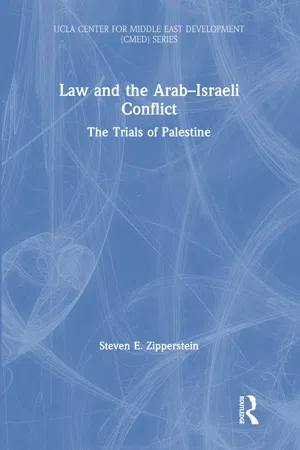
Law and the Arab–Israeli Conflict
eBook - ePub

Law and the Arab–Israeli Conflict

The Trials of Palestine

  1. 396 pages
  2. English
  3. ePUB (mobile friendly)
  4. Available on iOS & Android
eBook - ePub

Law and the Arab–Israeli Conflict

The Trials of Palestine

About this book

During the British Mandate for Palestine (1922–1948), Arabs and Jews repeatedly used the law to gain leverage and influence international opinion, especially in three dramatic and largely forgotten trials involving two issues: the interplay between conflicting British promises to the Arabs and Jews during World War I, and the parties' rights and claims to the Wailing Wall.

Focusing on how all three parties – Arab, Jewish, and British – used the law and the legal process to advance their objectives during the Mandate years, this volume reveals how the parties availed themselves – with varying degrees of success – of the law and the legal process. The book examines various legal arguments they proffered, and how that early tendency to resort to the law as a tool, a resource, and a weapon in the conflict has continued to this day. The research relies almost entirely on primary source documents, including transcripts of the public and secret testimony before the Shaw, Lofgren, and Peel Commissions, diaries, letters, government files, and other original sources.

This study explores the origins of many of the fundamental legal arguments in the Arab–Israeli conflict that prevail to this day. Filling a gap in research, this is a key text for scholars and students interested in the Arab–Israeli conflict, Lawfare, and the Middle East.

Trusted by 375,005 students

Access to over 1.5 million titles for a fair monthly price.

Study more efficiently using our study tools.

Information

Publisher
Routledge
Year
2020
Topic
History
eBook ISBN
9781000029079

1

McMahon-Hussein, Balfour, and the legality of the Jewish national home

Introduction

The background to the early legal history of the Arab–Israeli conflict begins with the tension between the famous (or infamous) McMahon-Hussein Correspondence of 1915–16 and the famous (or infamous) Balfour Declaration of 1917. Were they incompatible and mutually exclusive, or non-conflicting and reconcilable?
As early as 1920 the Arabs had formed the legal argument, and have continued refining it to this day,1 that Britain irrevocably promised Palestine to the Arabs in a 24 October 1915 letter from McMahon to Hussein; the promise remains legally enforceable; and therefore the subsequent and diametrically conflicting Balfour Declaration and everything following in its wake, including the relevant provisions of the Palestine Mandate, were legally null and void ab initio.
The British and the Jews argued, on the other hand, that none of the correspondence between McMahon and Hussein formed a treaty or an otherwise legally binding instrument, but even if it did, nothing in the correspondence supports the Arab claim that Britain promised Palestine to the Arabs in 1915. Therefore, everything subsequent to the correspondence, including the Balfour Declaration and the Palestine Mandate, were legally valid and enforceable in their own right.
We will see in later chapters how this essentially legal dispute played out in the litigation before the Shaw Commission and in the testimony before the Peel Commission. First, however, it is essential to understand the historical background, “without which it is quite impossible to study the problem of Palestine.”2

The McMahon-Hussein correspondence

Palestine had been under Turkish (Ottoman) rule since 1516, but the Ottomans saw their grip on the Middle East waning by the early 20th century. In September 1914, shortly after the outbreak of World War I, Lord Kitchener, the newly appointed British Secretary of State for War, directed British officials in Cairo to make a secret overture to the Sherif Hussein of Mecca, later King of the Hejaz and father of the future Jordanian King Abdullah I and the future Iraqi King Feisal. The British first approached the Sherif’s son Abdullah to ascertain whether the Arabs would side with Britain in the event Turkey allied with Germany.3
Abdullah responded favorably, writing the Arabs would be
well satisfied with a more close union with Great Britain … so long as she protects the rights of our country and the rights of the person his Highness our present Emir and Lord and the rights of his Emirate and its independence in all respects without any exceptions or restrictions.4
The British Government replied “[i]f the Emir of Mecca is willing to assist Great Britain with this conflict, Great Britain is willing … to guarantee the independence, rights and privileges of the Sherifate.”5
FIGURE 1.1 Abdullah, first King of Jordan, seated at right
(Matson Photograph Collection, Library of Congress).6
In April 1915 the Foreign Office authorized British officials in the region to
let it be known … that His Majesty’s Government will make it an essential condition in the terms of peace that the Arabian peninsula and its Mohammedan Holy Places should remain in the hands of an independent sovereign state. It is not possible to define at this stage exactly how much territory should be included in this State.7
By the end of June the British were distributing proclamations announcing this policy in Egypt and Sudan, and air-dropping the same proclamations over Arabia.8
Against this background, Sherif Hussein wrote directly to Sir Henry McMahon, the British High Commissioner in Cairo, in mid-July 1915, initiating what was to become known as the “McMahon-Hussein Correspondence.” McMahon and the Sherif wrote a total of ten letters to each other between July 1915 and March 1916.9 The correspondence was conducted completely in Arabic, with McMahon’s English originals translated into Arabic for transmission to the Sherif.10
The letters reveal the Sherif’s willingness to lead a British-funded Arab revolt against the Turks in exchange for Britain promising independence and self-determination for the Arabs.11 The Sherif wanted Britain to agree on the outer boundaries of the territory encompassing the future Arab states. The Sherif also insisted Britain not sell out the Arabs in any future peace negotiations with Turkey.
FIGURE 1.2 Sherif Hussein of Mecca
(Alamy Images).12
McMahon, acting on instructions from London, first tried to delay any discussion of borders, but eventually agreed to the Sherif’s terms, subject to a specific carve-out for certain geographic areas. McMahon, however, used ambiguous language to describe those areas. The proper interpretation of that language, as we will see, became the subject of heated legal debate between the Arabs, British, and Jews for the next 25 years, and continues to provoke legal arguments to this day.
McMahon also added a general carve-out, excluding from Arab independence any areas where France’s traditional interests were implicated.13 French suspicion of British aspirations in the Middle East had been a source of tension between the two allies in the years immediately preceding World War I.14 McMahon needed to exercise caution not to exacerbate those tensions by promising territory to the Sherif in which French interests were at stake.
One commentator recently noted the importance of placing the McMahon-Hussein correspondence in the proper historical context:
When McMahon and Hussein were secretly writing to one another between 1915 and 1916, the Balfour Declaration had not yet been written; there was no mandate in Palestine and no dispute between British, Zionists and Arabs over the control of Palestine. The letters were part of a different story of Arab–British wartime diplomacy. The correspondence therefore cannot properly be understood as the first step in the dispute over Palestine. It is, however, a part of broader regional politics that was overshadowed by the later conflict.15
The key question raised by the correspondence, and that has raged on ever since, is whether or not McMahon’s pledge to the Sherif included or excluded Palestine.16 We will explore in Chapters 3 and 5 how the Arabs and Jews litigated that issue before the Shaw and Peel Commissions, and how both sides linked the proper interpretation of the McMahon pledge to the validity of the Balfour Declaration. We examine here the foundation for those legal arguments.

The letters

Before analyzing the correspondence, we will summarize the relevant portions of the letters:17

14 July 1915, from the Sherif of Mecca to McMahon18

Sherif Hussein proposed six points for agreement: (i) England to “acknowledge the independence of the Arab countries” from the Persian border in the east to the Mediterranean and the Red Sea in the west, and from Mersina and Adana in the north to the Indian Ocean in the south, except for Aden (“to remain as it is”) and “England to approve the proclamation of an Arab Khalifate of Islam”; (ii) England shall receive economic preference in all Arab countries; (iii) “both high contracting parties to offer mutual assistance” during the war and not proclaim peace without mutual agreement; (iv) if one party embarks on offensive operations, the other to remain neutral pending consultations; (v) England to acknowledge the abolition of foreign privileges in the Arab countries; and (vi) “Articles 3 and 4 of this treaty” to remain in force for 15 years, with one year’s notice for renewal negotiations.19

30 August 1915, from McMahon to the Sherif of Mecca20

McMahon reaffirmed a message from Lord Kitchener that had been hand-delivered to the Sherif, in which Britain “stated clearly our desire for the independence of Arabia and its inhabitants, together with our approval of the Arab Khalifate when it should be proclaimed.”21 McMahon pushed back on reaching any agreement on boundaries for the future Arab state(s), saying
it would appear to be premature to consume our time in discussing such details in the heat of war … especially as we have learned, with surprise and regret, that some of the Arabs in those very parts, far from assisting us, are … lending their arms to the German and the Turk.
The letter closes with an offer to send the Sherif and the Arab nobles “the charitable offerings of Egypt.”

9 September 1915, from the Sherif of Mecca to McMahon22

The Sherif expressed dissatisfaction with McMahon’s “coolness and hesitation … in the question of the limits and boundaries,” saying the Arabs are demanding “limits which include only our race.” The Sherif bluntly stated the Arab decision whether to join Britain in the fight against the Turks awaits “the result of these negotiations, which are dependent only on your refusal or acceptance of the [boundary] limits.”
****
In early October 1915, before McMahon had responded to the Sherif’s 9 September letter, an Arab (or possibly Kurdish) Officer in the Turkish Army named Mohammed al Farouki deserted and crossed over to the British lines in the Dardanelles. The British brought Farouki to Cairo for interrogation. Farouki, who belonged to a secret society within the Young Arab Party known as “Fatat al Arab,”23 eventually met with McMahon. During the meeting Farouki told McMahon the Germans had made an overture to the Arabs, offering to meet all their demands, including independence, in...

Table of contents

  1. Cover
  2. Half Title
  3. Series Page
  4. Title Page
  5. Copyright Page
  6. Dedication
  7. Table of Contents
  8. List of figures
  9. List of tables
  10. List of maps
  11. List of cases and statutes
  12. Preface and explanatory note
  13. Acknowledgments
  14. Introduction
  15. 1. McMahon-Hussein, Balfour, and the legality of the Jewish national home
  16. 2. The Wailing Wall: conflicting legal claims
  17. 3. The Shaw Commission
  18. 4. The Lofgren Commission
  19. 5. The Peel Commission
  20. 6. The early legal battles and their relevance today
  21. Conclusion
  22. Bibliography
  23. Index

Frequently asked questions

Yes, you can cancel anytime from the Subscription tab in your account settings on the Perlego website. Your subscription will stay active until the end of your current billing period. Learn how to cancel your subscription
No, books cannot be downloaded as external files, such as PDFs, for use outside of Perlego. However, you can download books within the Perlego app for offline reading on mobile or tablet. Learn how to download books offline
We are an online textbook subscription service, where you can get access to an entire online library for less than the price of a single book per month. With over 1.5 million books across 990+ topics, we’ve got you covered! Learn about our mission
Look out for the read-aloud symbol on your next book to see if you can listen to it. The read-aloud tool reads text aloud for you, highlighting the text as it is being read. You can pause it, speed it up and slow it down. Learn more about Read Aloud
Yes! You can use the Perlego app on both iOS and Android devices to read anytime, anywhere — even offline. Perfect for commutes or when you’re on the go.
Please note we cannot support devices running on iOS 13 and Android 7 or earlier. Learn more about using the app
Yes, you can access Law and the Arab–Israeli Conflict by Steven E. Zipperstein in PDF and/or ePUB format, as well as other popular books in History & Middle Eastern History. We have over 1.5 million books available in our catalogue for you to explore.