eBook - ePub
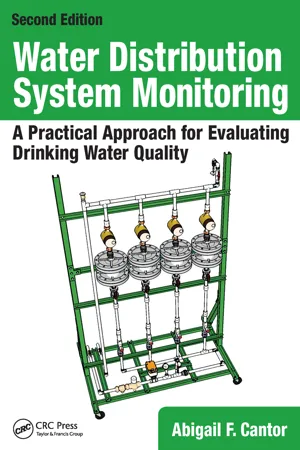
Water Distribution System Monitoring
A Practical Approach for Evaluating Drinking Water Quality, Second Edition
- 190 pages
- English
- ePUB (mobile friendly)
- Available on iOS & Android
eBook - ePub
Water Distribution System Monitoring
A Practical Approach for Evaluating Drinking Water Quality, Second Edition
About this book
Updated throughout for this new edition, Water Distribution System Monitoring describes the latest water quality monitoring approaches, techniques, and equipment that will assist water utilities for compliance with the "Lead and Copper Rule" as well as address numerous other water quality issues. Water quality data are obtained using the appro
Trusted by 375,005 students
Access to over 1.5 million titles for a fair monthly price.
Study more efficiently using our study tools.
Information
1Introduction
The United States has been very successful in protecting drinking water quality. We do not think twice about traveling anywhere in the country and drinking water in restaurants and other buildings. However, there have been some major incidents regarding drinking water quality over recent years. A notable case involved high lead levels in Washington, DC’s drinking water in 2001 (Washington Post 2004). Another prominent case occurred in Flint, Michigan, in 2014, where high lead, iron, disinfection by-products, as well as a presence of E. coli coincided with an uptick in illness from Legionella (Masten et al. 2016). Why were the drinking water regulations unable to prevent these catastrophes?
The answer is based on where the contaminant enters the water. Drinking water regulations have been the most effective when the contaminant enters via the source water. See Figure 1.1.

Figure 1.1Contaminant in the source water.
In Figure 1.1, a contaminant is found in the groundwater or surface water that is the source of the drinking water. The contaminant can be measured before it enters the water distribution system. If it is higher in concentration than limiting regulatory or voluntary health goals, then a treatment plant can be placed at the same location to remove the contaminant.
In contrast, when a contaminant enters the drinking water from within the distribution system, its concentration changes over location in the distribution system and over time. See Figure 1.2. The contaminant concentration varies like this because it is created in the distribution system from interactions in the water as it resides in the pipes and from interactions between the water and the piping material.

Figure 1.2Contaminant entering the drinking water from interactions in the distribution system and varying over location and time.
In this instance, instead of a discrete number of locations to study and control, as in Figure 1.1, there are an unknown number of water quality scenarios around the distribution system and many dilemmas arise:
- Where do we measure the contaminant so that it is representative of what consumers are exposed to?
- How do we measure the contaminant if every building piping system is different?
- What do we measure to determine how the contaminant is created in the distribution system?
- How are we going to prevent or treat the contaminant throughout the distribution system?
Drinking water regulations must answer these questions in order to protect consumers against each distribution-system contaminant. But water distribution systems are a dynamic complex of physical, chemical, and microbiological forces. Some drinking water regulations, such as the U.S. Environmental Protection Agency’s (EPA’s) Lead and Copper Rule (40 CFR Part 141 Subpart I), have not yet been able to adequately address this complexity.
This book tackles the complexity of water distribution systems. It is a practical step-by-step approach to understanding and controlling the drinking water quality that consumers experience in a water system. It demonstrates how to be proactive on water quality issues through routine monitoring of the distribution system and is written to help the practitioner prevent the devastating and costly effects of
- Falling out of compliance with the Lead and Copper Rule
- Developing pinhole leaks in water service lines and private plumbing
- Leaving the water distribution system vulnerable to microorganisms that can cause illness or can corrode metals
- Experiencing unwanted side effects from treatment chemicals
- Adding the wrong water treatment chemical or using the wrong dosage
- Alarming consumers with water that is discolored or has a bad odor
- Releasing other metals that have accumulated in the distribution system that may cause consumer health issues, such as arsenic or radium
This book describes a path to well-defined and measurable control of the distribution system water quality that consumers experience.
2A Comprehensive Perspective of Drinking Water Quality
In order to tackle the complexity of water distribution systems, a comprehensive perspective of drinking water quality is necessary. In a comprehensive perspective, water entering distribution system piping is a complex solution of naturally occurring chemicals and microorganisms as well as added treatment chemicals.
Drinking water comes to the system from nature, where it has been in contact with soil, rocks, and air. Chemicals from those media dissolve into the water or become entrained as particulate matter. Microorganisms, which are everywhere in our environment, are also transferred to the water along with nutrients for their growth. Water treatment, when performed, does not necessarily remove all of the chemical and microbiological components in the water. Additional chemicals may also be included in the treatment.
When inside of distribution system piping—not only the water mains, but also the service lines and building plumbing—water is subjected to even more complexity as it comes in contact with pipe wall accumulations of chemical scales and...
Table of contents
- Cover
- Half Title Page
- Title Page
- Copyright Page
- Contents
- List of Figures
- List of Tables
- Acknowledgments
- Author
- Chapter 1 Introduction
- Chapter 2 A Comprehensive Perspective of Drinking Water Quality
- Chapter 3 A Quick but Powerful Assessment of Drinking Water Quality
- Chapter 4 Strategic Planning for Improved Water Quality
- Chapter 5 Data Management and Analysis
- Chapter 6 Case Studies
- Chapter 7 A Philosophy of Drinking Water Quality Control
- Appendix A Process Research Solutions Monitoring Station
- Appendix B Analyzing Pipe Wall Accumulations
- Appendix C Water Quality Measurement Guidelines
- References
- Index
Frequently asked questions
Yes, you can cancel anytime from the Subscription tab in your account settings on the Perlego website. Your subscription will stay active until the end of your current billing period. Learn how to cancel your subscription
No, books cannot be downloaded as external files, such as PDFs, for use outside of Perlego. However, you can download books within the Perlego app for offline reading on mobile or tablet. Learn how to download books offline
Perlego offers two plans: Essential and Complete
- Essential is ideal for learners and professionals who enjoy exploring a wide range of subjects. Access the Essential Library with 800,000+ trusted titles and best-sellers across business, personal growth, and the humanities. Includes unlimited reading time and Standard Read Aloud voice.
- Complete: Perfect for advanced learners and researchers needing full, unrestricted access. Unlock 1.5M+ books across hundreds of subjects, including academic and specialized titles. The Complete Plan also includes advanced features like Premium Read Aloud and Research Assistant.
We are an online textbook subscription service, where you can get access to an entire online library for less than the price of a single book per month. With over 1.5 million books across 990+ topics, we’ve got you covered! Learn about our mission
Look out for the read-aloud symbol on your next book to see if you can listen to it. The read-aloud tool reads text aloud for you, highlighting the text as it is being read. You can pause it, speed it up and slow it down. Learn more about Read Aloud
Yes! You can use the Perlego app on both iOS and Android devices to read anytime, anywhere — even offline. Perfect for commutes or when you’re on the go.
Please note we cannot support devices running on iOS 13 and Android 7 or earlier. Learn more about using the app
Please note we cannot support devices running on iOS 13 and Android 7 or earlier. Learn more about using the app
Yes, you can access Water Distribution System Monitoring by Abigail F. Cantor in PDF and/or ePUB format, as well as other popular books in Technology & Engineering & Environmental Science. We have over 1.5 million books available in our catalogue for you to explore.