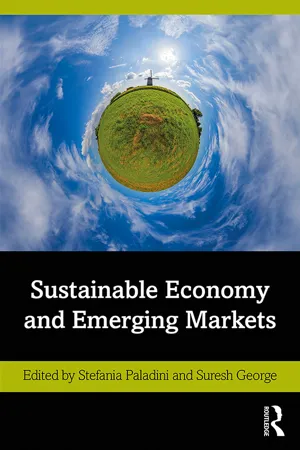
Sustainable Economy and Emerging Markets provides a snapshot of the different dimensions of sustainability and analyses how they interact and configure themselves, case by case, in selected emerging economies. The parameters of economic growth in developing economies are explored in the context of systems, climate change, and environmental challenges.
With contributions from a range of business academics, economists, and practitioners, this book conveys a picture of the complex nature of the new global business environment, especially the geopolitical dynamics of emerging countries, and breaks down the challenges across geographic fault lines, offering insights into current business practice. By adopting an in-depth case study approach, this edited book offers and discusses examples from several emerging markets and elucidates how these organisations have modelled business based on sustainable development in its various forms.
This book will prove valuable reading for students and scholars of international business, international trade, sustainability, and development.
DIMENSIONS OF SUSTAINABILITY IN IMPOVERISHED CONTEXTS IN EMERGING ECONOMIES
Stefanie Beningeri and Matthew Wilsonii
Introduction
Sustainability has emerged as an important topic across industry, academia, and governments alike. The Brundtland Commission’s report, formally called the World Commission on Environment and Development (1987), is often credited with making sustainability – also characterized as sustainable development1 – mainstream: It conceives of sustainable development as a dynamic process focused on four imperatives: safeguarding the environment (the environmental imperative), strengthening cohesion by enabling justice (the social imperative), and securing participation in decision making (the institutional imperative), all of which are sustained by a vibrant economy (economic imperative) (Spangenberg, 2004). These imperatives, with a “core objective … to provide to everybody everywhere and at any time the opportunity to lead a dignified life in his or her respective society” (Spangenberg, 2004, p. 2), are often categorized as dimensions of sustainability. Indeed, most frameworks include the dimensions of economic, environmental, and social sustainability, while others also include an institutional dimension (Labuschagne et al., 2005) and, more recently, a cultural dimension (Soini & Birkeland, 2014). In the literature about sustainability, there is currently no consensus regarding the right number of dimensions (Waas et al., 2011) and frameworks exhibit heterogeneity in their choice and content of dimensions (Labuschagne et al., 2005).
i IE Business School, IE University, Spain
ii Central Michigan University, Marketing and Hospitality Services
Despite a growing interest in evoking concepts of sustainability, an overarching – and holistic – framework on how to approach these contexts is missing. Further, much research on the nexus between business and poverty focuses only on one or two dimensions of sustainability (see Kolk et al., 2014), neglecting the interplay among its various dimensions. Drawing on these five dimensions of sustainability – economic, social, environmental, institutional, and cultural – we intend to present a set of twelve underlying elements of sustainability that can be a useful lens with which to approach business activities in impoverished contexts, an important group in emerging markets. We also explore how the twelve elements of these dimensions relate to research on and practice in impoverished contexts, as well as discussing trade-offs that exist between these dimensions.
In order to provide a practical approach to sustainability, we have sought to strike a balance between generalizability and specificity regarding the twelve underlying elements. These elements go beyond providing a broad overview of the various dimensions of sustainability, while still remaining at a higher level than specific sustainability metrics developed at the company level (such as GRI G4; ISO 26000; SA8000), which can be too detailed and difficult to tailor to a manager’s approach to business in these contexts (Kaptein & Wempe, 2001). Our comprehensive approach is thus specific enough to account for the idiosyncrasies of these contexts while still generalizable enough to the overarching commonalities. Overall, this approach builds on prior work such as London’s (2009) framework of specific sustainability metrics at both local individual and community level, including regarding economics (such as income, debt, and productivity levels), capabilities (such as training and education, health, and morbidity outcomes), and relationships (such as social status and gender equality). This also answers calls to bring a holistic approach to business in poverty (Viswanathan et al., 2009). This is especially important, given the sheer number of those living in impoverished contexts in emerging economies and the related impact on sustainability (Jose, 2008).
Poverty is difficult to quantify, as poverty is a multifaceted phenomenon involving deprivations in money, education, services, health, and security (World Bank, 2018). Nonetheless, the World Bank has collected data through household level data for decades towards quantifying and tracking the phenomenon. They estimate that over 735 million people live in extreme poverty as of 2015, defined as those living on less than $1.90US a day (World Bank, 2018). Even at a higher poverty line, that of $3.20US per day, over 26% of the world’s population falls below that cut off (World Bank, 2018). This finding indicates that approximately 2 billion people worldwide live on less than $3.20US a day.
While poverty affects every region of the globe, almost half of the world’s poor living under this amount reside in South Asia and Sub-Saharan Africa (see Table 1.1), with over a quarter of the world’s poor living in India, and Nigeria coming close to matching that rate (World Bank, 2018). People living under the poverty line are also disproportionately young, where over 60% of the world’s poor are estimated to be under the age of twenty-four years (World Bank, 2018). Those in impoverished contexts in emerging economies generally share several important contextual variables, although experiences vary across regions and at different incomes. These individuals are vulnerable to external shocks due to a lack of consistent access to resources (Hahn, 2009), and tend to pay more for their products and services than those in wealthier contexts do, a phenomenon named the ‘poverty penalty’ (Prahalad, 2005).
TABLE 1.1 Overview of global poverty
Global Region
Regional poverty rates (estimated in 2015)
Number of extreme poor (estimated in 2015)
Total Population (estimated between 2010–2015)
Sub-Saharan Africa
41.1%
413.3 million
1,005.6 million
South Asia
12.4%
216.4 million
1,744.2 million
Middle East and North Africa
5.0%
18.6 million
371.6 million
Latin American and Caribbean
4.1%
25.9 million
626.5 million
Europe and Central Asia
1.5%
7.1 million
487.0 million
East Asia and Pacific
2.3%
47.2 million
2,036.6 million
Rest of the world
0.7%
7.3 million
1,083.6 million
Source: Authors’ elaboration on World Bank data, 2018
Isolation, borne from the lack of infrastructure, can lead to geographical and social exclusion (London, 2009). Although they have little in the way of tangible resources and face unstable incomes (Anderson & Billou, 2007), strong relationship networks provide access to resources (Viswanathan et al., 2014), as do community resources (Beninger & Francis, 2016), such as generationally transmitted traditional knowledge including technical, ecological, and medical know-how and abilities (WIPO, n.d.). However, these contexts can be fraught with a lack of formal institutions, which are typically available to wealthier counterparts, such as access to banks, communication platforms, and energy grids (Prahalad, 2005).
In what follows, we describe the twelve key elements within the five dimensions of sustainability (see Figure 1.1), highlight how each element relates to these contexts, discuss challenges facing managers regarding each element, provide suggestions to overcome these challenges (findings are summarized in Table 1.2), and discuss trade-offs between the dimensions. Ideally, these elements will prompt discussion within organizations on ways to improve sustainability outcomes, as well as contributing to a broadened discussion of sustainability in these contexts in academic literature.
FIGURE 1.1 The five dimensions of sustainability
TABLE 1.2 Potential challenges and solutions for sustainability dimensions
Dimension
Element
Challenges
Possible Solutions
Illustrative
Economic Dimension
Financial performance
Unstable cash flows
Price sensitivity
Appropriate solution with high volume sales
Flexible, low cost, and long-term orientation
Hatton National Bank’s Barefoot
Banker
(Elaydi and Harrison, 2010)
Economic contribution
Pressure for profit
Pressure to maximize profits
Provide income-generating opportunities
Set limits and measure economic contribution
Honey care Africa
Needs Provision
Making presumption
Lack of understanding about needs
Cultivating desires for non-essential or harmful items
Involving local stakeholders
Identifying non-owner-base solutions
The Tanzanian
Federation of the
Urban Poor
(Lindeman, 2014)
Social Dimension
Social equity
Some individual control resources, including information
Social impact assessments
Merit-based hiring and promoting
Reducing pay gaps
Eskom
(UN, 2007)
Social
cohesion
Engage with all community members
Understand differences in power and privilege within communities
Potential lack of trust
Involve those with deep knowledge
Provide training
Increase transparency
Deliver on promises
Coffee producer’s
projects
(Kolk et al., 2014)
Environmental Dimension
Regeneration of natural capital
Few business models designed for regeneration
Pressure to drive down cost
Implement community-based initiatives
La Cruz Habitation Protection Project (Gau et al., 2014)
Preservation of natural capital
Natural resources necessary as inputs
Rethink solutions
Reconfigure supply chains
Azmeraw Zeleke (Beninger & Robson, 2014)
Efficient use of natural capital
Lack of innovations and technologies
Participate in local innovation competitions
Use existing efficient solutions
D. light Solar
Precautionary principle
Lack means to assess risks, future costs and benefits
Urgent need for products and services
Perform risk assessments; cost benefits and uncertainty analyses
Rigorous evaluation processes of inputs
The Body Shop (Jedlicka, 2009)
Institutional Dimension
Participation
Lack of access to global knowledge networks
Cultural biases against board-based participation
Use available communications media
Capabilities focus
Structure organization to facilitate voice
Indian Department of Posts (Vachani & Smith, 2008)
Cultural Dimension
Cultural Heritage
Difficulty knowing what constitutes heritage
Tension between preserving heritage and using it for economic gain
Cultivate cultural understanding
Adopt policies that prioritize protection of heritage
Train and educate stakeholders
Traditional Knowledge Digital Library (Chakravarty, 2010)
Cultural vitality
Lack of knowledge about processes leading to vitality
Pressure to engage in scaling solutions
Take into account local practices
Build flexibility into supply chains
Add local context to solutions
Mozilla (AFP Relaxnews, 2014)
The dimensions of sustainability
As specified above, we present here a comprehensive approach to sustainability, which includes economic, social, environmental, institutional, and cultural dimensions. We will also draw on the existing literature of sustainability to identify a set of twelve underlying elements capturing several of the principles underlying the abovementioned five dimensions of sustainability. These are described in turn below.
(a) The economic dimension
Economic growth and a vibrant economy are often seen as the foundation for other dimensions of sustainability, as they generate wealth, provide employment, and educate (Spangenberg, 2004). Financial performance and economic contribution are the two key elements of the economic dimension. Financial performance refers to the financial stability of an organization and is frequently captured by metrics such as liquidity, profitability, and solvency (Labuschagne et al., 2005). Financial performance has long been a focus of literature related to businesses in general, and in these contexts in particular. However, literature is increasingly focusing on the wider contribution to communities, such as fostering livelihoods and opportunities, sustaining the local economy, and facilitating new buying power (Viswanathan et al., 2009), which are related to the following element: economic contribution.
Economic contribution represents the broader economic impact of an organization on its stakeholders and its local economy (Labuschagne et al., 2005). Economic contribution can be captured by metric...
Table of contents
Cover
Half Title
Title Page
Copyright Page
Table of Contents
List of contributors
Introduction: sustainable economy and emerging markets
PART I
PART II
PART III
Conclusions: many paths to sustainability, an underlying philosophy
Index
Trusted by 375,005 students
Access to over 1.5 million titles for a fair monthly price.
Study more efficiently using our study tools.
Frequently asked questions
Yes, you can cancel anytime from the Subscription tab in your account settings on the Perlego website. Your subscription will stay active until the end of your current billing period. Learn how to cancel your subscription
No, books cannot be downloaded as external files, such as PDFs, for use outside of Perlego. However, you can download books within the Perlego app for offline reading on mobile or tablet. Learn how to download books offline
Perlego offers two plans: Essential and Complete
Essential is ideal for learners and professionals who enjoy exploring a wide range of subjects. Access the Essential Library with 800,000+ trusted titles and best-sellers across business, personal growth, and the humanities. Includes unlimited reading time and Standard Read Aloud voice.
Complete: Perfect for advanced learners and researchers needing full, unrestricted access. Unlock 1.5M+ books across hundreds of subjects, including academic and specialized titles. The Complete Plan also includes advanced features like Premium Read Aloud and Research Assistant.
Both plans are available with monthly, semester, or annual billing cycles.
We are an online textbook subscription service, where you can get access to an entire online library for less than the price of a single book per month. With over 1.5 million books across 990+ topics, we’ve got you covered! Learn about our mission
Look out for the read-aloud symbol on your next book to see if you can listen to it. The read-aloud tool reads text aloud for you, highlighting the text as it is being read. You can pause it, speed it up and slow it down. Learn more about Read Aloud
Yes! You can use the Perlego app on both iOS and Android devices to read anytime, anywhere — even offline. Perfect for commutes or when you’re on the go. Please note we cannot support devices running on iOS 13 and Android 7 or earlier. Learn more about using the app
Yes, you can access Sustainable Economy and Emerging Markets by Stefania Paladini,Suresh George in PDF and/or ePUB format, as well as other popular books in Economics & Business General. We have over 1.5 million books available in our catalogue for you to explore.