![]()
Chapter 1
Introduction
This book seeks to shed new light on how brands are built in Asia through the eyes of those managing, enacting and consuming them. We explore in particular the practical, everyday challenges that surround the development of brands in Asia and how these are addressed not only by Asian-based Chief Executive Officers (CEOs) and their brand marketing reports, but also through the operatives and customers on the ground. The initial idea for this book stemmed from multiple discussions held at the bi-annual Singapore brand conference over the years concerning not just Asian branding per se, but also on what we felt was missing in the published literature to date. Seeking – in what follows – to balance the often abstract, top-down perspectives which tend to populate the branding literature, we emphasize the lived experiences of those at the organization-customer interface. Exploring both the narratives of consumers and, in particular, the neglected front-line employees (whose attitudes and behaviours can make or break the brand promise), our hope is that we can unravel and better understand the challenges of building brands in Asia (e.g. Baladi, 2011; Roll, 2015; Temporal, 2001).
Our understanding of brands and how they are (and should be) built has grown and evolved markedly over the past decade. From its roots in product marketing, the notion of the brand has metamorphosed in recent years to become not only the most valuable asset the corporation possesses, but also the sentinel behind which – and through which – the integrated organizational strategy is enacted. In some respects this embodies the shift in perspective, which assumes branding to be an enclave of marketing to one where marketing is seen as an enclave of branding. Accordingly, rather than focusing on the building of brands through slick, seductive imaging the gathering view is that the marketing function, while still critical, constitutes but one side of the overall endeavour – specifically the external branding (or imaging) function centred at the organization-customer interface. But a particular problem with this old – though still prevalent – ‘image-led’ approach is that the marketing department – often with a brand agency in tow – risks putting out slick, highly attractive copy embedded with promises which the organization cannot then deliver on due to a lack of requisite commitment, understanding or even knowledge among those charged with enacting the promise from within. Promises made fall by the wayside. And so far as the building of trust is concerned there is nothing worse than the broken promise.
In recent times, branding has thus come to be seen as more than just customer marketing, more than just images created in the minds of advertisers (informed by market research). Indeed, it has been claimed recently that the brand represents the heart and soul of the venture – the beginning, the middle and the end of everything the company is and can become (Aaker, 2010; Baladi, 2011), targeting stakeholders both inside and out and infusing and influencing organizational activities from top to bottom (Hatch and Schultz, 2008).
From this perspective, as an organization-wide preoccupation, branding needs to incorporate the engagement of employees, who are more often than not these days referred to as the true source of brand equity creation and the foundation for a strong and sustainable brand. Building brands from within in this manner – often termed as the identity approach where the assumption is identity precedes image (e.g. Burmann, Jost-Benz and Riley, 2009) – involves uniting employees behind a common ‘higher purpose’ embedded in the brand’s mission, one which goes far beyond money-making for the owners. This purpose then needs to be grounded in values to which employees (and all other internal stakeholders) are committed to championing, both in their thoughts and deeds before the brand’s promise is communicated outside. In this way, what is projected outwards will be an authentic representation of what the organization represents, of who the organization is. This is becoming increasingly essential in this era of transparency and choice.
As Baladi (2011) argues, companies often live or die on the basis of a single equation – promise and delivery, founded on the relevance and attractiveness of the former plus the consistency inherent in the latter. So whereas nothing that is important and valuable is easy to deliver, brands built from within are more likely to acquire a competitive advantage which is sustainable by means of building a strong brand whose positioning (re: customer loyalty, high market share and price premium) then extremely difficult for competitors to threaten or copy (Burmann, Zeplin and Riley, 2009).
Sadly, however, the transformation in our understanding of how brands should be built which encompasses the ‘brand identity’ approach has, to date in Asia, gained only moderate traction. Branding across the Asian continent – and particularly within the emerging markets of the Association of South East Asian Nations (ASEAN) – remains synonymous with advertising or logo design, a mere appendage to the ongoing business. This, in turn, continues to reflect a predominantly outside-in approach that assumes that brand equity originates exclusively from the brand knowledge of buyers, with marketers as the sole and rightful custodians of its development. In short, Asian brands continue to over-promise and under-deliver (Baladi, 2011).
Despite the growing acceptance of the need to build trust by keeping one’s word, there is very little attention paid to date to who, where, why, how this can or should actually occur, or with the challenges faced at the ‘coalface’ by those charged with enacting the brand experience day by day. For Asian companies, as well as for the Asian-based subsidiaries of well-developed international brands, the challenges of getting employees in Asia ‘on-brand’ and on message in creating a stronger internal corporate culture remains formidable and, moreover, under-explored. As one executive told us, ‘style over substance’ is ‘endemic’.
Executives building brands in Asia thus continue to experience major challenges with regard to differentiation and consistency. The major works to date on branding in Asia have focused on the role and import of Asian CEOs (e.g. Baladi, 2011; Roll, 2015; Temporal, 2001) on whom, as with corporate leaders generally, brand-oriented employee behaviour is predominantly initiated (Burmann, Zeplin and Riley, 2009). In general terms, such leaders need to champion their brands, ‘conveying their passion to employees, customers, suppliers and all stakeholder groups’ (Hitchens and Hitchens, 2014: 65). Yet aside from a relatively small (albeit growing) number of exceptional brand leaders, Asian CEOs as a whole are typically charged with hampering the building of robust brands due to a range of reasons that include misunderstanding, ignorance, invisibility, secrecy, subordinate management behaviour and so forth. Misunderstanding and ignorance concerns the tendency to equate brands with logos and packaging, a trait, which suffuses not only many agencies and consultancies within the region, but also business education, acculturating young minds into the dated dogma that branding is exclusively a ‘marketing topic’. The vision and discipline needed to build a strong brand thus tends to fall by the wayside in favour of the more traditional pursuit of opportunity wheresoever, howsoever, whensoever it should arise. Sacrificing the chance of short-term profit for something as inherently intangible, conceptual, invisible as brand identity/image is seen as laughable, a view that has proven difficult to shift over the years, even today.
In accounting for the continuing challenges of building brands in Asia, however, this ‘ignorance’ observed among the traditional Asian CEOs provides by no means the whole story. For example, even where they exhibit a clear and robust understanding of the holistic principles of brand development, the core brand tenets and values often never reach where they need to reach – especially (for services brands) among the frontline and other base-of-pyramid employees – where Western notions of empowerment and participation remain merely ‘notions’. Partly – as we shall return to below – this can be seen as a deep cultural characteristic of organizations in Asia where the traditional command and control business management style (where managers feel they lose face if soliciting the opinions of those ‘beneath’ them) often fails to encourage members of a company to work together. In this context, belief is often lacking, as is knowledge and understanding of what the brand is all about, as employees lower down feel discouraged to express themselves and remain disconnected from the organization.
Overall, then, CEOs in Asia are only one part of a wider issue and for an increasing number of companies (especially Western-headquartered) multinational corporations (MNCs) this may no longer be the critical issue at all. For sure, company leaders are there to ‘head-up’ the enterprise in a way that provides more than window dressing (Hatch and Schultz, 2008). But they cannot build a company on their own. As we’ve often found as consultants, the problem often lies deeper on inside the company, especially among the middle and lower levels of the hierarchy. Throughout this book we try to address this current gap in insight by uncovering some of the critical but, to date, neglected areas affecting frontline brand delivery consistency in Asia, the so-called ‘moments of truth’ where trust and loyalty can be gained and lost.
Two of these, barely touched on in prior texts, concern the impact of social and economic inequality on the one hand and indigenous cultural conventions and values on the other. Concerning the former, across much of emerging and transitional Asia (in particular) income levels are notoriously low at the base of the organizational hierarchy, a combination of usually miniscule GDP per capita and a high level of intra-nation economic inequality. This is reflected not only in low wages and benefits but also inadequate education levels and poor health which together can cause a raft of challenges affecting work absenteeism, job performance corruption and – ultimately – brand delivery consistency. Added to this is the collectivist, particularist nature of Asian culture in which low-level staff, locked in organizational silos (typically by department) under a patriarchal, autocratic head are unable and, or, unwilling to be the kind of brand ambassadors many MNCs would like them to be. This can be pervasive across much of the Asian region, whether in the emerging primarily agrarian countries of the Greater Mekong Subregion or the mature economies of Japan, Korea and even Singapore. Within this context, the idea of the engaged, empowered employee (or ‘brand ambassador’) bringing the brand to life and creating strong touchpoint experiences for customers often remains a fantasy. Despite the years of reported Asian companies breaking out of their traditional ‘original equipment manufacturer’ (OEM) moulds and developing their own brands, the discipline of internal brand engagement lower down the pyramid is still very much in its infancy. As a consequence, little effort is given to build from within a brand culture to which logos and straplines give expression (rather than the other way around).
Based on the relatively long, intermittent development of this book, what follows has been informed significantly by multiple, inter-related, sources of evidence and material. To begin with, we have interviewed a host of brand marketing executives, junior operatives and, crucially, customers and consumers from across the region. Their opinions, provocations and perceptions are what drive the book, both in the main body of the text and in the myriad of the boxed cases and vignettes along the way. We also amassed and collated ‘secondary source’ information from newspaper cuttings, notes from speeches and chats/discussions we had, academic journal papers, magazine articles from across Asia, company communication (both internally- and externally-directed), books and internet sources.
Finally, as the lens through which the above was filtered and organized we drew progressively on our own combined half-century of knowledge and experience of brands and branding in Asia, drawn from the interlocking worlds of academia, practice, consultancy and consumption. To give a rich, detailed account, this combined effort is often reflected in use of a collective ‘I’ throughout. Borne on these sources, and this approach, this book is designed as an informative guide to students, practitioners and the interested general reader with an interest in Asia-based brand building, either intrinsically or as part of their career.
Promising the earth: the wolves at Shangri La
Holding people’s attention to anything for thirty uninterrupted seconds is never easy in this age of fragmented, internet-fuelled instant (media) gratification. Holding one’s attention to a commercial this long is no exception and it requires the skill, ingenuity and creativity of brand marketing agencies (as well as a reminder of the import of the marketing function generally). A recent television advertisement shown on the international news networks provides a good example of how this can be achieved. Crucially, it also demonstrates clearly the scale of the challenge in delivering on the promise the commercial makes.
Here’s how it looked to us: An intrepid, explorer-type man trudges along in deep snow alongside a hillside forest. His suffering appears authentically rendered. He’s tiring visibly, he’s frostbitten, he’s struggling. It looks like a trailer for some reality survival show. Then, all of a sudden, the danger of the situation to hand is made clear as the camera switches back and forth from this seemingly lost, disoriented man to an increasingly interested, expectant pack of wolves, seemingly biding their time before moving in for the kill (and a welcome meal). Progressively the haggard, exhausted figure weakens. Then he staggers. Then he falls. The camera cuts to the wolves who make their move. Then it cuts to black. Time out.
To our surprise – as well as, apparently, to the man’s – the next time we see him he’s slowly sitting up, he’s alive, he’s unharmed. The surprise is then compounded by the reason thereof, for rather than having savaged him, the wolves have actually saved his life through their body warmth, bedding down around him in order to keep him alive as a member of their pack. It’s heart-warming stuff, but by this time of course we’re really just wondering ‘what the hell is this all about?’
Then along comes the answer in the form of two straplines from either side of the screen, followed by the logo. The first reads, ‘to embrace a stranger as one’s own …’ and the second reads ‘… it’s in our nature’. And then, finally, the logo, the realization: Shangri-La Hotels and Resorts.
Credit where it’s due, eh? It’s a good commercial, it works. But that isn’t the reason we’re describing it to you. We’re highlighting it here because of the promise that it embodies – critically illustrative in appreciating the challenges involved in keeping the promise-delivery equation intact across Asia. Concerning the content of the promise, what we understood this to be concerns the warmth of the experience you will receive as well as the luxury and prestige you would associate with Shangri-La. To us, it helps to dispel the often intimidating prospect of the traditional ‘high end’ hotel with its aloofness and frigidity with the ‘you’re now one of us’ mantra, that you’ll be ‘one of our family’. Implicitly the collective, the group, to which you’re being welcomed and embraced is a positive, welcoming, caring experience, a promise which is delivered from within, naturally, effortlessly, authentically.
Regarding the nature of the promise, two things stand out above all others. The first concerns the extent because, by any reckoning, it’s a BIG promise. It serves to both expand and cement expectations for any Shangri-La and any connection with its brand, and that means anywhere across Asia and anywhere across the world. Secondly, it can only be kept and delivered primarily through the frontline employees. For these will be your Shangri-La family – not the General Manager, nor the marketing director, nor the publicity manager or the agency making you these promises. These you only get to meet – let’s be honest – when there is a problem. So it’s really then the maids, the front desk, the catering staff, the security guards. And the thing about these frontliners is that they’re often the lowest paid, least educated members of the staff. It’s also more likely in emerging and transitional Asia they’ve have never stayed in any hotel – not just the Shangri-La, not just any 5-star hotel but ANY hotel, period. Such is the challenge of building brands here in developing Asia.
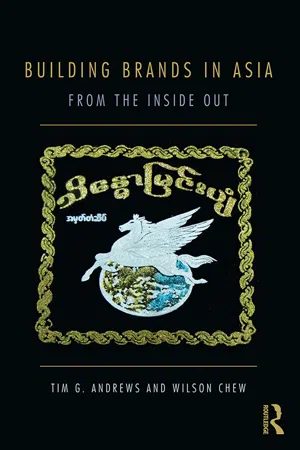
This is not the first book on branding in Asia. It won’t be the last. Nonetheless, however, this current text embodies an approach that affords us several points of departure from the existing literature. Aside from the ‘frontline promise-delivery’ emphasis that threads through the pages that follow, the second major difference concerns our regional centres of gravity (as embodied in our choice of book cover discussed below). The Asian continent – to cite a now well-worn depiction – has become THE global battleground for brands of all origins. But given the vast, dynamic, diverse entity that is ‘Asia’ no single book on branding (or theology, venomous snakes or anything else) can ever hope to do justice to a region at once so large and diverse. In other words, there will always be a trade-off to be made in terms of breadth versus depth, in terms of the industries, countries drawn upon in illustration and peoples referred to. Furthermore, in highlighting the delivery of the brand promise as the key avenue to building trust and loyalty, in focusing on the micro-challenges giving rise to the anecdotal evidence of necessity, we are foregrounding our own areas of experience over those areas where our work has been more infrequent.
Accordingly, while continuing to draw on the ‘standards’ (as well as new cases) from Japan, Korea, India, China and so forth, we also take the road less travelled to focus on ASEAN as a fresh, under-researched centre of gravity. Using the twin epicentres of Thailand and Singapore, our bases for investigation, we are well placed for an on-the-ground account spanning not only the world’s most expensive city but also the Siamese hub of the Greater Mekong Subregion (Asia’s ‘last investment frontier’). This positions us at the timely cusp of a major shift in attention in Asia, opening a door on the changes afoot as a result of the coming onstream of the ASEAN Economic Community. Furthermore, we adopt a ‘dual’ perspective on organizational actors in the sense that we explore not just Asian brands but also external – particularly Western – players developing and managing their brands in the region, exploring the often varied and complex challenges they face.
Finally, and as stated from the outset, stylistically we wished to move away from the ‘best-principles-in-practice’ (‘star’) illustrations in order to focus more on the realities of brand delivery day by day, not only where this has gone well but also where principles were not adhered to and where mistakes were made to be learned from. In t...