eBook - ePub
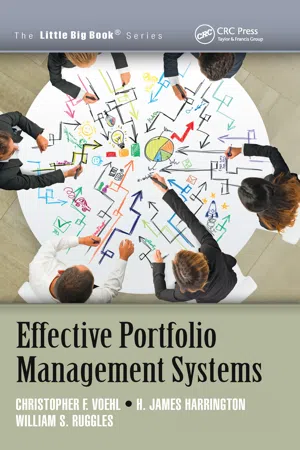
Effective Portfolio Management Systems
- 190 pages
- English
- ePUB (mobile friendly)
- Available on iOS & Android
eBook - ePub
Effective Portfolio Management Systems
About this book
With an estimated 70 percent of new projects failing to add value to the organization, reducing project failure rate represents one of the biggest improvement opportunities available today. This book highlights proven approaches designed to separate the successful projects from the potential losers before the projects are started. This represents h
Chapter 1
Overview of Organizational Portfolio Management
Introduction
I have too few resources and too many new projects. How can I possibly keep the present commitments that are being made by our sales force and still assign the resources required to support the new projects that are going to drive our future? I need to keep our delivery commitments to our present customers as my top priority or we won’t have customers when the new projects are completed.
We hear this comment over and over and, when we don’t hear it, it is because they are thinking it, but don’t want to say it. New projects are the lifeblood of most organizations. Without them the organization has little or no future.
Once we opened up the world as our customers, we also opened up organizations around the world as our competition. This has resulted in the highly competitive research activities that have resulted in extremely short product cycles. Many of our best-known and most productive organizations depend upon technology as their edge against competition. However, in today’s environment, technology can be picked up and transferred around the world in a matter of hours resulting in very little competitive advantage. Where technology and the latest software applications used to be considered a competitive advantage, it now is a requirement to keep from becoming noncompetitive. As a result, there has been a great deal of pressure to reduce project cycle times and greatly improve the percentage of projects that are completed successfully. The organizations that are the most successful today are the organizations that can create new concepts on demand, minimize the time from concept to delivery, and have the highest percentage of projects that are successful.
Many people are promoting the idea that we learn from our failures. That’s a good concept, but if it’s the one you are using, let’s hope you don’t spend a significant portion of your resources learning instead of succeeding.
Once we increased the emphasis on innovation, which has resulted in more projects being introduced into our systems with increased requirements for implementing them in shorter periods of time, the importance of effective management of these projects became a key element for successful organizations. With this increased emphasis on efficient and effective project management activities, the concept of Organizational Portfolio Management became a key element in an organization’s competencies. The purpose of this book is to highlight effective, proven approaches to maximize the quantity and caliber of the innovative concepts that successfully complete the process from business plan to external positive results based on the resource limitations within the organization. This requires a continuous focus on optimizing the resource usage consumed by the Organizational Portfolio that is going on within the organization.
In order to eliminate any confusion, we are employing the following definitions of key terms used. (Appendix A is a complete list of definitions and acronyms that are commonly used throughout this book.)
- Business Case: A business case captures the reason for initializing a project or program. It is most often presented in a well-structured written document, but, in some cases, also may be in the form of a short verbal argument or presentation. The logic of the business case is: Whenever resources, such as money or effort, are consumed, they should be in support of a specific business need or opportunity.
- Manager: A manager is an individual who accomplishes an assigned task through the use of other individuals to whom the work is delegated.
- Organizational: This refers to those activities, projects, programs, processes, and systems that apply to the total organization, not just one or two departments or units.
- Organizational Portfolio: A collection of the organization’s projects, programs, subportfolios, and operations managed as a group to achieve strategic objectives. Projects and programs may work independently, but they are often linked to the organization’s strategic plan. An individual organizational portfolio can contain all of the organization’s active projects and/or programs or a portion thereof.
- Organizational Portfolio Management (OPM): The combined coordination and management of all the active projects/programs to maximize the value they add to the organization by continuously monitoring their progress, prioritizing work, and allocating resources. It refers to the combined activity of all the active portfolios and independent projects going on within the organization and the improvement of the organization’s capability linking Project/Program/Portfolio Management with organizational facilitators (structural, cultural, technological, Human Resources practices) to support strategic goals. To apply this methodology, organizations must first measure existing capabilities, then plan and implement the improvements.
- Organizational Portfolio Manager: The individual that is assigned to manage the organization’s Portfolio leaders. The individual is held responsible for Organizational Portfolio Management activities. In organizations that have a project office, this individual is often referred to as the project office manager.
- Organizations: Systematic arrangements of entities (people, departments, companies, divisions, teams, agencies, etc.) aimed at accomplishing a purpose, which may involve undertaking projects. They often are documented in an organization chart that shows the relationships of the individual organization to the total organization.
- Portfolio Leader: A senior project manager qualified and appointed to lead multiple concurrent programs and/or projects. Portfolio leader roles are typically project managers with years of demonstrated success organizing and managing projects/programs. Some organizations call this individual a Portfolio manager. They serve as one part of the total Organizational Portfolio Management activities.
- Portfolio Steering Committee: An executive committee that is responsible for overseeing all the active projects/programs. All major changes in timing, funding, and an output from the project process need to be approved by this committee.
- Process: It is a series of interrelated actions and/or tasks performed to create a prespecified product, service, or result. Each process is comprised of inputs, outputs, tools, and techniques, with constraints (environmental factors), guidance, and criteria (organizational process assets) taken into consideration.
- Program: A group of related projects, subprograms, and program activities managed in a coordinated way to obtain benefits not available from managing them individually. May include work outside the scope of projects within it. A program will always have projects.
- Program/Project Management: The application of tasks/tools/techniques and skills/knowledge to meet program requirements, to obtain benefits and control not available from managing them individually. It is harmonizing projects and program components, controlling interdependencies to achieve benefits outlined in the business case and...
Table of contents
- Preface
- Acknowledgments
- About the Authors
- Chapter 1 - Overview of Organizational Portfolio Management
- Chapter 2 - Phase I: Develop the Organizational Portfolio
- Chapter 3 - Phase II: Create the OPM System Implementation Plan
- Chapter 4 - Phase III: Implement the OPM System
- Chapter 5 - Phase IV: Change Management—Practical Applications within OPM
- Appendix A: Project and OPM Definitions
- Appendix B: Potential Project and OPM/PPM Resources
- Appendix C: Sample Project Authorization Form (PAR)
Trusted by 375,005 students
Access to over 1.5 million titles for a fair monthly price.
Study more efficiently using our study tools.
Frequently asked questions
Yes, you can cancel anytime from the Subscription tab in your account settings on the Perlego website. Your subscription will stay active until the end of your current billing period. Learn how to cancel your subscription
No, books cannot be downloaded as external files, such as PDFs, for use outside of Perlego. However, you can download books within the Perlego app for offline reading on mobile or tablet. Learn how to download books offline
Perlego offers two plans: Essential and Complete
- Essential is ideal for learners and professionals who enjoy exploring a wide range of subjects. Access the Essential Library with 800,000+ trusted titles and best-sellers across business, personal growth, and the humanities. Includes unlimited reading time and Standard Read Aloud voice.
- Complete: Perfect for advanced learners and researchers needing full, unrestricted access. Unlock 1.5M+ books across hundreds of subjects, including academic and specialized titles. The Complete Plan also includes advanced features like Premium Read Aloud and Research Assistant.
We are an online textbook subscription service, where you can get access to an entire online library for less than the price of a single book per month. With over 1.5 million books across 990+ topics, we’ve got you covered! Learn about our mission
Look out for the read-aloud symbol on your next book to see if you can listen to it. The read-aloud tool reads text aloud for you, highlighting the text as it is being read. You can pause it, speed it up and slow it down. Learn more about Read Aloud
Yes! You can use the Perlego app on both iOS and Android devices to read anytime, anywhere — even offline. Perfect for commutes or when you’re on the go.
Please note we cannot support devices running on iOS 13 and Android 7 or earlier. Learn more about using the app
Please note we cannot support devices running on iOS 13 and Android 7 or earlier. Learn more about using the app
Yes, you can access Effective Portfolio Management Systems by Christopher F. Voehl,H. James Harrington,William S. Ruggles in PDF and/or ePUB format, as well as other popular books in Business & Business General. We have over 1.5 million books available in our catalogue for you to explore.