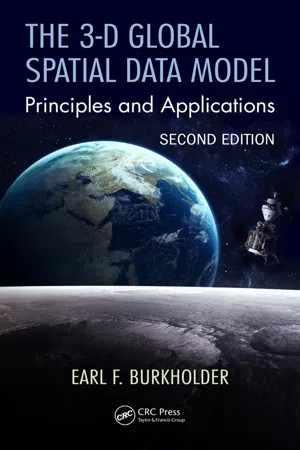
Traditional methods for handling spatial data are encumbered by the assumption of separate origins for horizontal and vertical measurements, but modern measurement systems operate in a 3-D spatial environment. The 3-D Global Spatial Data Model: Principles and Applications, Second Edition maintains a new model for handling digital spatial data, the global spatial data model or GSDM. The GSDM preserves the integrity of three-dimensional spatial data while also providing additional benefits such as simpler equations, worldwide standardization, and the ability to track spatial data accuracy with greater specificity and convenience. This second edition expands to new topics that satisfy a growing need in the GIS, professional surveyor, machine control, and Big Data communities while continuing to embrace the earth center fixed coordinate system as the fundamental point of origin of one, two, and three-dimensional data sets. Ideal for both beginner and advanced levels, this book also provides guidance and insight on how to link to the data collected and stored in legacy systems.
eBook - ePub
The 3-D Global Spatial Data Model
Principles and Applications, Second Edition
- 492 pages
- English
- ePUB (mobile friendly)
- Available on iOS & Android
eBook - ePub
About this book
Information
1
The Global Spatial Data Model (GSDM) Defined
Introduction
Geospatial data representing real-world locations are three dimensional (3-D), and modern measurement systems collect data in a physical 3-D environment. Time as the fourth dimension is acknowledged, but this book focuses on 3-D data. This chapter defines and describes the Global Spatial Data Model (GSDM) as a collection of mathematical concepts and procedures that can be used to collect, organize, store, process, manipulate, evaluate, and use 3-D spatial data. Although the terms “spatial data” and “geospatial data” are often used interchangeably, spatial data are those generic data that describe the size and shape of an object while geospatial data are referenced to planet Earth. It can be argued that geospatial data are a special category of spatial data. It can also be argued that spatial data are a subcategory of geospatial data. While the default context of the GSDM is geospatial data, the geometrical and mathematical properties of spatial data are essentially the same as for geospatial data.
Measurements of quantities such as angles, length, time, current, mass, and temperature are used with known physical and geometrical relationships to compute spatial data components that are stored for subsequent use and reuse. In the past, records of such measurements were written in field books, logs, or journals, and the spatial information was compiled into an analog map that typically served two purposes. The map was simultaneously the primary storage medium for the spatial information and the end product of the data collection process. Spatial data are now collected, stored, and manipulated digitally in an electronic environment, and the primary storage medium is rarely the end product. Instead, the same digital data file can be duplicated repeatedly and used to generate and/or support many different spatial data products. In either case, whether developing an analog or digital spatial data product, algorithms are the mathematical rules used to manipulate measurements and spatial data to obtain meaningful spatial information. In addition, the quality of spatial information is dependent upon the quality of the original...
Table of contents
- Cover
- Halftitle Page
- Title Page
- Copyright Page
- Dedication Page
- Contents
- Preface to the Second Edition
- Preface to the First Edition
- Acknowledgments
- Author
- List of Abbreviations
- Introduction
- Chapter 1 The Global Spatial Data Model (GSDM) Defined
- Chapter 2 Featuring the 3-D Global Spatial Data Model
- Chapter 3 Spatial Data and the Science of Measurement
- Chapter 4 Summary of Mathematical Concepts
- Chapter 5 Geometrical Models for Spatial Data Computations
- Chapter 6 Overview of Geodesy
- Chapter 7 Geometrical Geodesy
- Chapter 8 Geodetic Datums
- Chapter 9 Physical Geodesy
- Chapter 10 Satellite Geodesy and Global Navigation Satellite Systems
- Chapter 11 Map Projections and State Plane Coordinates
- Chapter 12 Spatial Data Accuracy
- Chapter 13 Using the GSDM to Compute a Linear Least Squares GNSS Network
- Chapter 14 Computing Network Accuracy and Local Accuracy Using the Global Spatial Data Model
- Chapter 15 Using the GSDM–Projects and Applications
- Appendix A: Rotation Matrix Derivation
- Appendix B: 1983 State Plane Coordinate Zone Constants
- Appendix C: 3-D Inverse with Statistics
- Appendix D: Development of the Global Spatial Data Model (GSDM)
- Appendix E: Evolution of Meaning for Terms: Network Accuracy and Local Accuracy
- Index
Trusted by 375,005 students
Access to over 1.5 million titles for a fair monthly price.
Study more efficiently using our study tools.
Frequently asked questions
Yes, you can cancel anytime from the Subscription tab in your account settings on the Perlego website. Your subscription will stay active until the end of your current billing period. Learn how to cancel your subscription
No, books cannot be downloaded as external files, such as PDFs, for use outside of Perlego. However, you can download books within the Perlego app for offline reading on mobile or tablet. Learn how to download books offline
Perlego offers two plans: Essential and Complete
- Essential is ideal for learners and professionals who enjoy exploring a wide range of subjects. Access the Essential Library with 800,000+ trusted titles and best-sellers across business, personal growth, and the humanities. Includes unlimited reading time and Standard Read Aloud voice.
- Complete: Perfect for advanced learners and researchers needing full, unrestricted access. Unlock 1.5M+ books across hundreds of subjects, including academic and specialized titles. The Complete Plan also includes advanced features like Premium Read Aloud and Research Assistant.
We are an online textbook subscription service, where you can get access to an entire online library for less than the price of a single book per month. With over 1.5 million books across 990+ topics, we’ve got you covered! Learn about our mission
Look out for the read-aloud symbol on your next book to see if you can listen to it. The read-aloud tool reads text aloud for you, highlighting the text as it is being read. You can pause it, speed it up and slow it down. Learn more about Read Aloud
Yes! You can use the Perlego app on both iOS and Android devices to read anytime, anywhere — even offline. Perfect for commutes or when you’re on the go.
Please note we cannot support devices running on iOS 13 and Android 7 or earlier. Learn more about using the app
Please note we cannot support devices running on iOS 13 and Android 7 or earlier. Learn more about using the app
Yes, you can access The 3-D Global Spatial Data Model by Earl F. Burkholder in PDF and/or ePUB format, as well as other popular books in Technology & Engineering & Data Mining. We have over 1.5 million books available in our catalogue for you to explore.