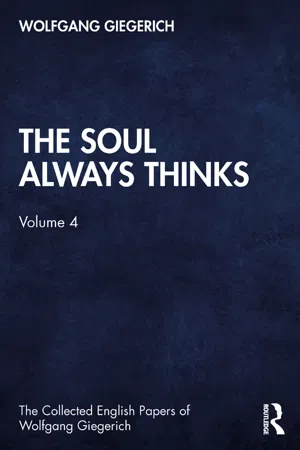
C. G. Jung regarded the soul to be a reality in its own right which reflects itself in all manner of images and events. symbols and traditions. In this fourth volume of his Collected English Papers, Giegerich recalls the soul to the inwardness of its own home territory by bringing out the thought-character of the self-creating, self-unfolding logical life that it is. In addition to clarifying what thought means for psychology and analyzing certain misconceptions surrounding the topic of "soul and thought" a challenging thesis concerning the limitation of an imaginal, "anima-only" approach in psychology (given the essential historicity of the soul) is carefully argued, while examining at the same time such topics as "the end of meaning and the birth of man," "anima mundi and time", "the metamorphosis of the gods," and the logical steps involved in the transition from childhood to adulthood and from a psychological oneness with nature to modern alienation from nature. The book also discusses the notion of the soul's logical life and shows in action the psychological procedure of "absolute-negative interiorization" of phenomena into their soul and truth in a number of in-depth examinations of particular phenomena (e.g. Heraclitus' dictum about the soul's depth, the "leap into the solid stone," the negativity of the "stone which is not a stone"). In thorough-going critical engagements with other authors in the field, it demonstrates specific instances where psychology fails to do its job due to faulty presuppositions, above all psychology's failure to face the modern world. It emphasizes the active role of the mind in soul-making as the making of psychic reality. It addresses the questions of the future of psychology and whether progress in psychology is possible.
- 620 pages
- English
- ePUB (mobile friendly)
- Available on iOS & Android
eBook - ePub
About this book
Information
Table of contents
- Cover
- Half Title
- Title Page
- Copyright Page
- Table of Contents
- Acknowledgments
- Sources and Abbreviations
- Introduction: “Thought”: Some Signposts
- Chapter One: The Lesson of the Christmas Tree1
- Chapter Two: The Rescue of the World
- Chapter Three: Effort? Yes, Effort!
- Chapter Four: Shalt thou build me an house for me to dwell in? Or: Anima mundi and Time. A response to Hillman’s “Cosmology for Soul. From Universe to Cosmos”
- Chapter Five: The Dignity of Thought: In Defense of the Phenomenon of Philosophical Thought
- Chapter Six: Is the Soul ‘Deep?’–Entering and Following the Logical Movement of Heraclitus’ ‘Fragment 45’
- Chapter Seven: The Leap Into the Solid Stone
- Chapter Eight: The Future of Psychology: Its Going Under
- Chapter Nine: The End of Meaning and the Birth of Man. An essay about the state reached in the history of consciousness and an analysis of C.G. Jung’s psychology project
- Chapter Ten: The Soul as Axis of the World
- Chapter Eleven: The Movement of the Soul
- Chapter Twelve: Psychology - The Study of the Soul’s Logical Life
- Chapter Thirteen: The Ego-Psychological Fallacy A note on “the birth of the meaning out of a symbol”
- Chapter Fourteen: Once More “The Stone Which is Not a Stone.” Further Reflections on “Not”
- Chapter Fifteen: “By Its Colorful Tunes the Lark Blissfully Climbs Up Into the Air.” A Few Reflections on Soul- Making as the Making of Psychic Reality
- Chapter Sixteen: Irrelevantification. Or: On the Death of Nature, the Construction of “the Archetype,” and the Birth of Man
- Chapter Seventeen: “The Unassimilable Remnant”: What is at Stake? A Dispute with Stanton Marian
- Chapter Eighteen: Imaginal Psychology Gone Overboard: Michael Vannoy Adams’ ‘Imaginology’ A Defense of the Image Against the Detraction by its Devotees
- Chapter Nineteen: Psychologie Larmoyante: Glen Slater, For Example. On Psychology’s Failure to Face the Modern World
- Chapter Twenty: Jung’s Idea of a Metamorphosis of the Gods and the History of the Soul
- Chapter Twenty-One: There Is Psychological Progress. Can There Be Progress of Psychology?
- Index
Trusted by 375,005 students
Access to over 1.5 million titles for a fair monthly price.
Study more efficiently using our study tools.
Frequently asked questions
Yes, you can cancel anytime from the Subscription tab in your account settings on the Perlego website. Your subscription will stay active until the end of your current billing period. Learn how to cancel your subscription
No, books cannot be downloaded as external files, such as PDFs, for use outside of Perlego. However, you can download books within the Perlego app for offline reading on mobile or tablet. Learn how to download books offline
Perlego offers two plans: Essential and Complete
- Essential is ideal for learners and professionals who enjoy exploring a wide range of subjects. Access the Essential Library with 800,000+ trusted titles and best-sellers across business, personal growth, and the humanities. Includes unlimited reading time and Standard Read Aloud voice.
- Complete: Perfect for advanced learners and researchers needing full, unrestricted access. Unlock 1.5M+ books across hundreds of subjects, including academic and specialized titles. The Complete Plan also includes advanced features like Premium Read Aloud and Research Assistant.
We are an online textbook subscription service, where you can get access to an entire online library for less than the price of a single book per month. With over 1.5 million books across 990+ topics, we’ve got you covered! Learn about our mission
Look out for the read-aloud symbol on your next book to see if you can listen to it. The read-aloud tool reads text aloud for you, highlighting the text as it is being read. You can pause it, speed it up and slow it down. Learn more about Read Aloud
Yes! You can use the Perlego app on both iOS and Android devices to read anytime, anywhere — even offline. Perfect for commutes or when you’re on the go.
Please note we cannot support devices running on iOS 13 and Android 7 or earlier. Learn more about using the app
Please note we cannot support devices running on iOS 13 and Android 7 or earlier. Learn more about using the app
Yes, you can access The Soul Always Thinks by Wolfgang Giegerich in PDF and/or ePUB format, as well as other popular books in Psychology & Mental Health in Psychology. We have over 1.5 million books available in our catalogue for you to explore.