- 200 pages
- English
- ePUB (mobile friendly)
- Available on iOS & Android
eBook - ePub
About this book
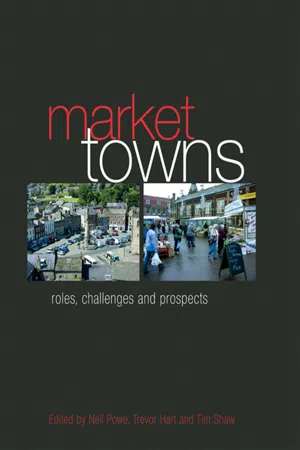
Original and insightful, this volume, giving in-depth consideration to the key issues affecting the future of market towns, provides readers with a framework for evaluating policy initiatives and progress in market towns.Through a detailed analysis of the characteristics of over 200 towns and in-depth studies of eleven towns in different parts of E
Information
Chapter 1
The challenges of understanding market towns
Introduction
Say the phrase ‘market town’ and it conjures up a place that teenagers would probably find boring, but their parents or grandparents would probably find comfortable or welcoming. These forty-year-olds and over are the people who help to put such towns on the lists of most desirable places to live in lifestyle surveys. But, if they are so desirable, why, as has been the case for much of the past decade, should these same market towns have become the focus of government policy initiatives to regenerate rural areas? Places in need of regeneration are rarely seen as desirable places to live and come at the opposite end of the spectrum in the same lifestyle surveys. These apparent contradictions provide an impetus for this book, which seeks to understand the similarities and differences between the many places that have come to be encompassed by the term ‘market town’, and to identify the trends and forces that are shaping them. This can then contribute to the development of policy for market towns, a better understanding of the impacts of policy, and help build a picture of what the future may hold for the towns.
In spite of a long-established policy to protect the countryside from development, rural areas have experienced growing populations, a trend often attributed to the catch-all term ‘counter-urbanisation’. So, ‘although professional and political opinion favours accommodating housing growth in cities, where the release of land is least controversial, the strongest demand for housing is in the very opposite types of locations, where the pressure not to build is at its most intense’ (Buller et al. 2003: 5). Market towns have participated in this trend and Champion and Fielding (1992: 2) have observed that these flows of population ‘have added small estates of owner occupied detached houses to small- and medium sized free-standing towns’, a description that encompasses those places identified as ‘market towns’. While functional motivations – such as taking up new employment – are part of the migration decisions that are driving this trend, moving to the countryside is often a ‘lifestyle’ choice.
Opportunities for exercising such a lifestyle choice have been enhanced through a combination of factors, perhaps the most fundamental of which relates to transport. With rising levels of car ownership, and the costs of motoring falling as a proportion of disposable income (DfT 2005), urban residents are able to widen their search for a residential location that offers the physical and social qualities they seem to prefer (Halfacree 1994). This greater mobility has facilitated the enjoyment of both a rural residence and the services available in larger urban areas, and contributed to the development of a less contained lifestyle, with many rural residents travelling significant distances for shopping and employment (SERRL 2004).
This increasing mobility, which has helped bring growth to market towns, also presents them with a challenge, in that they now have to compete for custom for the services that they have traditionally provided for local and hinterland residents. The strength of this challenge has been amplified by trends in retailing, which has increasingly sought to develop larger-scale facilities in centralised locations away from places like market towns, contributing to difficulties experienced in maintaining their role as rural service centres (English Market Towns Forum 2002). The leakage of expenditure from the towns that can result may start to undermine the economic rationale for their existence and pose a threat to their viability. A decline in physical fabric and environment may follow, resulting in boarded-up shop frontages and run-down buildings, detracting from the appeal of the town centres for retailers and customers and initiating a cycle of decline that may be difficult to arrest.
Increasing mobility also challenges current policy, which seeks to promote sustainable patterns of development and living. The agenda for promoting sustainable development in rural areas sees potential for settlements such as market towns in terms of co-locating homes, work and services (MAFF and DETR 2000; DEFRA 2004a). However, realising this potential relies on market towns offering the quantity and quality of facilities that residents are seeking. Housing growth in market towns also runs the risk of exacerbating another problem that is seen as endemic in rural areas – the shortage of affordable housing. Fuelled by external demand, rural house prices have increased markedly (CRC 2005a). The general shortage of affordable rented housing in rural areas, along with the wider choice of employment in urban areas (Green 1999), contributes to a continuing out-migration of young people. This in turn compromises the ability of the towns to fill the – often lower-paid – posts in service employment on which their success depends.
With declining levels of village services, market towns have become increasingly important for the less mobile in rural areas, and perhaps have a particular role in addressing rural social exclusion. Given the inadequacy of public transport, which may be largely irrelevant for the elderly (Moseley 1996), for some there may be little alternative other than to move to market towns, where the provision of services is increasingly focused. This additional challenge for market towns of playing a part in tackling social exclusion can be made more difficult by their ‘intermediate’ position, somewhere between the truly rural and the truly urban, making it less easy to access the government support required. As such, these towns may face ‘urban’ problems of disadvantaged households, communities and economic decline, without access to the funding for regeneration and social policy that is available only to larger towns and cities.
Clearly, circumstances will vary from place to place, and it is reasonable to expect market towns in booming regions to face different challenges from those in declining regions, or towns in the shadow of large conurbations to perform different roles from those that are more remotely located. It is also possible for challenges of growth in one dimension to coincide with decline in another. So, the challenges facing market towns are likely to be both complex and particular, and systematic study is necessary to develop a robust basis for both analysis and policy.
Policy and market towns
Although settlements such as market towns have long had a central role in policy guiding development in rural areas, they have recently become central to national and regional efforts to drive rural regeneration. Building on some work by the Civic Trust and the Rural Development Commission in England in the early 1990s, market towns initially emerged as a theme in the first Rural White Paper in 1995. The Labour government that took office in 1997 continued and developed this interest in its own Rural White Paper published in 2000 (MAFF and DETR), which presaged the introduction of a programme known as the Market Towns Initiative (MTI). Based on joint working between the Countryside Agency and the recently established Regional Development Agencies (RDAs), towns in each region were selected for support based on a perception of need. What was originally a national programme has gradually been absorbed into the work of the RDAs, which have developed regionally differentiated approaches, with RDAs continuing to give prominence to market towns in their activities in rural areas.
Throughout this period of increasing policy activity, the term ‘market town’ has been used consistently. Essentially, ‘market town’ is an historical term being applied to current circumstances that differ significantly from history (see Appendix 1 for a brief history of market towns). What is usually being referred to is one of the many towns in rural areas that act as some kind of service centre – a function that was, in the past, commonly associated with the presence of a cattle or produce market – for the surrounding area of hamlets and villages. Although most such towns no longer have cattle markets (Swain 1997), some form of local market continues to take place in many market towns. Marketplaces have remained important attractions and locations for such markets as well as festivals. Although the original ‘market crosses’ have often been replaced, they still provide a focus for many marketplaces and are part of the ‘heritage’ which helps define the attraction of many market towns (Plate 1, Plate 2, Plate 3).1
For policy purposes, ‘market towns’ have been identified mainly on the basis of size, but the chosen size band of between 2,000 and 30,000 residents can include many different types of places with differing characteristics. Our use of the term ‘market town’ in this book refers to this wide group of market towns but our purpose is to seek to develop a better understanding of the differences that exist within this diverse group of places.
Purpose of this book
In the future, the fortune of market towns is likely to depend on both sustaining traditional functions as service centres for their rural hinterland, and developing newer roles, for example, as locations for new housing or as visitor destinations. The aim of this book is to try to bring some clarity to the understanding of just what a market town is and what role it performs in today’s countryside. In doing this, it is hoped to provide a better basis for considering the impact of trends and policy initiatives on the towns. It does this by:
• exploring market towns’ contemporary roles and the policy framework that has sought to guide and manage their development;
• exploring relevant issues and challenges; and
• forming a judgement about the likely future prospects for market towns.
These three elements are addressed sequentially in the three sections of the book.
Content
Part 1: Characteristics, roles and policy
Part 1 provides the framework for the remainder of the book. Chapter 2 considers the meaning of the term ‘market towns’ in terms of both policy and public perceptions. The chapter then goes on to provide a descriptive analysis of over 200 market towns in England (details of the sample given at the end of this chapter), and, using regression and cluster analysis, explores this data further to identify the nature and extent of the similarities and differences between the towns. The chapter concludes by providing a list of contemporary functional roles, establishing the framework for Chapter 3. Chapter 3 reviews relevant literature on market towns, and illustrates the characteristics and roles of market towns, as well as giving more detailed profiles of the 11 towns we have studied in greater depth. Having established a good understanding of market towns, Chapter 4 then provides an overview of relevant policy, specifically considering rural settlement policy and initiatives to regenerate the towns.
Part 2: Issues and challenges
Part 2 provides greater detail on a number of topics emerging from the analysis in Part 1, all of which contribute to our understanding of the likely issues and challenges faced by market towns. The section begins with a review of trends in transport (Chapter 5), which has been identified in this chapter as a key factor shaping the future of market towns. Another important rural trend is the ageing of population that has accompanied the migration process. Chapter 6 considers the evidence of ageing in Britain’s rural places and the implications this has for market towns. As part of the analysis it considers the extent to which there is a robust framework in place to meet the specific needs and aspirations of older people resident in market towns and their rural hinterlands.
Chapter 7 provides an overview of housing and regeneration in market towns. This chapter considers trends in house prices, the delivery of affordable housing and the role of regeneration funding in meeting the need for housing renewal. Given the importance of the housing role of market towns and the significant differences in levels of pressure of population growth between regions in England, Chapter 8 goes on to consider specifically the implications of regional housing allocations for market towns. This is achieved through detailed case studies of four towns in two regions, with the East of England providing an example of a region needing to accommodate high levels of population and household growth, and the North East of England an example of a region that, in aggregate terms at least, has a relatively low level of need for new housing. How these different regional characteristics are translated into policies at the local level and the implications these policies might have for the future character of the towns are examined, and consequent challenges and issues are highlighted.
Chapter 9 explores the scope for market towns to act as centres for employment, and considers the contribution of employment development to the fortunes and futures of the towns in a number of related dimensions. It begins by considering the context in which they operate, by reviewing employment trends in rural areas, before reviewing evidence on employment in market towns, from literature and from the work undertaken in the 11 case study towns.
The last chapter in this part () explores the retail futures of market towns by considering their roles as rural service centres and visitor attractions; to do this it makes use of the results of surveys of both market town residents and potential visitors from urban areas. The chapter explores the synergies and inconsistencies between pursuing both these roles.
Part 3: What prospects for market towns?
This final part effectively provides the discussion and conclusion for the book, but is separated into two chapters. Drawing from 11 case study towns, Chapter 11 considers the context and challenges facing the towns; strategies adopted to improve the towns; developments occurring within the towns; and their experiences with the Market Towns Initiative. The overriding objective of this chapter is to identify some of the key drivers for change affecting the towns.
Chapter 12 reflects on the characteristics of the large and diverse group of rural settlements that are referred to by the term ‘market town’, and considers the challenges they face. In the light of these findings a vision is proposed and some of the factors affecting its implementation are identified. The chapter and book ends with some speculation about the likely future for market towns.
The information base of the book
In studying a hard-to-define subject such as market towns, inevitably some choices have to be made about where to focus work and which data to collect and analyse. Secondary data is clearly easier to access and has the virtue of often being comparable between places. But it is unlikely that data will be available for the areas and covering the range of topics considered by this study, rendering some primary research necessary. So, we have proceeded on the basis of using a combination of secondary and primary data for a selection of towns.
A choice of towns
If we start by using size as a tool for selecting towns to study we find that there are about 1,200 small towns in England with populations between 2,000 and 30,000. There was thus a need to work with a sample from these towns. Given their evident policy relevance, those towns taking part in the Market Towns Initiative provided an obvious group on which to focus. More specifically, 227 towns were listed in response to a parliamentary question as taking part in th...
Table of contents
- Cover
- Title
- Copyright
- Contents
- List of illustrations
- Notes on contributors
- Foreword
- Acknowledgements
- Abbreviations
- 1. The challenges of understanding market towns
- PART 1. Characteristics, roles and policy
- PART 2. Issues and challenges
- PART 3. What prospects for market towns?
- Appendix 1. A short history of market towns
- Appendix 2. A short guide to the English development planning system
- Bibliography
- Index
Trusted by 375,005 students
Access to over 1.5 million titles for a fair monthly price.
Study more efficiently using our study tools.
Frequently asked questions
Yes, you can cancel anytime from the Subscription tab in your account settings on the Perlego website. Your subscription will stay active until the end of your current billing period. Learn how to cancel your subscription
No, books cannot be downloaded as external files, such as PDFs, for use outside of Perlego. However, you can download books within the Perlego app for offline reading on mobile or tablet. Learn how to download books offline
Perlego offers two plans: Essential and Complete
- Essential is ideal for learners and professionals who enjoy exploring a wide range of subjects. Access the Essential Library with 800,000+ trusted titles and best-sellers across business, personal growth, and the humanities. Includes unlimited reading time and Standard Read Aloud voice.
- Complete: Perfect for advanced learners and researchers needing full, unrestricted access. Unlock 1.5M+ books across hundreds of subjects, including academic and specialized titles. The Complete Plan also includes advanced features like Premium Read Aloud and Research Assistant.
We are an online textbook subscription service, where you can get access to an entire online library for less than the price of a single book per month. With over 1.5 million books across 990+ topics, we’ve got you covered! Learn about our mission
Look out for the read-aloud symbol on your next book to see if you can listen to it. The read-aloud tool reads text aloud for you, highlighting the text as it is being read. You can pause it, speed it up and slow it down. Learn more about Read Aloud
Yes! You can use the Perlego app on both iOS and Android devices to read anytime, anywhere — even offline. Perfect for commutes or when you’re on the go.
Please note we cannot support devices running on iOS 13 and Android 7 or earlier. Learn more about using the app
Please note we cannot support devices running on iOS 13 and Android 7 or earlier. Learn more about using the app
Yes, you can access Market Towns by Neil Powe,Trevor Hart,Tim Shaw in PDF and/or ePUB format, as well as other popular books in Architecture & Architecture General. We have over 1.5 million books available in our catalogue for you to explore.