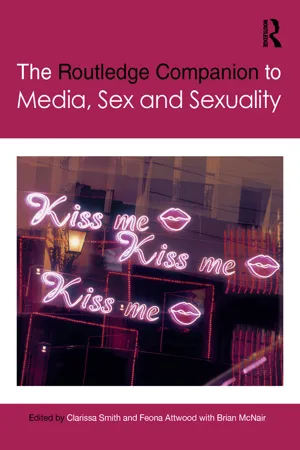
The Routledge Companion to Media, Sex and Sexuality is a vibrant and authoritative exploration of the ways in which sex and sexualities are mediated in modern media and everyday life.
The 40 chapters in this volume offer a snapshot of the remarkable diversification of approaches and research within the field, bringing together a wide range of scholars and researchers from around the world and from different disciplinary backgrounds including cultural studies, education, history, media studies, sexuality studies and sociology.
The volume presents a broad array of global and transnational issues and intersectional perspectives, as authors address a series of important questions that have consequences for current and future thinking in the field. Topics explored include post-feminism, masculinities, media industries, queer identities, video games, media activism, music videos, sexualisation, celebrities, sport, sex-advice books, pornography and erotica, and social and mobile media.
The Routledge Companion to Media, Sex and Sexuality is an essential guide to the central ideas, concepts and debates currently shaping research in mediated sexualities and the connections between conceptions of sexual identity, bodies and media technologies.
Public exhibitions of the Norma and Normman statues
Elizabeth Stephens
In June 1945, a pair of composite statues called Norma and Normman went on public display at the American Museum of Natural History in New York (see Figure 1.1).
The two statues had been modelled using the statistical averages of two very large anthropometric sets: Normman’s dimensions were calculated from the anthropometric records of First World War soldiers collected by Albert G. Love and Charles Davenport, founder of the Eugenics Records Office;1 Norma’s were derived from the records of 15,000 ‘native white’ American women collected by the Bureau of Home Economics in 1940, in an attempt to establish a system of standardised sizing for the ready-made clothing industry.2 The statues were produced by the eminent gynaecologist and sexologist Robert Latou Dickinson, working in collaboration with the artist Abram Belskie. After a short but well-publicised exhibition at the American Museum of Natural History, reported in Time magazine, the statues were purchased with great fanfare by the Cleveland Museum of Health, where they were put on permanent exhibition in July 1945.3 In September of that year, the local newspaper, the Cleveland Plain Dealer, announced a competition to find the living embodiment of Norma. The entry form, printed daily on the front page of the newspaper, was a detailed anthropometric chart, which applicants were required to fill out. Almost 4,000 women entered the contest, each recording over a dozen physical measurements. In the summer of 1945, the Norma and Normman statues (and especially Norma) provided a focal point for public debate about the new social and physical norms emergent in the immediate post-war period, and new expectations about gender, class and race. As such, Norma and Normman are a reminder of how culturally influential the space of public health exhibitions remained up until the middle of the previous century, constituting a key part of what Tony Bennett has termed the ‘exhibitionary complex’: that network of cultural institutions by which the disciplinary society produced docile, self-improving subjects (1995: 59–88). In 1945, public exhibitions were important sites of education and entertainment, serving much the same cultural function as would later popular media such as radio and television. Thus while, considered from a present perspective, composite statues might seem very marginal cultural objects, in their own day they had a significant impact on popular ideas and public discussion about gender, sexuality and race.
Figure 1.1Dickinson and Belskie’s Normman and Norma statues, 1945.
Source: Courtesy of the Warren Anatomical Museum in the Francis A. Countway Library of Medicine. Photograph by Samantha van Gerbig, Collection of Historical Scientific Instruments, Harvard University.
One of the most significant ways in which they did this, as their very names suggest, was by introducing the concepts of normal and normality to popular discourse. Prior to 1945, the word ‘normal’ was one rarely heard in everyday speech. Instead, it remained a term of medical and mathematic jargon, confined almost exclusively to professional discourses: in medicine, it had been used since the early 1800s to refer to the ‘normal anatomy’; at the end of the nineteenth century it entered statistics through the term ‘normal distribution’. But in 1945, the word remained in very limited circulation. The circumstances in which the normal first began to move into popular speech have been examined in two recent cultural histories of normality, both of which open with a detailed discussion of Norma and Normman: Anna Creadick’s Perfectly Average: The Pursuit of Normality in Postwar America (2010) and Julian B. Carter’s The Heart of Whiteness: Normal Sexuality and Race in America, 1880–1940 (2007). For Carter, the statues are representative of the new formations of heterosexuality and whiteness emergent in the USA at the start of the twentieth century. Carter argues that whereas in the late nineteenth century whiteness and heterosexuality had been often seen as precarious cultural formations, by the twentieth century they had become both institutionally and discursively entrenched, and disassociated from their disciplinary history, acquiring ‘the appearance of blank emptiness and innocence’ (Carter, 2007: 31). The history of the term ‘normal’ as a scientific and quantitative one further reinforced its epistemological neutrality (Carter, 2007). In the USA in the mid-century, Carter shows, the term normal gradually usurped the place of the earlier phrase ‘native white American’, erasing its racial specificity while further establishing its dominance. The concept of normality was hence embedded in a racial and corporeal specificity disguised as a neutral and universal standard. Like Carter, Anna Creadick argues that the cultural force and authority of normality as it emerged in the middle of the twentieth century derived in large part from its claims to mathematical rationalism and scientific objectivity. For Creadick, too, Norma and Normman are representative of the way in which what were seen as objective facts – statistical averages – were equally shaped by interpretive frameworks and evaluative judgements. Creadick, however, argues that even at its point of emergence, the concept of normality was the subject of contention rather than agreement, and that it fragmented as much as consolidated emergent ideas about gender, sexuality, race and embodiment. The post-war American culture of conformity so closely associated with the popular concept of normality was, even at its inception, an object of resistance and dissatisfaction and, as Creadick argues, perceived by some as stultifying and oppressive:
Even as it was being employed at this time, however, normality was also being questioned and critiqued. The concept shifted from … claiming the authoritative discourse of scientific rationality to voicing a contradictory discourse of popular psychology; from offering a source of security to being a metonym for conformity and danger to ‘progress’.
(2010: 2)
In the years following 1945, as the word moved into widespread circulation, its significance became much broader but also much vaguer and more difficult to define. The public exhibitions of Norma and Normman are thus both representative of and a significant catalyst for the cultural conditions in which the concept of normality came to be so pervasive and important in popular culture in the middle of the previous century. The Norma and Normman statues were thus produced at the very moment the word normal began to move into the popular sphere, and have much to tell us about the conditions in which it did so. In the years before televised media, these two statues were the very embodiment of new norms about gender and sexuality, and representative of the means by which these were widely disseminated.
The normal American: reimagining the statistically average American
Norma and Normman were the result of a previous successful collaboration between Dickinson and Belskie. This was a collection of obstetric models made for the 1939 New York World’s Fair, and called the ‘Birthing Series’. The models were designed to provide realistic yet respectable depictions of foetal development and childbirth, in a manner suitable to be seen by a broad audience. In this Dickinson and Belskie were very successful, and the exhibition proved enormously popular with visitors to the Fair. Afterwards, Dickinson’s correspondence reveals, he was inundated with requests from educational and community groups wanting to purchase photographic plates and reproductions of his models. Dickinson and Belskie published The Birthing Atlas in 1941, and began a follow-up volume, Human Sex Anatomy: A Topographical Hand Atlas, shortly afterwards. The idea for Norma and Normman developed during the preparation of that book, as visual representations of the normal (‘native white’ American) reproductive adult male and female.4 Norma and Normman were thus ‘normal’ in the medical sense of the term: they were designed to make visible the ‘normal anatomy’ and ‘normal state of health’ of the average young white American, a project Dickinson argued (incorrectly) ‘ha[d] never been undertaken before’ (letter, 4 January 1945). They were also ‘normal’ in the statistical sense, because their dimensions had been calculated from the averaged anthropometrics measurements of (young white) American bodies.5 Beyond this, however, Norma and Normman were also ‘normal’ in another, newer way, one whose meaning was much more general and difficult to articulate. They were conventionally, rather than exceptionally, fit and healthy; able-bodied and represented as a reproductive pair. As the word normal moved into more general circulation, its significance broadened and became more diffuse, disappearing into the cultural background even as it became conceptually more ubiquitous. The public exhibition of Norma and Normman, and its coverage in the popular media, thus allows us to see how new ideas of gender and sexuality coalesced around the semi-scientific understanding of normality at this time.
Norma and Normman first went on display at the American Museum of Natural History in New York, the location of the Second and Third International Congresses on Eugenics, in June 1945. A long article written by curator Harry L. Shapiro, entitled ‘Portrait of the American People’, appeared in the Museum’s journal, Natural History Magazine, in the same month.6 Shapiro argued that Norma and Normman were important scientific statues for two key reasons. First, they contributed to wider anthropological studies of the ‘native white’ American type, which he argued was a relatively recent area of research and a subject of contemporary fascination. Norma and Normman provided a rare and scientifically accurate portrait of this type.7 Second, the statues prompted the viewer to reflect on what statistics had to tell us about that type, and the relation between the ‘average’ and the individual:
Norma and Normman exhibit a harmony of proportion that seems far indeed from the usual or average. One might well look at a multitude of young men and women before finding an approximation to those normal standards. We have to do here then with apparent paradoxes. Let us state it in this way: the average American figure approaches a kind of perfection of bodily form and proportion; the average is excessively rare.
Ordinarily, when we think of perfection … we place it at one extreme of a curve of frequency, whose middle range or average is equivalent to mediocrity. Virtuosity, for example, is never at the middle range of a curve of frequency … Why, then, should the average of our bodily proportions strike us as a form of perfection, and if it is average, why is it rare? I shall confine myself to statistical explanations. The extremes of any single physical character are generally statistically rare, whereas the average is frequent … But the combination of many [individual] averages in one individual is rare and unusual.
(Shapiro, 1945: 252–253)
How was it, Shapiro asked, that these models of the average American young man and woman seemed so much better than the actual average American? The answer, he explained, came from understanding the relationship between statistics and individuals. The ‘perfectly average’ bodies represented by Norma and Normman were ‘excessively rare’ because they embodied an anthropometric average in not just one part of their bodies but in every single aspect. Any individual body was statistically unlikely to coincide with so many averages.
After their short exhibition at the American Museum of Natural History, the statues were purchased by the Cleveland Museum of Health, where they went on display in July 1945. The Museum also bought the ‘Birthing Series’ at the same time, along with reproduction rights for photographic plates and plaster models for all Dickinson and Belskie’s models.8 The collection was exhibited together as ‘The Wonders of Life’. The Director of the Museum, Bruno Gebhard, was already familiar with Dickinson and Belskie’s work, having overseen the public health exhibitions at the 1939 World’s Fair in New York. Gebhard had been the Curator of the Deutsches Hygiene Museum in Dresden from 1927 to 1935, and was well known for his eugenics exhibition at the Second International Hygiene Exhibition in Dresden. This was attended by a number of American health workers, including representatives of the American Public Health Association, who in 1934 arranged for the exhibition to be brought to the United States. Titled ‘Eugenics in New Germany’, it toured the US in 1934 before finding an eventual permanent home at the Buffalo Museum of Science.9 Gebhard’s role in public health education in the USA from the 1930s to 1960s is an important reminder both of how entrenched eugenics was to the exhibitory culture of this time and of how complex the field of eugenics was itself. Gebhard was both an enthusiastic supporter of...
Table of contents
Cover
Half Title
Title Page
Copyright Page
Table of Contents
List of figures and tables
List of contributors
Introduction
Part I Representing sexualities
Part II Sex genres
Part III Representing sex
Part IV Deconstructing key figures
Index
Trusted by 375,005 students
Access to over 1.5 million titles for a fair monthly price.
Study more efficiently using our study tools.
Frequently asked questions
Yes, you can cancel anytime from the Subscription tab in your account settings on the Perlego website. Your subscription will stay active until the end of your current billing period. Learn how to cancel your subscription
No, books cannot be downloaded as external files, such as PDFs, for use outside of Perlego. However, you can download books within the Perlego app for offline reading on mobile or tablet. Learn how to download books offline
Perlego offers two plans: Essential and Complete
Essential is ideal for learners and professionals who enjoy exploring a wide range of subjects. Access the Essential Library with 800,000+ trusted titles and best-sellers across business, personal growth, and the humanities. Includes unlimited reading time and Standard Read Aloud voice.
Complete: Perfect for advanced learners and researchers needing full, unrestricted access. Unlock 1.5M+ books across hundreds of subjects, including academic and specialized titles. The Complete Plan also includes advanced features like Premium Read Aloud and Research Assistant.
Both plans are available with monthly, semester, or annual billing cycles.
We are an online textbook subscription service, where you can get access to an entire online library for less than the price of a single book per month. With over 1.5 million books across 990+ topics, we’ve got you covered! Learn about our mission
Look out for the read-aloud symbol on your next book to see if you can listen to it. The read-aloud tool reads text aloud for you, highlighting the text as it is being read. You can pause it, speed it up and slow it down. Learn more about Read Aloud
Yes! You can use the Perlego app on both iOS and Android devices to read anytime, anywhere — even offline. Perfect for commutes or when you’re on the go. Please note we cannot support devices running on iOS 13 and Android 7 or earlier. Learn more about using the app
Yes, you can access The Routledge Companion to Media, Sex and Sexuality by Clarissa Smith, Feona Attwood, Brian McNair, Clarissa Smith,Feona Attwood,Brian McNair in PDF and/or ePUB format, as well as other popular books in Social Sciences & LGBT Studies. We have over 1.5 million books available in our catalogue for you to explore.