The need to address the energy problem and formulate a lasting solution to tame climate change has never been so urgent. The rise of various renewable energy sources, such as solar cell technologies, has given humanity a glimpse of hope that can delay the catastrophic effects of these problems after decades of neglect.
This review volume provides in-depth discussion of the fundamental photophysical processes as well as the state-of-the-art device engineering of various emerging photovoltaic technologies, including organic (fullerene, non-fullerene, and ternary), dye-sensitized (ruthenium, iron, and quantum dot), and hybrid metal-halide perovskite solar cells. The book is essential reading for graduate and postgraduate students involved in the photophysics and materials science of solar cell technologies.
Department of Physics, Jinan University, Huangpu Avenue West 601, Guangzhou, Guangdong 510632, China [email protected]
1.1 Introduction
The history of organic photovoltaic (OPV) research dates back to more than a half-century ago, since the first observation of photovoltaic effect on anthracene crystals in 1959 [1]. Despite this relatively long history, its potential for commercial application has long been underestimated. The situation changed when conducting polymer was discovered in the late 1970s [2, 3, 4, 5], which opened a new chapter in OPV research. It brought opportunity to synthesize materials with desired properties, and led to the acceleration in its power conversion efficiency (PCE). Currently, PCE of OPV devices with single junction reaches 14% [6], and PCE of multi-junction geometry reaches 17% [7]. High-throughput production of OPV devices and modules has already been demonstrated [8, 9, 10] and launched in many countries for commercial use [11].
The fundamental component in OPV is the organic conjugated material, which is considered as “the fourth generation of polymeric materials” [12, 13]. Similar to most polymeric materials, Van der Waals force dominates the intermolecular interaction, inducing some typical “plastic” properties, such as soft and lightweight. The backbone of organic conjugated molecular typically contains alternating single bonds and double bonds with many repeat times known as conjugation. This conjugated chemical bonding leads to one unpaired electron per carbon atom and a continued overlapping of Pz orbital, which was theoretically demonstrated using the Su–Schrieffer–Heeger (SSH) model [3, 14]. This unpaired electron is called π electron. The induced split energy bands are called π band and π* band, which is analogous to the conduction band and the valence band, respectively, in the Energy Band Theory [15]. The organic conjugated materials used as a light absorber in OPV are usually intrinsic, meaning the molecule has its π band filled and π* band empty. The gap between the highest occupied molecular orbital (HOMO) and lowest unoccupied molecular orbital (LUMO) is corresponding to the bandgap. This kind of material inherits the convenience of chemical structure tailing, the easily processing properties and mechanical properties from the old generation of polymeric materials.
In OPV, when the light absorber materials absorb light, strongly bonded electron–hole pair is generated. This quasi-particle called exciton has a binding energy (an electrostatic attractive force) measured to be around 0.5 eV or more [16, 17], which is much higher than the thermal energy of the particle at room temperature, ∼25 meV. Because organic conjugated materials have a relatively low dielectric constant, consequently resulting in a large electrostatic attractive force [13]. Besides, the exciton in OPV has a short diffusion length. Typically, the diffusion length is around 20 nm long for polymer [18, 19], although long-range diffusion happens in crystallized molecule domain [20] or with triplet exciton [21] were demonstrated. For high PCE, high exciton splitting rate is a prerequisite; therefore, overcoming the high binding energy and limited diffusion length of the exciton in OPV device is the most important at the very beginning of its operation.
For quite a long time, devices with a single component as light absorber were used but presented extremely low photocurrent (1950s–1980s) [22]. The breakthrough came when fullerene-based materials were introduced. In 1984, Tang’s bilayer OPV device first showed a dramatically enhanced photocurrent compared to the single component device [23]. Later, researchers found that the interface between two materials with different electronegativity and electron affinity is a splitting area for hot exciton. These two materials are named as electron-donor (D) and electron-acceptor (A), respectively, indicating the former is the hole transport dominated material, and the latter is electron transport dominated material. In 1992, time-resolved photoluminescence (PL) measurement revealed that the photo-induced electron transfer from the conjugated polymer (MEH-PPV) donor to fullerene (C60) acceptor is in the time scale of 50–100 femtoseconds [24], which is 1000 times faster than any exciton decay processes, such as photoluminescence (nanosecond scale) and charge recombination (microsecond scale). In 1995, the boom of PCE arrived through the use of a donor: fullerene derivate blend in the active layer, which is called bulk-heterojunction active layer [25, 26].
In this chapter, we will review the investigations on fullerene-based OPV, to elucidate the understanding of fullerene-based OPV regarding working principle, materials, morphology and operation stability.
1.2 Working Principle of Organic Solar Cells
1.2.1 Structure of Bulk-Heterojunction OPV
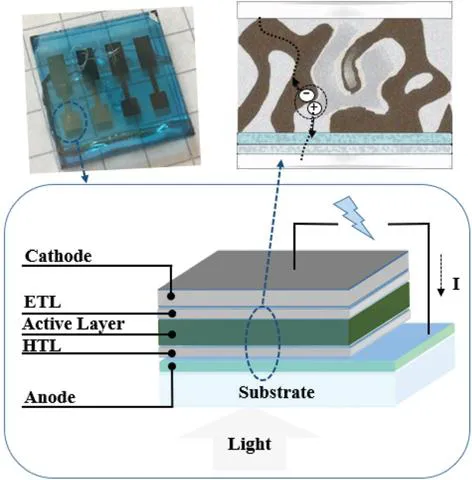
OPV device is a typical two-terminal diode using a layer-by-layer stacked sandwich geometry. The total thickness of the device is commonly less than half a micrometer, although micrometer thick device has also been reported [27]. In the laboratory, the OPV device is fabricated with a rigid substrate, whose active area is defined by the electrode pattern as shown in Fig. 1.1.
The device structure contains three types of functional layers. They are the active layer with light absorber material, metallic electrodes used for the electricity connection (anode and cathode), and carrier transport layers for the charge carriers transport and collection (the hole transport layer (HTL) and the electron transport layer (ETL)). Figure 1.1 shows a conventional geometry of the device, in which light is injected through the anode electrode (high potential electrode). Another device geometry is an inverted structure with the light injected through the cathode, which is not shown here. Due to the performance issue, bulk-heterojunction is the most popular structure for the active layer till now [25]. The electronic structure of devices is mainly decided by the nanoscale morphology in the active layer [28]. Also shown in Fig. 1.1 (top, right) is a typical morphology of donor and acceptor molecules separated in randomly distributed phases, some domain form continuous interpenetrating networks. More details on morphology will be discussed in Section 1.4. The ETL and HTL are used to improve the transport and collection efficiency of electron and hole, respectively, by aligning the energy level between the active layers and the electrodes. In general, a waterfall-like potential alignment is desired, which reflects as the contact resistance approaching zero [29, 30, 31, 32].
Figure 1.1 Top left: photograph of OPV device in the laboratory; top right: schematic of the morphology of the active layer, area with different color represents different material domain. Exciton splits at the two-material interface. Bottom: conventional device geometry.
1.2.2 The Power Conversion Process
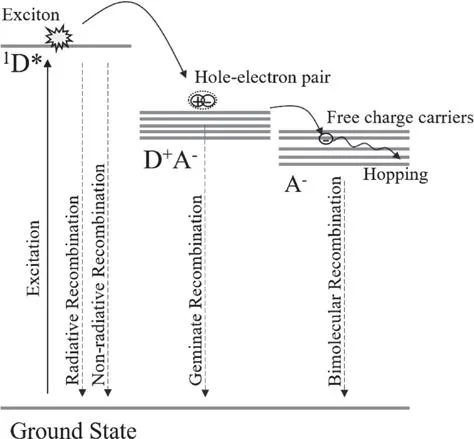
In OPV, the quasiparticle species involved in the energy conversion process, with different energy states are identified as photon, exciton, interfacial hole–electron pair and free charge carriers (hole or electron). When the incident light hit the light absorbers, either electron donor or electron acceptor, a photon with energy larger than the optical bandgap (Eg) is converted into a neutral exciton. Excitons are generated inside the molecule with a size of few nm [33, 34, 35], and they split at the D/A interface. The induced exciton concentration gradient provides the driving force for the exciton to diffuse toward D/A interface during its lifetime. Else, excitons decay via radiative recombination or non-radiative recombination pathways [36].
Figure 1.2 Energy conversion process schematic in a state energy diagram, 1D* is the singlet excitonic level, D+A– is the CT state, and A– is the transport state in acceptor.
At the D/A interface, the exciton converts into a bound hole–electron pair at the heterojunction. This hole–electron pair is settled at a D/A complex energy state called charge transfer (CT) state [37, 38]. Charge recombination could happen and is identified as geminate recombination at this step [39, 40]. The geminate recomb...
Table of contents
Cover
Half Title
Title Page
Copyright Page
Table of Contents
Preface
1. Fullerene-Based Organic Solar Cells
2. Non-Fullerene-Based Polymer Solar Cells
3. Ternary Sensitization of Organic Solar Cells: A Multifunctional Concept to Boost Power Conversion Efficiency
4. Dye-Sensitized Solar Cells: Photophysics of Coordination Complex
5. Fe Complexes as Photosensitizers for Dye-Sensitized Solar Cells
6. Quantum Dot–Sensitized Solar Cells
7. Time-Resolved Spectroscopic Studies of Perovskites
8. Using First-Principles Simulations to Understand Perovskite Solar Cells and the Underlying Opto-Electronic Mechanisms
Index
Trusted by 375,005 students
Access to over 1.5 million titles for a fair monthly price.
Study more efficiently using our study tools.
Frequently asked questions
Yes, you can cancel anytime from the Subscription tab in your account settings on the Perlego website. Your subscription will stay active until the end of your current billing period. Learn how to cancel your subscription
No, books cannot be downloaded as external files, such as PDFs, for use outside of Perlego. However, you can download books within the Perlego app for offline reading on mobile or tablet. Learn how to download books offline
Perlego offers two plans: Essential and Complete
Essential is ideal for learners and professionals who enjoy exploring a wide range of subjects. Access the Essential Library with 800,000+ trusted titles and best-sellers across business, personal growth, and the humanities. Includes unlimited reading time and Standard Read Aloud voice.
Complete: Perfect for advanced learners and researchers needing full, unrestricted access. Unlock 1.5M+ books across hundreds of subjects, including academic and specialized titles. The Complete Plan also includes advanced features like Premium Read Aloud and Research Assistant.
Both plans are available with monthly, semester, or annual billing cycles.
We are an online textbook subscription service, where you can get access to an entire online library for less than the price of a single book per month. With over 1.5 million books across 990+ topics, we’ve got you covered! Learn about our mission
Look out for the read-aloud symbol on your next book to see if you can listen to it. The read-aloud tool reads text aloud for you, highlighting the text as it is being read. You can pause it, speed it up and slow it down. Learn more about Read Aloud
Yes! You can use the Perlego app on both iOS and Android devices to read anytime, anywhere — even offline. Perfect for commutes or when you’re on the go. Please note we cannot support devices running on iOS 13 and Android 7 or earlier. Learn more about using the app
Yes, you can access Emerging Photovoltaic Technologies by Carlito Ponseca, Carlito S. Ponseca in PDF and/or ePUB format, as well as other popular books in Physical Sciences & Biology. We have over 1.5 million books available in our catalogue for you to explore.