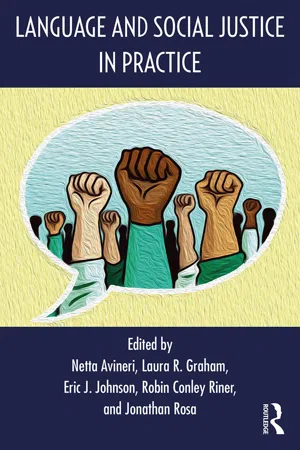
From bilingual education and racial epithets to gendered pronouns and immigration discourses, language is a central concern in contemporary conversations and controversies surrounding social inequality. Developed as a collaborative effort by members of the American Anthropological Association's Language and Social Justice Task Force, this innovative volume synthesizes scholarly insights on the relationship between patterns of communication and the creation of more just societies. Using case studies by leading and emergent scholars and practitioners written especially for undergraduate audiences, the book is ideal for introductory courses on social justice in linguistics and anthropology.
eBook - ePub
Language and Social Justice in Practice
- 248 pages
- English
- ePUB (mobile friendly)
- Available on iOS & Android
eBook - ePub
Language and Social Justice in Practice
About this book
Information
Part I
Language and Race
Introduction
The chapters in this section approach race as a central consideration in analyses of language and social justice. Research on this topic includes of the stigmatization of racialized language practices as well as discourses that perpetuate the racialization of particular populations. These examinations of race and language seek to understand and unsettle entrenched societal hierarchies and power relations. The broader goal is to connect scholarship on race and language to political struggles over access to rights, resources, and institutions. The chapters in this section frame these issues in relation to education, media representations, and popular discourses. The case studies focus on White public school teachers’ fraught positionality in classrooms predominated by students of color, media discourses surrounding the 911 call made by George Zimmerman before he killed Trayvon Martin, an unarmed African American teenager, efforts to eradicate the use of the term “illegal” in reference to immigration in mainstream media representations, the discursive enactment of Islamophobia through instances of the profiling of race, language, and religion of perceived Muslim populations, and the role of digital discourses in the Black Lives Matter movement. Collectively, these chapters present a critical view of the role of language in reproducing racial injustice as well as its potential to contribute toward efforts to disrupt inequity.
Critical Questions
As you read these cases, we encourage you to consider the following questions:
1 What is the relationship between the linguistic enactment of racism on interpersonal and institutional levels?
2 How are racial and linguistic stereotypes linked to one another?
3 How can language alternately reproduce and contest racial hierarchies?
1 “Never Tell Me How to Say It”
Race, Language Ideologies, and Harm Reduction in Secondary English Classrooms
Julia R. Daniels
On an early morning in April of my third year teaching high school English, I sat at my desk with a young student. Elizabeth was a tall ninth-grader with blue braces and short hair, always ready to laugh or speak out in defense of a friend. Elizabeth and I talked about her grade for a few minutes—then her other classes and the peer who annoyed her in my morning class. Eventually we settled on the essay she had recently written analyzing Sherman Alexie’s (2007) novel, Flight, and the comments I had written on her paper. Elizabeth turned to me: “Don’t ever tell me how to talk or change my writing like that, Ms. Daniels. Never tell me how to say it. That shouldn’t be your job.”
As a White1 high school English teacher I taught at a school that served exclusively students of Color. My students—including Elizabeth, who identified as Chicana and a speaker of English, Spanish, and Spanglish—spoke, wrote, and read in a variety of languages. Almost all of the teachers at my school were White and, like me, identified as monolingual English speakers. My discussion with Elizabeth, and the ensuing conversations students and I had in our classes, dramatically reshaped my understanding of language and school-based language pedagogies—and, especially, my understanding of my “job” as a White high school English teacher who taught students of Color.
In this chapter, I rely on my own experiences as a White high school English teacher and later, teacher educator and educational researcher, to explicate the often-“invisiblized” (Lipsitz 1998) ideologies of schooling-based language practices that ignore the mutually constitutive relationship between race and language (Alim and Reyes 2011; Aneja 2016; Bucholtz and Hall 2005; Fairclough 2003; Valdes 2016; Young 2009). I argue that our raciolinguistic (Flores and Rosa 2015) identities are always implicated in the work of teaching or talking about language. My identity as a White woman and my students’ identities as people of Color and speakers of multiple languages and language varieties shaped our experiences of the language pedagogies and practices that I enforced and that students resisted and contested. I focus specifically on the commonly accepted schooling practice of teaching code switching to students of Color—or, as Elizabeth might have argued, of teaching students “how to say it.” I use the phenomenon of White teachers teaching students of Color to code switch into a Standardized English (Charity-Hudley and Mallinson 2010) as a prism through which to explicate the relationship between race and language.
Throughout my analysis, I draw from the public health tradition of harm reduction in order to situate my analysis within broader struggles for racial and linguistic justice. Harm reduction allows us to name and work to mitigate injustice without fundamentally altering the conditions that created such injustice in the first place—even as we acknowledge the profound inadequacy of such an approach (Karoll 2010; Roberts and Marlatt 1999; Wodak 2003). In this case, harm reduction allowed me to engage with the urgency of the racialized harm that White teachers perpetuate through our language pedagogies—while also naming the inadequacy of that engagement and the profound need for more fundamental change in teacher demographics and language ideologies.
The Raciolinguistic Ideologies of Teaching Code-Switching
Secondary English classrooms are powerful laboratories for explorations of raciolinguistic ideologies—ideologies that cast speaking subjects according to their racialized positions as opposed to any objective language practices (Flores and Rosa 2015). Secondary English classrooms produce, reflect, and contest dominant raciolinguistic ideologies—as well as the particular raciolinguistic ideologies of the often White teachers who make up 80 percent of public school teachers (Charity-Hudley and Mallinson 2010; National Center for Educational Statistics 2012; Wheeler and Swords 2006). As a White teacher, I believed it was my responsibility to teach students of Color to code switch: to speak and write in Standardized English in schools. According to the ideological perspectives to which I subscribed, Standardized English was both static and aracial: a fixed language form that opened doors for whoever spoke or wrote according to its rules, regardless of their racialized identities (Rosa 2016). My commitment to teaching code-switching to students of Color rested on powerful ideological assumptions about the separation of race and language and the fixedness of language itself (Aneja 2016; Valdes 2016).
Code switching typically refers to “the use of two or more languages or varieties of a language in the same speech situation” (Kamwangamalu 2010, 116). However, the term is commonly used in the context of schooling to refer to an “appropriateness-based” pedagogy and approach to language education (Flores and Rosa 2015). As a teacher I relied on this common conception of code-switching: I taught my students that while “nonstandard varieties of English and nonstandard varieties of languages other than English . . . are appropriate for out-of-school contexts,” students must learn to employ “standard conventions [in schools] . . . because these linguistic practices are appropriate for a school setting” (Flores and Rosa 2015, 153).
The teaching of code switching is a commonly accepted practice in schools and is often framed as a uniformly positive, necessary, and racially neutral teaching practice (Godley, Reaser, and Moore 2016; Delpit 2006; Wheeler and Swords 2006). Young (2009) points out that teachers are often encouraged to avoid making connections between race and language when teaching students to code switch: Wheeler and Swords (2006) write that teachers should “refrain from referring to race when describing code-switching. It’s not about race,” (161). Advocates of teaching code switching frame it as an “asset-based” alternative to “deficit approaches” to language teaching that focus on the “inadequacies” of nonstandardized languages and language varieties (Godley et al. 2006). For proponents, the teaching of code-switching does not send students the message that nonstandardized language varieties are inferior—only that nonstandardized language varieties are “inappropriate” for school contexts (Flores and Rosa 2015). Within my own classroom, I explicitly taught students that code-switching was necessary because it would allow them access to institutions of higher education and the formal education necessary to fight for a more socially just world.
There are numerous assumptions underlying the above statements and belief in the importance of teaching students of Color to code switch. As Flores and Rosa (2015) argue, teaching students of Color to code switch rests on the false assumption that employing particular language practices will necessarily alter the ways that a student is heard by a “White listening subject.” In other words, the authors argue that teaching students of Color to employ particular language practices ignores the reality that students will often be racialized in harmful ways regardless of the language practices they employ. Teaching students of Color to code switch with the hope of giving them the language necessary to enact social change, then, ignores the ways in which racism will work against student of Color regardless of the language varieties they employ (Rosa 2016).
At the same time, Flores and Rosa (2015) point out the ways that an “appropriateness-based” language pedagogy relies on an understanding of language as static and a refusal to engage with the mutually constitutive relationship between race and language (Alim and Reyes 2011; Aneja 2016; Bucholtz and Hall 2005; Fairclough 2003; Valdes 2016; Young 2009): “notions such as ‘standard language’ or ‘academic language’ and the discourse of appropriateness in which they both are embedded must be conceptualized as racialized ideological perceptions rather than objective linguistic categories” (Flores and Rosa 2015, 152). If we understand Standardized English as a fixed and “objective” target toward which students’ language practices should move, then we ignore the ways in which Standardized English is in fact a dynamic and constructed linguistic form that depends on the racial identity—the Whiteness—of its speaker in order to make itself true (Aneja 2016; Flores and Rosa 2015; Valdes 2016). As a White teacher, I ignored the ways in which my speech was always already identified as standardized regardless of the particular linguistic forms I employed; my students’ language practices, however, were always read as racially and linguistically “deviant” (Aneja 2016; Davila 2012; Flores and Rosa 2015; Hill 1998; Urciuoli 1996).
At the same time, my commitment to teaching code switching to students of Color as a White woman erased the consequences of my Whiteness as a fundamental part of my teaching—and my students’ experiences of being taught. Like many teachers, I focused on what I believed my students needed to know—not on what my students of Color needed to learn from me, given my Whiteness. I believed that my students needed to know how to employ Standardized English. In doing this, I ignored the potential consequences of teaching students of Color to speak and write in particular ways—and, in fact, policing their language—as a White woman, and the racialized histories upon which my teaching necessarily built. When I crossed out the words in Elizabeth’s paper, I built on a history of White people shaming and policing the language practices of people of Color. Regardless of my justification and my belief that Elizabeth needed to write in a Standardized English in order to get into college and effect a more just world, my position as a White person in power defined the impact of crossing out Elizabeth’s words—of telling her “how to say it.”
“Do I Have to Say it for a White Person?”
In my third year of teaching, I stopped teaching my students to code-switch to particular linguistic forms. While this choice did not absolve my classroom of its raciolinguistic complexity, it revealed and engaged that complexity, pushing me to name the harmful contradictions in my teaching and—perhaps—to mitigate some of that harm.
The vast majority of teachers at my school were White and I came to understood our very presence in positions of power as harmful to students of Color. The discourses of Whiteness center and normalize within classrooms particular experiences, knowledges, languages, feelings, and ways of being while marginalizing others (Foster 2013; Frankenberg 1993; McIntyre 2002). Classrooms lead by White teachers mirror the circumstances under which people of Color are forced to develop a painful double consciousness (DuBois 1903): contexts in which people of Color are made to see and imagine themselves seen through the eyes of White people because those White people wield significant power and police narrow ways of being. In considering my work as a White teacher, I began to borrow from the public health tradition of harm reduction in which any work meant to reduce harm must first acknowledge that it is incapable of eliminating that harm. Given that I could not immediately change the broader demographic trends of teachers, the teacher demographics of my school, or remove myself instantaneously from the classroom without abandoning my students to daily substitutes, I considered how I might acknowledge and mitigate the racialized harm that I perpetuated in my own classroom—and, in particular, how I might do that through my language pedagogies.
After my conversation with Elizabeth—and numerous conversations with students, colleagues, and former students—my students and I embarked on an exploration of the language choices and pedagogies that might do the least harm given the racialized and linguicized power dynamics in our classroom. After much discussion and research—reading texts by Lisa Delpit (2006) exploring the merits of code switching as well as texts like Gloria Anzaldua’s (1987) Borderlands/La Frontera and June Jordan’s (1988) essay, “Nobody mean more to me than you and the future life of Willie Jordan” that refused to abide by “appropriateness-based” (Flores and Rosa 2015) language expectations—my students and I developed a set of questions that accompanied any assignment in our class: “What language(s) and/or language variety(ies) did you choose to use in this assignment? What register(s) and/or jargon(s) did you use? Why did you make these choices? How did those choices reflect your purpose and your intended audience? Did those choices give you power? Why or why not?”
These questions and the discussions they provoked forced our class to explicitly engage with the ways that race and language were tangled up with each other, both reproduced and contested in our classroom. My students and I examined my language practices: the language I chose to use when writing assignments, when describing my upbringing or family, when sending letters home to students’ families, and when expressing frustration at students. Students pointed out the ways that I asserted or avoided claiming my Whiteness through language: affecting racialized linguistic forms, for instance, in attempts to “con...
Table of contents
- Cover Page
- Half Title
- Title Page
- Copyright Page
- Table of Contents
- List of Figures
- List of Tables
- List of Contributors
- Acknowledgments
- Introduction: Reimagining Language and Social Justice
- PART I: Language and Race: Introduction and Critical Questions
- PART II: Language and Education: Introduction and Critical Questions
- PART III: Language and Health: Introduction and Critical Questions
- PART IV: Language and Social Activism: Introduction and Critical Questions
- PART V: Language, Law, and Policy: Introduction and Critical Questions
- Index
Trusted by 375,005 students
Access to over 1.5 million titles for a fair monthly price.
Study more efficiently using our study tools.
Frequently asked questions
Yes, you can cancel anytime from the Subscription tab in your account settings on the Perlego website. Your subscription will stay active until the end of your current billing period. Learn how to cancel your subscription
No, books cannot be downloaded as external files, such as PDFs, for use outside of Perlego. However, you can download books within the Perlego app for offline reading on mobile or tablet. Learn how to download books offline
Perlego offers two plans: Essential and Complete
- Essential is ideal for learners and professionals who enjoy exploring a wide range of subjects. Access the Essential Library with 800,000+ trusted titles and best-sellers across business, personal growth, and the humanities. Includes unlimited reading time and Standard Read Aloud voice.
- Complete: Perfect for advanced learners and researchers needing full, unrestricted access. Unlock 1.5M+ books across hundreds of subjects, including academic and specialized titles. The Complete Plan also includes advanced features like Premium Read Aloud and Research Assistant.
We are an online textbook subscription service, where you can get access to an entire online library for less than the price of a single book per month. With over 1.5 million books across 990+ topics, we’ve got you covered! Learn about our mission
Look out for the read-aloud symbol on your next book to see if you can listen to it. The read-aloud tool reads text aloud for you, highlighting the text as it is being read. You can pause it, speed it up and slow it down. Learn more about Read Aloud
Yes! You can use the Perlego app on both iOS and Android devices to read anytime, anywhere — even offline. Perfect for commutes or when you’re on the go.
Please note we cannot support devices running on iOS 13 and Android 7 or earlier. Learn more about using the app
Please note we cannot support devices running on iOS 13 and Android 7 or earlier. Learn more about using the app
Yes, you can access Language and Social Justice in Practice by Netta Avineri, Laura R. Graham, Eric J. Johnson, Robin Conley Riner, Jonathan Rosa, Netta Avineri,Laura R. Graham,Eric J. Johnson,Robin Conley Riner,Jonathan Rosa in PDF and/or ePUB format, as well as other popular books in Languages & Linguistics & Linguistics. We have over 1.5 million books available in our catalogue for you to explore.