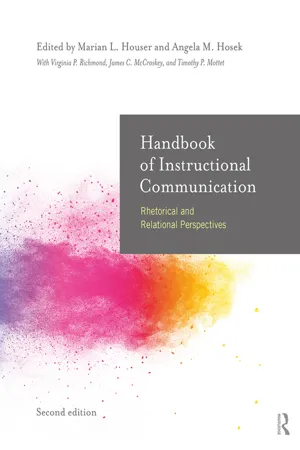
The Handbook of Instructional Communication offers a comprehensive collection of theory and research focusing on the role and effects of communication in instructional environments. Now in its Second Edition, the handbook covers an up-to-date array of topics that includes social identity, technology, and civility and dissent. This volume demonstrates how to understand, plan, and conduct instructional communication research as well as consult with scholars across the communication discipline. Designed to address the challenges facing educators in traditional and nontraditional settings, this edition features a wealth of in-text resources, including directions for future research, suggested readings, and surveys for instructional assessment.
eBook - ePub
Handbook of Instructional Communication
Rhetorical and Relational Perspectives
- 270 pages
- English
- ePUB (mobile friendly)
- Available on iOS & Android
eBook - ePub
Handbook of Instructional Communication
Rhetorical and Relational Perspectives
About this book
Information
1
Historical Roots and Trajectories of Instructional Communication
Introduction
Historical Overview of Instructional Communication
Interdisciplinary Foundations of Instructional Communication
Educational Psychology: Learner Focus
Pedagogy: Instructor Focus
Communication: Message Focus
Communication as Action
Communication as Interaction
Communication as Transaction
Rhetorical Tradition
Relational Tradition
Current State of the Discipline
An Integrative Review
Future of Instructional Communication Scholarship: Methodological Advances
Longitudinal Design
Dyadic Data Collection and Analysis
Sample Recruitment
Theoretical Advances
Content and Context Advances
Communication Technologies
Identity Studies
Biosocial Approach
Dark Side
Summary
References
Knowledge is valuable in itself, but no matter how much one knows, there is no guarantee he or she can teach that knowledge to others. Communication is the crucial link between a knowledgeable teacher and a learning student. From the vantage point of a professional educator, then, the difference between knowing and teaching is communication in the classroom.
(Hurt, Scott, & McCroskey, 1978, p. 3)
Introduction
For more than four decades, instructional communication scholars have explored the interactions between instructors and students with the goal to improve student learning and teaching effectiveness. Hence, instructional communication is conceptualized as “the process by which teachers and students stimulate meanings in the minds of each other using verbal and nonverbal messages” (Mottet & Beebe, 2006, p. 5). This definition asserts the communication between teachers and students is transactional in nature and acknowledges that both teachers and students are affected by the communication they share. For over 40 years, teacher-student interactions examined by instructional communication scholars have been reported to influence student learning, motivation, and engagement as well as teacher satisfaction, credibility, self-efficacy, and a myriad of other positively and negatively valenced outcomes.
The overarching goal of this chapter is to present the history and trajectories of instructional communication scholarship beginning with its roots in varied disciplines. The first section of this chapter focuses on the history of the discipline followed by the interdisciplinary foundations of instructional communication. Next, we review a content analysis of 10 years’ worth of instructional communication scholarship in an attempt to gain a holistic view of the literature since the publication of the previous edition of this Handbook. Finally, this chapter concludes with opportunities for research reflection, and directions for future research.
Historical Overview of Instructional Communication
The history and future of the instructional communication discipline has been discussed at length in various manuscripts, book chapters, and a more recent focus in a special issue of Communication Education (Frymier, 2014; Nussbaum & Friedrich, 2005; Preiss & Wheeless, 2014; Scott & Wheeless, 1977; Staton-Spicer & Wulff, 1984; Waldeck, Kearney, & Plax, 2001). We too aim to provide an overview of the history and future of the discipline. To begin, we trace the roots of the discipline from its infancy with the goal to examine the trajectory and future directions of instructional communication research.
The origins of instructional communication scholarship can be traced back to 1972 when Barbara Lieb-Brilhart and Robert Kibler were instrumental in creating and gaining approval for the Instructional Communication Division of the International Communication Association (ICA). Although other divisions centered on the exploration of teaching communication content earlier, this was the first interest group devoted specifically to the study of instructional communication and officially recognized by one of communication’s professional associations. ICA’s recognition legitimized the study of instructional communication and provided scholars the opportunity to present their research endeavors at ICA conventions (McCroskey & McCroskey, 2006). Additionally, when ICA launched its inaugural publication outlet, Communication Yearbook, in 1977, instructional communication scholars who authored top papers at the convention were invited to publish their manuscripts in the yearbook. Thus, ICA housed instructional communication scholarship, and much of the research from 1972 to 1986 was published in Communication Yearbook (McCroskey & McCroskey, 2006). After this, editors in other communication journals such as Communication Quarterly and Communication Research Reports began to invite instructional communication scholarship.
The first doctoral program in instructional communication was developed at West Virginia University in 1973. This occurred after faculty in the department began teaching a class entitled “Communication in the Classroom” for K–12 instructors. Doctoral students in the instructional communication program at West Virginia University team-taught the course for elementary and secondary education teachers while simultaneously learning about the field as part of their coursework. According to data provided by the National Communication Association (2012), three instructional communication doctoral programs currently exist. However, students interested in studying instructional communication at the graduate level are able to find coursework and faculty advisors who study instructional communication at numerous institutions such as: Illinois State University, Ohio University, San Diego State University, Texas Christian University, Texas State University, University of Kentucky, University of Miami of Ohio, and West Virginia University, to name a few.
Additionally, instructional communication scholars are able to find professional homes at many regional, national, and international associations. Communication Education, formerly known as The Speech Teacher, is considered the flagship journal in instructional communication and is published by the National Communication Association. Dallas C. Dickey served as the first editor (Frymier, 2014), and the emphasis was originally, and solely, on teaching communication content. Today, the journal is focused more specifically on publishing instructional communication scholarship. Many of the international, national, and regional associations have interest groups and subdivisions that center on the study of teaching and learning: International Communication Association, National Communication Association, Central States Communication Association (CSCA), Eastern Communication Association (ECA), and Western States Communication Association (WSCA). CSCA has recently announced it will sponsor a new journal entitled Journal of Communication Pedagogy that will invite manuscripts focused on both instructional communication and communication education.
Additionally, the Basic Course Directors’ conference is held annually, where faculty from across the United States discuss issues involving communication curricula, communication assessment, and instructional communication practices. Research surrounding the basic communication course has its own outlet in the Basic Communication Course Annual, currently published online through the University of Dayton. Communication Teacher also predominantly publishes manuscripts focused on communication education, although instructional communication scholars seek both of these outlets for publishing. Along with these publications, instructional communication scholars continue to publish in journals devoted to more general communication scholarship including Communication Quarterly, Communication Research Reports, and the Western Journal of Communication.
In addition to exploring the history of the discipline, we trace the interdisciplinary roots of instructional communication as a field of study. In the following section, we provide a discussion of three distinct disciplines that have contributed to the development of instructional communication scholarship.
Interdisciplinary Foundations of Instructional Communication
The beginnings of instructional communi...
Table of contents
- Cover
- Title
- Copyright
- Contents
- Preface
- About the Authors
- CHAPTER 1 Historical Roots and Trajectories of Instructional Communication
- UNIT 1 Introduction to the Rhetorical Perspectives of Instructional Communication
- UNIT 2 Introduction to the Relational Perspectives of Instructional Communication
- UNIT 3 Introduction to Social Identity in the Instructional Context
- UNIT 4 Introduction to Technology in the Instructional Environment
- UNIT 5 Introduction to Instructional Communication Methodological Approaches
- Index
Trusted by 375,005 students
Access to over 1.5 million titles for a fair monthly price.
Study more efficiently using our study tools.
Frequently asked questions
Yes, you can cancel anytime from the Subscription tab in your account settings on the Perlego website. Your subscription will stay active until the end of your current billing period. Learn how to cancel your subscription
No, books cannot be downloaded as external files, such as PDFs, for use outside of Perlego. However, you can download books within the Perlego app for offline reading on mobile or tablet. Learn how to download books offline
We are an online textbook subscription service, where you can get access to an entire online library for less than the price of a single book per month. With over 1.5 million books across 990+ topics, we’ve got you covered! Learn about our mission
Look out for the read-aloud symbol on your next book to see if you can listen to it. The read-aloud tool reads text aloud for you, highlighting the text as it is being read. You can pause it, speed it up and slow it down. Learn more about Read Aloud
Yes! You can use the Perlego app on both iOS and Android devices to read anytime, anywhere — even offline. Perfect for commutes or when you’re on the go.
Please note we cannot support devices running on iOS 13 and Android 7 or earlier. Learn more about using the app
Please note we cannot support devices running on iOS 13 and Android 7 or earlier. Learn more about using the app
Yes, you can access Handbook of Instructional Communication by Marian L Houser, Angela Hosek, Marian L Houser,Angela Hosek in PDF and/or ePUB format, as well as other popular books in Lingue e linguistica & Didattica inclusiva. We have over 1.5 million books available in our catalogue for you to explore.