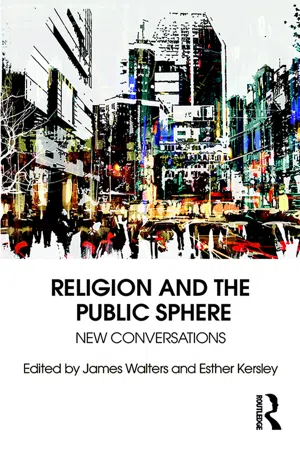
Religion and the Public Sphere: New Conversations explores the changing contribution of religion to public life today. Bringing together a diverse group of preeminent scholars on religion, each chapter explores an aspect of religion in the public realm, from law, liberalism, the environment and security to the public participation of religious minorities and immigration. This book engages with religion in new ways, going beyond religious literacy or debates around radicalisation, to look at how religion can contribute to public discourse. Religion, this book will show, can help inform the most important debates of our time.
- 110 pages
- English
- ePUB (mobile friendly)
- Available on iOS & Android
eBook - ePub
About this book
Information
PART I
Religion in plural publics
1
The future of faith
Charles Taylor and Craig Calhoun
This dialogue took place at the LSE Faith Centre on 1 December 2015 and was chaired by the Centre’s director, the Revd Dr James Walters.
JW: So Charles, Craig, I wonder if we can begin our conversation in the space that we’re in. This faith centre is a new facility that we opened nearly two years ago for religious observance and interfaith dialogue and it’s a space that has been created after 120 years of the LSE being around as a secular university and not seeing the need for such a space. So I suppose as we consider the questions around the future of faith, the question comes, the future of faith where? At this university, we gather students from all around the world and have a melting pot, a fusion of different perspectives. So I wonder what this space says about the future of faith or at least about the present state of play. Who wants to kick us off?
CT: Yeah, well I think what it says is that we’re entering an era, not everywhere but certainly in the West, in which instead of having societies organised around a single dominant or established faith (of course the US never was but every European country was more or less in the near past), instead of having societies organised around a single church or a single faith position, we have a society in which people are more and more finding their own paths – finding their own spiritual paths, finding their own directions. Even if they remain belonging to the same church as before, they very often find different ways of understanding that and, as it were, taking that as the basis of a spiritual path and they mostly don’t all belong to the same. So two questions come from this: what kind of life together does this require and what kind of life together does this kind of thing stimulate or suggest? I think that this kind of encounter becomes both more common and more necessary, we can work into the detail of that. I think that’s what this site triggers off in me.
CC: Well let me pick up on one theme in that Charles. In a way you describe three different experiences that seemingly come together. First, of each of several different faiths becoming more plural internally, so a new kind of plurality emerges inside Christianity or Islam or other faiths. Second, movement among faiths or among specific groups, and third a kind of seeking beyond specific doctrines or churches or other orthodoxies. So is there a sense in which the world of faith now is more free? That freedom is more allied to faith rather than opposed to it?
CT: Yes, I mean definitely when we had these national churches, there were very strong boundaries set from on top and people had to abide by them. We have to raise this concept, the concept of Christendom, as against Christianity. The concept of Christendom is a concept of a society which is entirely informed by the Christian faith, its politics, its art, its moral concepts, its way of conceiving, everything. So we have lived from roughly – very over simple – from Constantine until yesterday in the West, certainly in Latin Christendom, we’ve lived a Christendom. Pascal talks about ‘grandeur et misère’, its greatness and its less great elements. The point is, that is over. Lots and lots of people who remain Christian or remain in the same denomination, they just don’t want to have that kind of belonging. We can go into the reasons why that is not desired now, as well as reasons why it’s broken up, but I think that is a fundamental difference in predicament. So Christians, Jews, Muslims, whatever, in the West today are very much like, for instance, Christians in Africa or India, their plight is to be alongside a whole lot of other people with a whole lot of other faith positions.
JW: I’m conscious sitting here as a chaplain who’s a priest in an established church, so I recognise part of what you say, but Christendom is also still around in some ways and I suppose that points to the question of this new complexity about hosting and being a guest and how that plays out and I wonder how you see that in the Western context and perhaps in other contexts, how faith communities might be able to host some new plurality.
CT: Now the English establishment, like every other English thing, is very strange! It’s not what people often think of as establishment, and there is within England the continued establishment of the Anglican church, because there has been a move to pluralise that – to have members of the House of Lords who are nominated from other faiths, so the word is somehow factually correct but the spirit in which it is lived is very, very different. Now that also has the great advantage of being very plural in the approaches that it gathered into itself, it is pre-arranged to fit better into this type of world but I think that even where you have this plural kind of world, our traditions in Christendom have been formed on the assumption that you can’t have a properly unified society without an established church or its surrogate. So, the replacement for Catholic monarchism in France, was a ‘laïque’ republicanism with its own human-centred ethic. This is the idea, or unthought assumption, that kept the wars of religion going for so long. We’d like to tolerate you, but you pose an unacceptable challenge to order. Lots of people still have that mind set today. On the Christian side, that without the faith, our whole civilisational order will fall apart; on the anti-religious side, it powers hard secularism-laïcité.
CC: We might have a unified non-religion. We all don’t believe but in the same way.
CT: That’s right.
CC: In your account, if I hear it correctly, the secularism doesn’t mean simply the non-religious and it grows with religious plurality. It is in part the idea of a world in which religions relate to each other and religious people relate to each other and to those who are not religious inhabiting a common space but not necessarily the same as atheism or unbelievers.
CT: Yeah. I think there are two models to Western secularism – or laicité – depending on which language you’re speaking. One is the one that started in the States where the problem was ‘we’re very diverse so how are we going to co-exist’, so you have the no establishment clause, and the other is the one that we really think of in France where you have this tremendous struggle between Republic and Laicité on one side and a potentially hegemonic church on the other side. So there it meant putting religion in its place and stopping it from taking over. So these are two models and they are still alive today in people’s minds, although I’m very biased. I think only the first model makes sense for us today, but there are proponents of the other model.
CC: Is there also a phenomenon in which the meaning of religion changes? Not just religion in society changes, because there’s no longer this superordinate idea of one dominant faith. But with this pluralisation, the meaning of being a part of any one of these faiths is changed for people. Religion is not simply the obvious background that everyone shares, but something specific to you. You are somebody who has this faith, who embraces this position which implies someone might not, you might not under some other circumstances.
CT: Yeah, and not only you might not but you know people that are certainly brighter or just as bright as you, and very often better, or just as good as you, and so on, who have another view, who have a very different view.
CC: And so some of what happens historically then is that it’s not a movement from tight orthodoxy to fluidity, in a sense, because part of what’s opened up is the codification and the increase in orthodoxy and the raising of the stakes of which religion you belong to, expecting lay people, not just clergy, to have strong ideas about religion so that this is, in an interesting way, the production of orthodoxies precisely because of heterodoxy.
CT: That’s right. I think you could put it this way: it’s a new situation for everybody, a situation in which the structures of Christendom no longer hold or they no longer exist properly in an overarching way, or they certainly no longer hold your allegiance, and if people want to remain Christian or Catholic or Protestant or a Jew, they have to start thinking what this means and this is kind of inevitable, you can’t avoid in a certain way, innovating, having a different way of living it right.
Then there is a reaction of people who don’t like the idea of Christendom fading away and they are fighting very strongly against this. So we have, in all churches today, this kind of unfortunate polarisation between conservatives and liberals – innovators and non-innovators – and we have extremely tense relations which is really unfortunate, but the fact is that there is a growing field of those who are outside of that. So you get phenomena like, I want to mention Bonhoeffer here – this great German dissident who was fighting against the Nazis – where he talks about a ‘religionless’ Christianity. What he meant by religion was this close tie between the faith, on one hand, and the set of customs and a set of national institutions and a national identity, on the other hand, which he thought was very poisonous because, of course, Hitler was using that Germanism to seduce certain German Lutherans into the National Church and Bonhoeffer was very much opposed to that. So you get this very clear intuition in Bonhoeffer that you have to innovate, to continue Lutheran Christianity, it has to be done in a quite different way, unhooked from a society which officially has all those folk ways and rules and national identities. You get this again and again and again, and of course on the Catholic side you get someone like Mounier who made a great impression on me in the early period after the war, he wrote a book called Feu la chrétienté (The Late Christendom), in which he made this very strong point.
CC: I’m going to take us back to James’ introduction about the LSE and its secular history and the place of faith in it. It seems one of the ways to think about what you’re talking about is, students come to the LSE from a variety of communities, including communities in which there are dominant religions. When they come to the LSE, part of the LSE experience is that there are all these other people who have all kinds of different beliefs. They come in more different varieties than ever I thought possible and that’s a challenging experience, some people find it unsettling, but other people find it clarifying about what they in fact believe or what their own location is. But it is, in a way, a microcosm of the experience you’re saying is the modern experience.
CT: Exactly. Plainly we’re moving into a world in which that’s more and more the case, but not just in the West. I mean, take any large globalising city, Mumbai, Tokyo, Sao Paulo, you name it, they all have this feature, that side by side there is an incredible number of different faith positions and non-faith positions that you just meet every day and you have to rub shoulders with. So more and more of the world’s population is moving into this kind of context.
JW: Can I just push the future of faith question a bit more and Bonhoeffer, who you’ve raised, presents this to us in that he didn’t just believe that faith needed to be reconceived beyond the apparatus of Christendom and religiosity and so forth but certainly towards the end of his life, talking about ‘a world come of age’, really believing that Christianity needed to be rethought without the apparatus of transcendence and that Christianity really needed to be re-conceived on the immanent plane, which obviously ties into a lot of your work. I think, regarding the fault line you pointed to earlier in terms of the tensions within churches, a lot of people will look at Bonhoeffer and say, ‘well that really was a failed enterprise, we can’t reconceive Christianity in that way; we need to return to the transcendent’, while others may persist. I just wonder how successful you think persisting would be. Not necessarily Bonhoeffer’s project, but is thinking about the future of faith on the immanent plane an authentically religious faith?
CT: I read Bonhoeffer slightly differently but you’re the theologian so I’m probably totally wrong. I don’t find him quite saying that, I find him saying that to be coming of age, being in the modern world, is standing in a universe which is deprived of all the formally recognised pathways beyond it. Now if we go back to the early modern period or the middle ages, one of the pathways beyond is that the cosmos is all ordered to the good and is pointing beyond itself to the good. Or we have this idea that the universe is this perfect design of God, Newton and so forth, so it points to God. Or we have the idea of some enchanted universe in which spirits are moving around, angels and so on, and they point beyond. Now we live in this radically disenchanted universe. Live, in the sense, that what we’re aware of day by day, that we share with everyone else, is a universe in terms of its natural operations, be it Newton, Galileo and so on, in terms of its political orders, they are all set up by somebody, at some point, in 1787 or whatever, and then within that, can you see, can you be drawn to something which really goes beyond this? But that can’t be hooked onto anything that’s a recognisable institution that’s telling you God is there. It’s that, it’s not the absence of transcendence. Well the issue of what transcendence means, Craig was very critical of my book and rightly so because I threw this word around a little bit too easily, there are 25 different meanings to it so it’s very, very slippery.
CC: One of the things I think Bonhoeffer offers the discussion is that transcendence has to be found in a more personalised way rather than as institutionally available, so that part of the contrast that’s been evoked is that in many contexts historically there have been accounts of the worldly and what’s beyond that are institutionally conveyed and you learn them in certain settings, you participate in them, you may find a religious vocation. Bonhoeffer’s suggestion is that if that’s wiped out, it doesn’t mean transcendence is wiped out, but it does mean that the challenge as an individual to find what that can mean for you is greatly heightened.
CT: Yeah.
CC: And I wonder, you talked a lot about, and many, many others have talked about what are often called ‘seekers’, but I would say also not just ‘seekers’ in the sense of people trying to find their right religion and shopping among different ones, but within a quest, a journey, an idea of the individual’s challenge to figure out what faith means for him or her in this modern context. Is this a sort of extension of that idea?
CT: Yeah exactly. In matter of fact, that’s something that is very old in Christendom anyway. Take the Catholic Church, well its great achievements have been the development constantly of new spiritualties, Franciscan, Dominican, Jesuits, those are the famous ones but also many others, and you find in our day, Charles de Foucauld, you find Jean Vanier – our great Canadian in this regard – innovating new ways in which to live that. Now this great inventivity was always there in a sense but it was in the context of this large casing that everybody belonged to and so on. The casing has fallen away in a certain sense. That is, we have to reconstitute these forms of collective existence which we call churches without that, by bringing together people who are seeking these different directions.
JW: So I wonder, in a sense what you’re saying is that the horizontality has held together through a certain personalisation. The onus is on the individual to recover that transcendence and I wonder whether part of the tensions that we’re now seeing is between an understanding of the future of faith as essentially personalist and a future of faith as more politicised.
CT: That’s right because there is a great fear of the decline of the civilisational embedding of religion and that of course is what gives rise to various kinds of fundamentalism. It’s not an accident that in the Islamic world these have arisen because you also have societies that have been, at various times, totally Islamic or officially maybe with tolerated minorities. That too, that kind of strain, is arising there as well with some of the same polarising…
JW: So, to throw in a provocative term, might that constitute a clash of civilisations?
CT: Well, you see, it constitutes a clash within each civilisation. That’s what we’re always fighting about within Western civilisation, does it only makes sense if it all centres in Rome, in the Vatican? Or no, that’s not the sense that we can make of it. We can make of it that we have a certain number of varied, profound, common aspirations – human rights, democracy and so on – which we’re living and we’ve got to find a way of living together without fighting. So it’s a fight within each civilisation, and in the case of the Islamic world it’s even more dramatic because the various forms of fundamentalism have radically narrowed the range of spiritualities that have been traditionally very present in Islamic societies and, as a matter of fact, you find now that there’s a fight back, there’s an international movement of Sufi traditions which are trying to wrest back a place within that tradition. This is a fight within Islam.
CC: It’s not completely different from fights within Christianity in earlier periods.
CT: Exactly.
CC: When there were Protestant sects saying we should have no stained glass windows, we should not have pipe organs, we shouldn’t have music in the service, that kind of puritan response is not completely different from the response within Islam or other faiths and similarly there are others who are saying we can find happy co-existence within our secular world and culture, and those who say, ‘No, we must make a sharp divide’. Wheth...
Table of contents
- Cover
- Half Title
- Title Page
- Copyright Page
- Table of Contents
- List of contributors
- Acknowledgements
- Introduction: Reimagining academic understanding of religion in the public sphere
- PART I: Religion in plural publics
- PART II: Religion and public good
- Afterword: Religion in the English public sphere
- Index
Trusted by 375,005 students
Access to over 1.5 million titles for a fair monthly price.
Study more efficiently using our study tools.
Frequently asked questions
Yes, you can cancel anytime from the Subscription tab in your account settings on the Perlego website. Your subscription will stay active until the end of your current billing period. Learn how to cancel your subscription
No, books cannot be downloaded as external files, such as PDFs, for use outside of Perlego. However, you can download books within the Perlego app for offline reading on mobile or tablet. Learn how to download books offline
Perlego offers two plans: Essential and Complete
- Essential is ideal for learners and professionals who enjoy exploring a wide range of subjects. Access the Essential Library with 800,000+ trusted titles and best-sellers across business, personal growth, and the humanities. Includes unlimited reading time and Standard Read Aloud voice.
- Complete: Perfect for advanced learners and researchers needing full, unrestricted access. Unlock 1.5M+ books across hundreds of subjects, including academic and specialized titles. The Complete Plan also includes advanced features like Premium Read Aloud and Research Assistant.
We are an online textbook subscription service, where you can get access to an entire online library for less than the price of a single book per month. With over 1.5 million books across 990+ topics, we’ve got you covered! Learn about our mission
Look out for the read-aloud symbol on your next book to see if you can listen to it. The read-aloud tool reads text aloud for you, highlighting the text as it is being read. You can pause it, speed it up and slow it down. Learn more about Read Aloud
Yes! You can use the Perlego app on both iOS and Android devices to read anytime, anywhere — even offline. Perfect for commutes or when you’re on the go.
Please note we cannot support devices running on iOS 13 and Android 7 or earlier. Learn more about using the app
Please note we cannot support devices running on iOS 13 and Android 7 or earlier. Learn more about using the app
Yes, you can access Religion and the Public Sphere by James Walters,Esther Kersley in PDF and/or ePUB format, as well as other popular books in Teología y religión & Religión. We have over 1.5 million books available in our catalogue for you to explore.