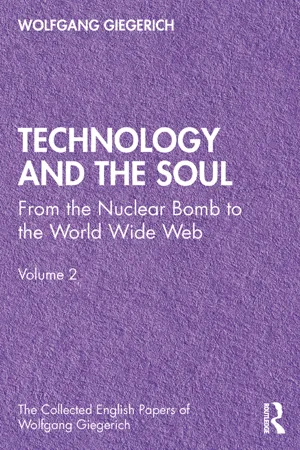
C. G. Jung famously declared that it is not the psyche that is in us, but rather we who are in the psyche. Updating this insight, the second volume of Wolfgang Giegerich's Collected English Papers examines what must be regarded as the most all-encompassing presence of our lives today: technological civilization. Living within technology, we now find that what we had formerly regarded as psychological phenomena—our feelings and emotions, images and dreams—have been superseded by phenomena bearing the predicates "artificial," "manufactured," and "virtual." Television, the World Wide Web, and the nuclear bomb are cases in point. Far from being mere things among things, each of these has transformed the whole of man's world-relation. Though deplored by many as soulless on this account, these phenomena, it may be argued, are the real gods, the real archetypes, of the soul today. Psychologically it is not what we think and feel about them that counts, but what they think, what they feel.
eBook - ePub
Technology and the Soul
From the Nuclear Bomb to the World Wide Web, Volume 2
- 360 pages
- English
- ePUB (mobile friendly)
- Available on iOS & Android
eBook - ePub
About this book
Information
PART I
__________
The Nuclear Bomb Papers
CHAPTER ONE
__________
Saving the Nuclear Bomb
Let me admit right at the outset: “Saving the Nuclear Bomb” sounds perverse. For, after all, is it the nuclear bomb that is threatened and needs to be saved, or is it not much rather we, who have to be saved from its threat? To want to save the nuclear bomb means turning things upside down. This is how it looks at first glance. But let us not be too hasty. Perhaps there is a sense in which it is indeed the bomb that is threatened, so that it would be legitimate to try to rescue, preserve, and redeem it. Then, of course, “saving” could not stand for the unscrupulous production of nuclear weapons and for protecting them against any word of warning or call for moderation and reflection. “Saving” would have to mean something altogether different. That which threatens the bomb is our general frame of mind, the way we meet reality, especially when it is undesirable. It seems Western man has only two approaches to reality, two ways to deal with predicaments. The one approach is the call for the expert who, with his knowledge of the facts and his technological know-how has to find a way out, a method of how to get rid of the problem—how to cut the tumor out or bombard it with rays, how to dump poisonous waste safely, how to free us from crime, to exterminate insect pests or human enemy forces. The other approach besides the expert knowledge is the personal feeling reaction and the call for political action.
We are for or against armament, abortion, evolution, or what have you; we demonstrate on the streets, sign petitions, protest with clenched fists, demand that this (or the opposite) be done. In neither case is the phenomenon that is causing us concern seen for what it is. The mind of the expert, to be sure, looks objectively at the facts, but only with a view to ridding us of the problem, to doing away with it. It is an exterminating, dumping frame of mind: pesticides, antibiotics, and the like are its trademark. But I want to stress: I am not just talking of the actual physical ridding us of problems, but much rather of the prior and more subtle extermination in our way of thinking about them, in the sense that unwelcome things are looked at exclusively as problems to be done away with. The same applies to the second, the pro-or-con approach to reality. Paradoxically, when we demonstrate let’s say for or against the bomb, the bomb itself is not the important thing, but what really counts and what we really demonstrate is our personal feelings about it, our wishes. We are displaying ourselves, talking more or less autistically about us, whereas the bomb, as a real phenomenon in its own right, is not much more than a peg for the manifestation of our emotions or opinions, our pro or con. So here too the real phenomenon is discarded, dumped.
In fairy tales, when the hero or heroine is in distress, he or she often comes across a brook which murmurs something to them, a tree, a bird, the wind which gives some important piece of advice, a frog, a horse, a snake which demands some service. Animals and things were able to speak. Why do animals, trees, things not speak to us? Is it because such speaking belongs solely in the world of fairy tales, but not in the real world, solely in the age once upon a time, but not in the here and now? I do not think so. Nature speaking is not, or would not have to be, a mere fairytale motif, a miracle, an utterly unreal fiction. Things do speak even today, only with our problem-solving mentality, we do not hear, we refuse to listen. And of all things, it is particularly the nuclear bomb that is speaking to us today. Indeed, it is not merely murmuring like the fairytale brook or whispering like the wind, it is yelling, shrieking, louder and louder, becoming ever more extreme, so that we need more and more noise, 24-hour TV, disco music, the loudness of high feelings or, on the other hand, perhaps something like the deafening silence of meditation to block out the voice of reality. Because there is no ear to listen to the message the real things have to impart, reality may well have to work itself up to its last resort, to the din of a nuclear explosion—to at least make itself felt, if not heard.
We really do not hear. We do not even know what hearing could possibly mean in this context. It is absolutely out of the question for us that such a thing as the bomb might have a message for us, could be a source of insight or even of wisdom. We know that things do not speak. They are dumb. Only man speaks and has an intelligence. Things, plants, animals are there to be used, to be disposed of.
But the nuclear bomb is something so utterly incredible and terrible, that disposing of it one way or other just won’t do. You can’t get rid of something real. You could at best exchange one evil for another, usually worse evil. No matter whether we build more and better bombs, or, conversely, eliminate them all—the bomb itself as a reality, as a powerful idea would remain, and remain unseen. So saving the nuclear bomb has nothing to do with defending it against the peace movement, but it means a third way beyond the entire alternative of pro or con, war or peace. It means listening to its voice, seeing its face, acknowledging its reality, and releasing it into its own essence. It means saving it from our habitual throw-away mentality. The question is not how to dispose of the bomb, but where to pose it, where to find its legitimate place.
I am here transferring the depth-psychological attitude toward the individual person’s symptom to the way of looking at the symptom of the body politic. C. G. Jung once said that in our “neurosis is hidden our best friend or enemy.”1 He did not just say “friend.” He said, “friend or enemy.” Put this way, friend and enemy cancel each other out like plus and minus, showing that the entire category of friend or enemy, pro or con, the perspective of our human likes and dislikes becomes irrelevant. What remains is “our best (friend or enemy),” our best, that is to say, the dignity of the real phenomenon itself, independent of, and prior to, our subjective valuation, a dignity even if the phenomenon is as painful as a neurotic symptom or as dangerous if not as evil as the nuclear bomb. “Saving” means restoring the dignity of things.
Because of our centuries-long training in quelling the voice of reality, we are not right away in a position from where we could hear the nuclear bomb speak or see its face. We have to overcome long distances to get there. And all I can hope to do at this time is to move us to a point where—if we are not too much out of breath—we can at least have a glimpse of its countenance, an inkling of its message. I will approach this point in a roundabout way, by leaving the bomb aside for the time being and turning first to another subject: nature.
In former times, nature was a wilderness, surrounding man on all sides, infinitely superior and inexhaustible. Human settlement, by contrast, was merely a tiny island within it. Nowadays this relationship is increasingly being reversed. It is nature that is about to become insular and to withdraw into the “zoo” or into that expanded version of the zoo we call nature reserve, wildlife sanctuary or national park, whereas the world of civilized mankind is more and more becoming the all-encompassing framework. This is not merely a quantitative change, the spreading of habitation and civilization and the corresponding diminishment of virginal nature. It is something much more radical than that wilderness is merely being pushed back to a few remnants. This is only the measurable aspect of what has taken place. But along with this quantitative reduction of wild nature to a few islands, a less noticeable but nevertheless world-shaking qualitative change is going on: a reversal in the relationship of nature and man, and thus a fundamental transformation in the very notion of nature, in its ontological essence, in what “nature” means.
It used to be inherent in the notion of nature that it is that which encompasses and bears our existence. Nature, that was Mother Earth, who brings forth and nourishes man and also takes him in again at his death. But what is nature today? She is no longer Mother, but rather man’s problem child. Now man is called upon to accept responsibility for nature, indeed to guarantee her survival: wildlife conservation, environmental protection. It is as if nature had become senile and helpless and now were utterly dependent on the care of her grown up children, or as if she were on welfare requiring our planning and support.
Strictly speaking, wildlife conservation or nature protection is a contradiction in terms. For in the very moment that nature needs to be protected, it is no longer nature in the true sense, and thus it is precisely by way of the protection of nature that its ontological annihilation is taking place, nature’s denaturation.
The change from the Great Mother to the problem child strikingly reveals the reversal that has taken place. Of course, you might say, nature needs protection only because we ruthlessly exploited the wilderness in the first place. But that we were able to do this is the very point: in former times, man could have committed the worst sin against nature without doing her any real harm, she would always have remained infinitely superior to him. But now the fate of nature herself is given into the hands of man. In this sense, it is now we who are superior to her and surround her from all sides.
We can express this change also as a movement from one place or topos to another. In earlier times, the place of nature was the open expanse surrounding man. My word for nature when it is at this topos is “wilderness.” The other topos I term “zoo.” In the zoo, the animals that used to belong to the wild are now locked into cages, so that they cannot threaten us from without. Rather, we can now in all safety walk around them. If “zoo” is here understood not as an empirical locality, but rather as an ontological topos, a place in the imagination, then “zoo” means that topos at which wild nature is encircled by and embedded in the civilized world; zoo means that ontological place at which nature—quite unnaturally—has its essence in being the object of human care-taking, planning, and research. Thus we find the zoo in this sense even where there is no literal zoological garden, not even a nature reserve, but where animals can still be seen in the wild. For even these animals have long ago become the objects of the curiosity of television viewers or of the cameras of safari tourists and therefore they at bottom are once and for all animals of the zoo, fenced in by the bars of an imaginal cage that modern man carries with him in his mind even when he ventures into the last remains of virginal nature. And his camera is the outward token and replica of the imaginal chamber (“camera”) into which all nature is placed today. With every photograph we prove our power to capture nature in a box that we can carry around with us, the power to freeze it onto film.
The same world-shaking change that happened to nature can also be observed with respect to history. Here too there is a reversal from a wide expanse or “wilderness” in which man found himself, to a tame interior, into which history is fenced. This interior is the museum, history’s equivalent of the zoo of nature. More and more the museum is becoming the place of history. Everything historical moves into the museum and turns into an antique. It is torn out of the “wilderness,” that is out of its living tradition and customary use, and is imprisoned in showcases, where we can safely walk around it. I say safely, for in former times the objects that we now find in the museum might, as it were, have “assaulted” us much as did certain wild animals. Let us take an altar piece as an example. In the museum, the painting is the dead object of the tourist’s aesthetic contemplation or curiosity. The same painting in its original place in the church a few hundred years ago would have “assaulted” the believer with its demand to bend his knees before it and cross himself in devotion. There, the picture was alive, it had a will of its own.
Of course, just as with the “zoo,” the “museum” does not refer solely to the literal building or institution of that name, but is the term of an imaginal topos. For even cathedrals and entire medieval cities that on account of their size would not fit into a museum are nonetheless huge open air museums, and historical personages, events or movements, which, since they are immaterial, could not be shown in a museum, are being viewed with a museum frame of mind.
Just as nature is to be protected, so the relics of history, when seen from the museum point of view, must be preserved and restored: protection of historical monuments. History too has been ontologically annihilated and denatured because it is deprived of its innermost nature, which was to be the wind of time. It has been reduced to a mass of antiques and factual knowledge about the past, a mass that has to be collected and protected by us. Here, too, man has taken over the responsibility for the historical and stands no longer in history, exposed to its wind. History has likewise become insular, so to speak, captured and contained in the museum, the history book, or in the documentary, not to mention in Disneyland.
Fortunately, we can observe a little more closely the actual historical moment of the radical reversal from man’s embeddedness in something expansive surrounding him to a state where that which used to surround him has shrunk to a limited object now encircled by man. I want to show this in one small example, in the change from the fear exuding for 17th-century man from the terrors of the night, of thunderstorms, and of high mountains, to 18th century man’s beginning fascination with the horrible. Way into the 17th century it was generally customary that every night before going to bed the head of the house would gather the entire household around him to say prayers for the night. Single people would sing their evening hymn in their bed chamber. We still have copies of the prayer and hymn books that people used then and that were produced and reprinted in millions of copies. They were true bestsellers of their age, which shows that they expressed and responded to the actual feelings of the vast majority of people. Now, the fact is that the texts of these evening prayers abound in descriptions of the horrors of the night. Some of them refer to actual, even if rather unlikely, dangers that might befall the innocent sleeper such as fire, theft, murder, or the violation of the virgin during her sleep. For the most part, however, they are monotonous clichés about totally unspecific dangers, the terror, awe and fear coming with the night, “black, sinister night.” As Richard Alewyn, who wrote about these fears, said, it is precisely the monotony of these cliché descriptions that is evidence of their authenticity.2 Obviously these are fears of intangible dangers of the night that cannot be pinned down to anything empirical, fears of the imaginal or mythical horrors of the night.
Similarly, the rugged mountains of the Alps caused sheer terror in the people of that age. The very same sights that today attract millions of tourists were then experienced as horrifying. Even courageous men would not venture into the “desolate and wayless wilderness of forests and mountains” without necessity. In the reports of travelers to Italy who had to cross the Alps, we read how horror-stricken they were at the sight of gorges and cliffs.
A hundred years later the situation began to change as a result of the Enlightenment. I confine myself to one example, that I also owe to the paper by Alewyn. Jean Jacques Rousseau, the French philosopher, describes in his autobiography that he loved to walk to his favorite place in the Savoyan Alps, a path at the edge of a ravine, where, secured by a railing, he could look down into the gorge in order “de gagner des vertiges tout à mon aise,” in order to procure the feeling of dizziness for himself at his ease, and he adds, “I love this whirling, provided that I am in safety.”3
Let us dwell for a moment on this image of Rousseau leaning on a railing and looking down into the gorge. What does this image tell us? What change has taken place here so that the same gorge that might have struck 17th century man with horror could now become thrilling?
I said, the same gorge. Indeed, the Alps out there did not change. What changed was the ontological framework within which the same sight is seen and from which it receives its nature, its ontological quality and status. In the one case, in the earlier century, the ravine was, to be sure, just as limited as at the time of Rousseau. But obviously, it was not confined to being merely this one particular thing. Rather, it opened up and allowed you to see the abyss of being as such, the primordial void, the yawning chasm prior to all creation, cosmological Chaos. The one individual gorge was like a window through which all-encompassing wilderness was glaring at you and into your life, threatening to intrude into the insular human world of day, hope, and safety. You looked at this particular thing, the one ravine ...
Table of contents
- Cover
- Half Title
- Title Page
- Copyright Page
- Table of Contents
- Acknowledgments
- Sources and Abbreviations
- Introduction: The Object of Psychology
- Part I: The Nuclear Bomb Papers
- Part II: Technological Civilization and “Medial” Modernity
- Coda: A Little Light, to Be Carried through Night and Storm: Comments on the State of Jungian Psychology Today
- Index
Trusted by 375,005 students
Access to over 1.5 million titles for a fair monthly price.
Study more efficiently using our study tools.
Frequently asked questions
Yes, you can cancel anytime from the Subscription tab in your account settings on the Perlego website. Your subscription will stay active until the end of your current billing period. Learn how to cancel your subscription
No, books cannot be downloaded as external files, such as PDFs, for use outside of Perlego. However, you can download books within the Perlego app for offline reading on mobile or tablet. Learn how to download books offline
Perlego offers two plans: Essential and Complete
- Essential is ideal for learners and professionals who enjoy exploring a wide range of subjects. Access the Essential Library with 800,000+ trusted titles and best-sellers across business, personal growth, and the humanities. Includes unlimited reading time and Standard Read Aloud voice.
- Complete: Perfect for advanced learners and researchers needing full, unrestricted access. Unlock 1.5M+ books across hundreds of subjects, including academic and specialized titles. The Complete Plan also includes advanced features like Premium Read Aloud and Research Assistant.
We are an online textbook subscription service, where you can get access to an entire online library for less than the price of a single book per month. With over 1.5 million books across 990+ topics, we’ve got you covered! Learn about our mission
Look out for the read-aloud symbol on your next book to see if you can listen to it. The read-aloud tool reads text aloud for you, highlighting the text as it is being read. You can pause it, speed it up and slow it down. Learn more about Read Aloud
Yes! You can use the Perlego app on both iOS and Android devices to read anytime, anywhere — even offline. Perfect for commutes or when you’re on the go.
Please note we cannot support devices running on iOS 13 and Android 7 or earlier. Learn more about using the app
Please note we cannot support devices running on iOS 13 and Android 7 or earlier. Learn more about using the app
Yes, you can access Technology and the Soul by Wolfgang Giegerich in PDF and/or ePUB format, as well as other popular books in Philosophy & Philosophy History & Theory. We have over 1.5 million books available in our catalogue for you to explore.