Known for its accessible approach and concrete real-life examples, the second edition of Practical Business Negotiation continues to equip users with the necessary, practical knowledge and tools to negotiate well in business. The book guides users through the negotiation process, on getting started, the sequence of actions, expectations when negotiating, applicable language, interacting with different cultures, and completing a negotiation. Each section of the book contains one or two key takeaways about planning, structuring, verbalizing, or understanding negotiation.
Updated with solid case studies, the new edition also tackles cross-cultural communication and communication in the digital world. Users, especially non-native English speakers, will be able to hone their business negotiation skill by reading, discussing, and doing to become apt negotiators.
The new edition comes with eResources, which are available at https://www.routledge.com/Practical-Business-Negotiation-2nd-Edition/Baber-Fletcher-Chen/p/book/9780367421731.
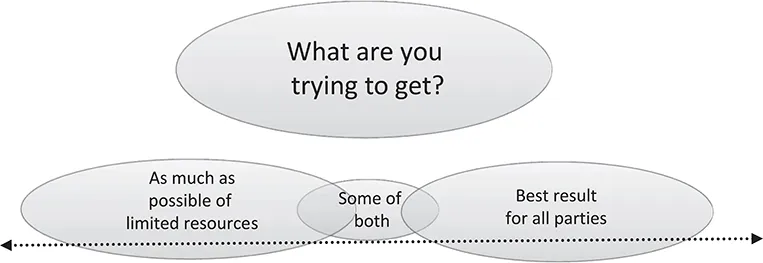
“What are you trying to get?” This is a key overall question to answer before beginning the planning and talking (see Figure 1.1).
Figure 1.1 What are you trying to get?
Your answer is likely to be “as much as possible” or “best result for all” or a combination of these two.
The following two concepts are fundamental to understanding negotiation and how negotiators think.
Distributive perspective. Negotiators try to dominate the other party because they believe they are in direct conflict with the other party over limited resources. Negotiators in a distributive situation fight hard for their positions (specific prices or amounts) because their loss is the other side’s gain. The negotiators believe there will be a clear winner and loser, but not multiple winners.
Adapted from Metcalf and Bird (2004)
Integrative perspective. Negotiators . . . believe that all parties can win through mutually beneficial solutions. Integrative negotiators take a problem-solving approach, putting focus on exchanging information in order to identify underlying issues and interests and to generate outcomes that benefit all parties.
Negotiators reach agreement by employing creative problem solving approaches to develop solutions that increase the benefits available to everyone.
Adapted from Metcalf and Bird (2004)
Distributive thinking is useful when you must get a certain amount of limited resources for your side. In most real world business situations, however, this kind of thinking will block you from creating and sharing maximum mutual value.
Integrative thinking is useful in complex situations where you need to connect many issues and when you want to maximize the opportunities for value.
Q1:
Which of these negotiations are probably distributive? _____
A renter and landlord negotiating the rental price of an apartment.
b. Deciding how Yumi, Ken, and Jun will share the last piece of cake.
c. Developers, manager, and residents considering a new training camp for a winning, major famous sports team in a rural area.
d. A football star working out a salary with the team’s managers.
Q2:
Ichiro is an international baseball star. He is so famous everyone recognizes him just by his first name! His main advertising contract is with Kirin beer, one of the three large beer makers in Japan. His negotiator gets a share of every advertising contract. How do you think the negotiator will approach negotiations? With distributive or integrative thinking? Why? _____________________________________________________________ _____________________________________________________________
Q3:
Which of these negotiations are probably “integrative”?
Buying a car.
Arranging a meal and price for your hiking club (40 people).
Buying snacks in the outdoor market.
Developing the annual financial budget of a city with 2 million inhabitants.
Q4:
Write an example of a typically distributive negotiation: ________________
Q5:
Write an example of a typically integrative negotiation: ________________
Q6:
Your company is buying a division of Osaka based Kansai Kogyou (KK). The agreement is complicated, but entirely based on money. Is it distributive or integrative?_____________________________________________________________
Once there were two little boys and one old broken bicycle. Each one wanted the bicycle; they could not agree to share it. Eventually they started talking … they learned that one wanted the old tires to make a catapult, and the other wanted the body to make pipes. Integration of their needs and interests made it possible to distribute everything successfully.
Another basic way to think about negotiation is Claiming and Creating Value.
When you claim value, you are aiming for the left side of Figure 1.1 as a distributive negotiator. Claiming value means getting as much as possible of limited resources.
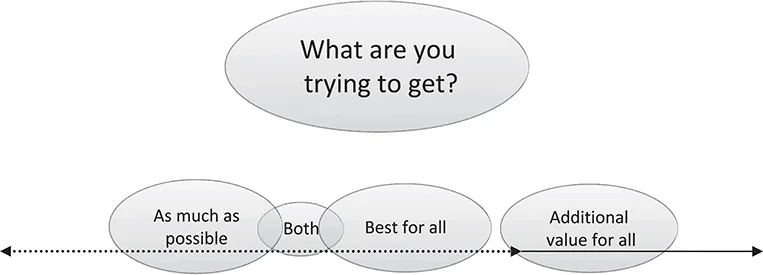
When you create value, you are aiming for the right side of Figure 1.1 … and beyond. Creating value is certainly integrative; you must bring many issues together, even issues not planned for the negotiation, to create new value.
See Figure 1.2 below for the idea of going beyond “Best”.
Figure 1.2 Try to get more
Example of creating new value
A manufacturer and a distributor were negotiating a typical limited distribution agreement. After some discussions, they agreed to have the distributor make a small change to products sold in one region. Therefore, the manufacturer sold more products and the distributor gained value-added work. Both sides created new value together, beyond their plans for “typical distribution”.
It is a good habit to think about opportunities for creating new value from the start of a negotiation, even during the early planning phases.
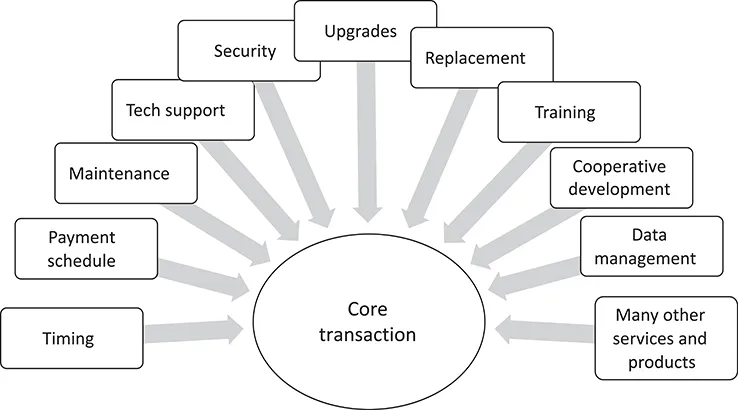
Movius and Susskind (2009, pp. 180–181) include a checklist for new value creation such as looking for different ways that the parties value the same issue, joint use of resources, differences in risk tolerance, and additional issues to add to the core transaction.
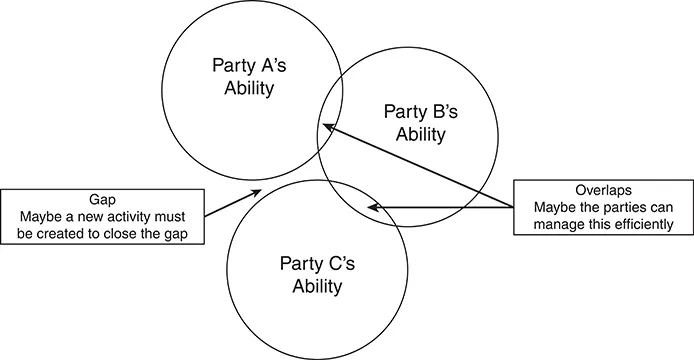
Following the ideas of Movius and Susskind, negotiators should look for opportunities to create new value in the gaps where the parties cannot easily match their abilities, viewpoints, values, or resources. For example, a party which sees no value in retail sales may be happy to let another party with distribution skills handle some retail work.
Along the way, parties should look for new value opportunities where skills, interests, viewpoints, and abilities overlap. For example, if both parties are good at an activity, they could bring their teams together to share best practices and gain efficiency.
Figure 1.3 illustrates the gaps and overlaps.
Figure 1.3 Creating new value: gaps and overlaps
Figure 1.4 provides additional practical ideas about where to search for new value opportunities in typical contracts and agreements.
Figure 1.4 Where to find new value opportunities
Section terminology
Integrate: combine various information, needs, and goals.
Resources: things used to conduct business such as time, money, equipment, staff, etc.
Tangible: physical things you can touch (money, equipment, products, etc.)
Intangible: non-physical things (brand, reputation, feelings, etc.)
Section summary
Most negotiations include sharing finite limited resources (distributive) that are connected with more complex, tangible or intangible issues (integrative).
Choosing the strategy
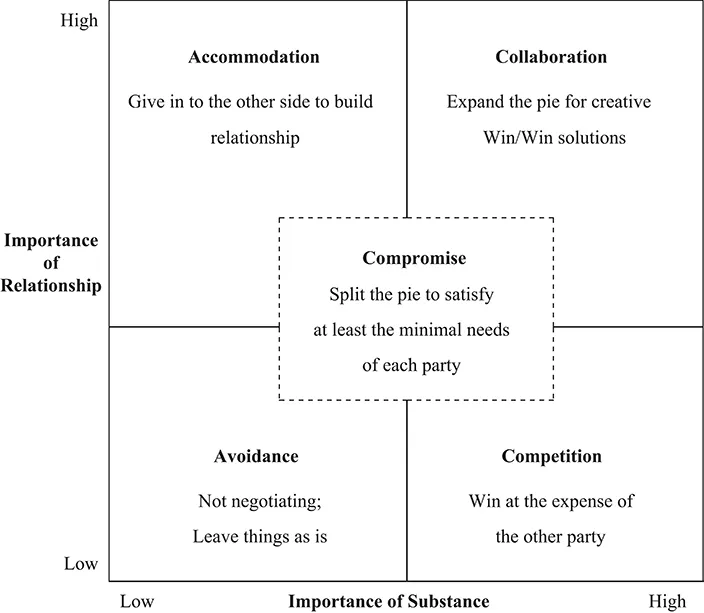
Five broad negotiation strategies, accommodate, collaborate, compromise, avoid, and compete are described by Lewicki, Hiam and Olander (1996) in their well-known graphic (Figure 1.5):
Figure 1.5 Choosing a negoti...
Table of contents
Cover
Half Title
Title Page
Copyright Page
Table of Contents
List of figures
List of tables
List of cases
Acknowledgements
Guide to using this book
Introductory Comment
1. What do you want to get from negotiations?
2. First connections
3. Core negotiation concepts
4. Structure and planning
5. Some cultural considerations
6. Talking the talk
7. Negotiation tactics
8. Win at home before you go
9. What kind of negotiator … are you? … are they?
10. Agreements
11. Review from a high altitude
12. Reflection on negotiation theory
Appendix I: Glossary
Appendix II: Case simulations
Appendix III: Planning documents
Appendix IV: Cultural differences
Appendix V: Understanding failure
Appendix VI: Stakeholder analysis
References
Index
Notes
Trusted by 375,005 students
Access to over 1.5 million titles for a fair monthly price.
Study more efficiently using our study tools.
Frequently asked questions
Yes, you can cancel anytime from the Subscription tab in your account settings on the Perlego website. Your subscription will stay active until the end of your current billing period. Learn how to cancel your subscription
No, books cannot be downloaded as external files, such as PDFs, for use outside of Perlego. However, you can download books within the Perlego app for offline reading on mobile or tablet. Learn how to download books offline
Perlego offers two plans: Essential and Complete
Essential is ideal for learners and professionals who enjoy exploring a wide range of subjects. Access the Essential Library with 800,000+ trusted titles and best-sellers across business, personal growth, and the humanities. Includes unlimited reading time and Standard Read Aloud voice.
Complete: Perfect for advanced learners and researchers needing full, unrestricted access. Unlock 1.5M+ books across hundreds of subjects, including academic and specialized titles. The Complete Plan also includes advanced features like Premium Read Aloud and Research Assistant.
Both plans are available with monthly, semester, or annual billing cycles.
We are an online textbook subscription service, where you can get access to an entire online library for less than the price of a single book per month. With over 1.5 million books across 990+ topics, we’ve got you covered! Learn about our mission
Look out for the read-aloud symbol on your next book to see if you can listen to it. The read-aloud tool reads text aloud for you, highlighting the text as it is being read. You can pause it, speed it up and slow it down. Learn more about Read Aloud
Yes! You can use the Perlego app on both iOS and Android devices to read anytime, anywhere — even offline. Perfect for commutes or when you’re on the go. Please note we cannot support devices running on iOS 13 and Android 7 or earlier. Learn more about using the app
Yes, you can access Practical Business Negotiation by William W. Baber,Chavi C-Y Fletcher-Chen,Chavi Fletcher-Chen in PDF and/or ePUB format, as well as other popular books in Personal Development & Business Communication. We have over 1.5 million books available in our catalogue for you to explore.