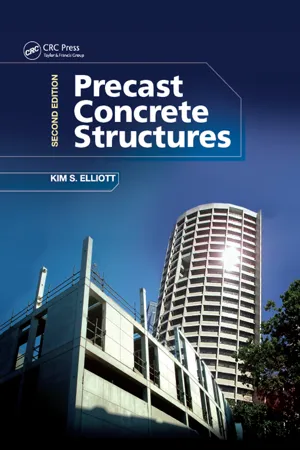
This second edition of Precast Concrete Structures introduces the conceptual design ideas for the prefabrication of concrete structures and presents a number of worked examples that translate designs from BS 8110 to Eurocode EC2, before going into the detail of the design, manufacture, and construction of precast concrete multi-storey buildings. Detailed structural analysis of precast concrete and its use is provided and some details are presented of recent precast skeletal frames of up to forty storeys.
The theory is supported by numerous worked examples to Eurocodes and European Product Standards for precast reinforced and prestressed concrete elements, composite construction, joints and connections and frame stability, together with extensive specifications for precast concrete structures. The book is extensively illustrated with over 500 photographs and line drawings.
What makes precast concrete different from other forms of concrete construction? Whether concrete is precast, that is statically reinforced or pretensioned (prestressed), is not always apparent. It is only when we consider the role concrete will play in developing structural characteristics that its precast nature becomes significant. The most obvious definition for precast concrete is that it is concrete which has been prepared for casting, cast and cured in a location which is not its final destination. The distance travelled from the casting site may only be a few metres, where on-site precasting methods are used to avoid expensive haulage (or VAT in some countries), or may be thousands of kilometres, in the case of high-value-added products where manufacturing and haulage costs are low. The grit basted architectural precast concrete in Figure 1.1 was manufactured 600 km from the site, whereas the precast concrete columns, beams and walls shown in Figure 1.2a and b travelled less than 60 m; wall panels have been stack-cast in layers between sheets of polythene adjacent to the final building.
What really distinguishes precast concrete from cast in situ is its stress and strain response to external (load-induced) and internal (autogenous volumetric changes) effects. These are collectively known as ‘actions’ in the Eurocodes, and those mainly applicable to precast concrete structures are the ‘keynote’ code EC0 (BS EN 1990 2002), the loading or ‘actions’ code EC1 (BS EN 1991-1-1 2002) and the ‘concrete design’ code EC2 (BS EN 1992-1-1 2004).
A precast concrete element is, by definition, of a finite size and must therefore be joined to other elements to form a complete structure. A simple bearing ledge or corbel will suffice, as shown in Figure 1.3. But when thermal shrinkage or load-induced strains cause volumetric changes (and shortening or lengthening), the two precast elements try to move apart (Figure 1.4a). Interface friction at the mating surface prevents movement, but in doing so creates a force F = μR which is capable of splitting both elements unless the section was suitably reinforced (Figure 1.4b). Figure 1.5a shows an example of where frictional forces due to relative, unreinforced movement between precast slabs and beams caused spalling in the beam. In other cases, spurious positive bending moments due to the restraint of relative movement or end rotation have caused cracking in the soffit of slabs, or at a beam-to-column corbel connection, as shown in Figure 1.5b.
Flexural rotations of the suspended element (the beam) reduce the mating length lb (bearing length), creating a stress concentration until local crushing at the top of the pillar (the column) occurs, unless a bearing pad is used to prevent stress concentration (Figure 1.4c). If the bearing is narrow, dispersal of stress from the interior to the exterior of the pillar causes lateral tensile strain, leading to bursting of the concrete at some distance below the bearing unless the section is suitably reinforced (Figure 1.4d).
Figure 1.1 Architectural-structural precast concrete frame at Scottish Office, Leith, United Kingdom. (Courtesy of Trent Concrete Ltd., Leith, UK.)
Figure 1.2 (a) Site cast using stack casting between sheets of polythene. (b) Completed structure of mould cast columns and beams and stack cast walls.
Figure 1.3 Simple bearing nib and corbel.
Figure 1.4 (a) Unrestrained movement between two precast concrete elements. (b) Restrained movement but without tensile cracking prevention. (c) Reduced bearing length and stress concentrations due to flexural rotation. (d) Lateral splitting due to narrow bearings (left) (A) and preventative (confinement) rebars (right) (B). (e) Loss of bearing due to accidental actions (left) (A) and preventative dowel bar (right) (B). (f) Loss of bearing due to settlement (left) (A) and preventative rebar loops (right) (B).
If the column is disturbed by an accidental or a structural force H such that H > μR, the displacement u is not elastically recoverable and may lead to instability or even loss of bearing altogether unless the bearing possesses shear capacity (Figure 1.4e). Should the column’s foundation fail, loss of bearing will occur unless the bearing has tensile capacity (Figure 1.4f).
These are some factors that distinguish precast concrete from other forms of construction.
Figure 1.5 (a) Spalling due to relative movement between slabs and beams. (b) Cracking due to spurious restraint at a beam-to-column corbel connection.
1.2 PRECAST CONCRETE STRUCTURES
A precast concrete structure is an assemblage of precast elements which, when suitably connected together, form a three-dimensional framework capable of resisting gravitation and wind (or even earthquake*) loads. The framework is ideally suited to buildings such as offices, retail units, car parks, schools, stadia, and other such buildings requiring minimal internal obstruction and multifunctional leasable space. The quantity of concrete in a precast framework is less than 4% of the gross volume of the building, and two-thirds of this is in the floors. In the case of the shopping centre and car park shown in Figure 1.6, the precast concrete elements supporting vertical actions (i.e. gravity loads) are columns, beams, floor slabs, staircases, and stair-cores. The framework is ‘braced’ against horizontal actions (i.e. lateral loads and wind pressure) using very deep columns (gable end to the left of the photo) and diagonal bracing (front elevation). The framework shown in Figure 1.7 was built using similar elements, but because the resistance against horizontal actions is provided by the same columns that support vertical actions, the framework and hence the columns are classed as ‘unbraced’. The precast framework Figure 1.8 is likewise a column, beam and slab structure, but here the beam-to-column connections are designed as moment resisting, and therefore together with the strength and stiffness of the beams and columns, the resistance against horizontal actions is provided frame action, in a similar manner as for cast in situ concrete frames. The distinguishing feature of the precast framework is that the beam-to-column connections are rarely fully rigid, known as ‘semi-rigid’, and therefore the columns must also resist horizontal actions as in the case of the unbraced frame in Figure 1.7. The frameworks shown in Figures 1.9 and 1.10 were built using similar elements, but t...
Table of contents
Cover
Half Title
Title Page
Copyright Page
Table of Contents
Preface to the First Edition
Preface to the Second Edition
Acknowledgement
About the Author
Notation
1 What is precast concrete
2 Materials used in precast structures
3 Precast frame analysis
4 Precast concrete floors
5 Precast concrete beams
6 Precast concrete columns
7 Shear walls
8 Horizontal floor diaphragms
9 Joints and connections
10 Beam and column connections
11 Ties in precast concrete structures
12 Design exercise for 10-storey precast skeletal frame
Index
Trusted by 375,005 students
Access to over 1.5 million titles for a fair monthly price.
Study more efficiently using our study tools.
Frequently asked questions
Yes, you can cancel anytime from the Subscription tab in your account settings on the Perlego website. Your subscription will stay active until the end of your current billing period. Learn how to cancel your subscription
No, books cannot be downloaded as external files, such as PDFs, for use outside of Perlego. However, you can download books within the Perlego app for offline reading on mobile or tablet. Learn how to download books offline
Perlego offers two plans: Essential and Complete
Essential is ideal for learners and professionals who enjoy exploring a wide range of subjects. Access the Essential Library with 800,000+ trusted titles and best-sellers across business, personal growth, and the humanities. Includes unlimited reading time and Standard Read Aloud voice.
Complete: Perfect for advanced learners and researchers needing full, unrestricted access. Unlock 1.5M+ books across hundreds of subjects, including academic and specialized titles. The Complete Plan also includes advanced features like Premium Read Aloud and Research Assistant.
Both plans are available with monthly, semester, or annual billing cycles.
We are an online textbook subscription service, where you can get access to an entire online library for less than the price of a single book per month. With over 1.5 million books across 990+ topics, we’ve got you covered! Learn about our mission
Look out for the read-aloud symbol on your next book to see if you can listen to it. The read-aloud tool reads text aloud for you, highlighting the text as it is being read. You can pause it, speed it up and slow it down. Learn more about Read Aloud
Yes! You can use the Perlego app on both iOS and Android devices to read anytime, anywhere — even offline. Perfect for commutes or when you’re on the go. Please note we cannot support devices running on iOS 13 and Android 7 or earlier. Learn more about using the app
Yes, you can access Precast Concrete Structures by Kim S. Elliott in PDF and/or ePUB format, as well as other popular books in Technology & Engineering & Civil Engineering. We have over 1.5 million books available in our catalogue for you to explore.