There are over half a million listed buildings in Britain, conservation areas can be found in every borough, and a large proportion of our housing stock pre-dates 1914. So, whether in extending a listed house, reordering a local church, or converting an historic warehouse, most architects will work with historic buildings at some point in their career – even if they are not a specialist conservation architect.
An Introduction to Architectural Conservation introduces non-specialist architects to the principles behind legislation concerning historic buildings. It will help them understand the practicalities of this legislation, the aims and objectives of Conservation Offices, Statutory Amenity Societies and other guardians of our heritage. With these skills, readers can advise clients more accurately, make successful listed building applications, and ensure their interventions are sensitive, appropriate and effective.
An Introduction to Architectural Conservation is also a practical guide to good working practice: taking readers through the process of preparing a listed building application, preparing a suitable tender package and administering the contract.
.
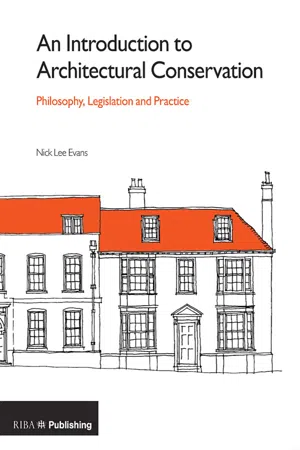
eBook - ePub
An Introduction to Architectural Conservation
Philosophy, Legislation and Practice
- 126 pages
- English
- ePUB (mobile friendly)
- Available on iOS & Android
eBook - ePub
About this book
Information
Topic
ArchitectureSubtopic
Architecture GeneralChapter 1
The Role of the Architect in Maintaining and Adapting Historic Buildings
Architects and surveyors play a vital role in both repairing and maintaining historic structures, as well as in making careful changes and conversions for modern occupation. Renewed usefulness through occupation is not the only value these buildings hold, they also provide a physical record of our history and often hold an emotional meaning in a community derived from its collective experience of a place. They give important insights into our past that can be physically experienced and understood, more so than through records on drawings, film or in words. They remind us of how earlier generations lived, and provide our historic towns and villages with the architectural heritage that is part of our cultural identity. They also often symbolise wider values, such as faith, and by definition listed buildings possess an architectural and historic importance. Historic structures for these reasons are valued as single examples of fine architecture or as groups that create urban landscapes of high cultural significance. Historic buildings are a treasured non-renewable resource, and therefore should only be altered after due consideration of their significance.
Heritage assets
Listed buildings, scheduled ancient monuments, historic gardens and castles, conservation areas and historic landscapes are given a special status as heritage assets in law because they hold meaning for society beyond their functional utility. Because of this cultural significance, strong feelings are often aroused in the community when we seek to alter such buildings. Government therefore seeks to protect them through legislation, and in consequence requires an informed approach in order to obtain consent to change designated heritage assets.
To work successfully on listed buildings and to ensure interventions are not damaging, architects need to understand the legislation and the conservation principles that underpin them. Such knowledge will allow architects to understand the objectives of conservation officers and other guardians of our heritage, and therefore facilitate in tailoring applications to satisfy their requirements. By developing these skills, architects will be better placed to advise clients with greater authority, make successful listed building applications, use time more efficiently in the process and leave behind better preserved built heritage for future generations.
In this guide we examine the principles behind the legislation as well as the designation systems currently in force to protect our nation’s heritage assets.
Preserving character does not mean preventing change
Buildings are not static objects; they decay, and their use often changes over time. Weather will transform them, and without maintenance and renewal buildings fall into disrepair. This can happen surprisingly quickly; tiles slip, gutters block and damp enters into the building leading to rot and fungal decay.
Architects and surveyors who are often involved in the maintenance of buildings need to recognise the causes of decay and know how to rectify problems. The choices made however when making repairs can also affect the architectural, historical and cultural significance of the building. For example, renewing all the decayed stone tracery in a church window will lose its patina and sense of age, whereas a more careful and thoughtful approach to specification will aim to preserve as much original material as possible, resulting in better retention of the essential character of the window and its architectural and historic interest. The critical judgement is in balancing these values against the need to avoid further work in the near future.
Old buildings can be of great architectural, cultural or historical significance, and in order for them to be maintained there has to be a sustainable continuing use which will pay for and ensure their upkeep. Often such buildings become redundant when they no longer suit their original uses, needing sensitive alteration to ensure their survival. The design skills of conservation architects can ensure a building has a continued use without destroying its architectural, historical or cultural value. This guide recognises the need for change, and sets out to give an introduction to the philosophical and legislative framework which should guide those who seek to work on historic and listed buildings.
Building technologies and sustainability
There isn’t scope in this guide to explain how all of the various and numerous historic building materials behave. Such knowledge is paramount for architects to bring to conservation projects, and there are many sources both printed and online that can guide architects, including SPAB Technical Guides, and publications from English Heritage on the repair of traditional building materials and techniques. This book however seeks to explain the commonly accepted principles of conservation and show how they can be applied to good working practices on a project, from the initial analysis of the fabric, through to the choice of repair, specification writing and contract management, and will also direct the reader to sources of specialist advice, in the Further Reading section.
The technical challenges of maintaining and adapting historic buildings require special knowledge by architects and surveyors, and furthermore an understanding that historic buildings were created with technologies that were usually based on local natural resources; often, such materials perform in very different ways to our modern construction methods. Materials and construction techniques used in traditional buildings are characterised by the widespread use of materials derived from natural sources such as lime, clay, stone, oak etc. These materials are normally more permeable than modern building materials and thus allow moisture to migrate through the building fabric more easily.
It is only from around 1919 onwards that new materials such as reinforced concrete, Portland cement mortars, damp proof membranes and related techniques such as cavity wall construction came into common use. Modern construction techniques also rely on impervious barriers such as plastic membranes to make the building resistant to moisture, often coupled with mechanical ventilation and heat recovery. Modern architects are not normally trained to understand traditional building and construction technologies, and if modern construction methods and materials are applied to an older building, damage can occur for example through moisture entrapment and reduced ventilation1.
All historic buildings have also taken considerable resources to build, and their replacement would require high levels of energy and resources in materials manufacture, transport and construction. There is therefore a strong case to retain and use or re-use our older building stock simply on grounds of sustainability, although there is a growing need to reduce the energy used to light, heat and maintain them. Upgrading old and significant structures to make them more energy efficient involves a special, and growing skillset. The standard methods of upgrading buildings, such as reducing air admittance, double glazing windows and using vapour impermeable insulation can cause many further problems and lead to accelerated fabric decay in historic buildings.
Do you need to be a specialist?
When work is proposed on the most important historic buildings there is clearly an advantage in being an accredited conservation architect who can demonstrate specialist knowledge. English Heritage promotes accredited conservation architects, and looks to registration bodies such as the RIBA and AABC to identify and accredit those with the appropriate skills. English Heritage and the Heritage Lottery Fund (HLF) ensures that agents applying for their grants are accredited, and the Government is promoting that all work on publicly owned historic buildings should use accredited specialist architects, surveyors and engineers. The steady growth of conservation accreditation for professionals does not stop many non-specialist, non-accredited architects, doing valuable work on listed buildings, most of which are private domestic buildings, as long as due care is taken and recognition of being out of one’s depth leads to seeking specialist advice and researching the problem area when necessary.
Increasingly those architects who have built up their skills to work on historic buildings may find it an advantage to have their skills recognised through accreditation bodies such as the RIBA Conservation Register, especially as more clients are now seeking architects with such additional qualification, and more public sector clients, heritage trusts and church authorities adopt membership on the Conservation Register as a prerequisite of tendering.
The RIBA Accreditation Scheme is based on recognising different levels of skills, so architects can develop over time from Registrants to Conservation Architects (CA) to Specialist Conservation Architects (SCA). It is hoped many architects will come to recognise the advantages of doing so. Those thinking of applying to enter the RIBA’s Conservation Register can find more details on the RIBA website2.
In the recession following the banking crisis of 2008 the number of new buildings architects have been asked to design has significantly dropped. However, RIBA benchmarking surveys show that since 2008, retrofitting and reuse of older buildings has been a growing proportion of architects’ workload3. There is clearly an ongoing need for those architects who can creatively maintain and adapt historic structures to continue their use and be made more energy efficient. This guide should be of interest to architects and surveyors seeking to exploit the work available not only in conserving and adapting historic buildings, but also those involved with refurbishing and retrofitting.
Summary
This book seeks to explain the commonly accepted principles of conservation and show how they can be used to guide good working practices on a project from the analysis of the fabric, choice of repair, dealing with legislation, to specification writing and contract management, and will also direct architects to sources of specialist advice.
It is written for non-specialist architects as well as conservation professionals. It seeks to introduce the commonly accepted principles of conservation, and explain how these have led to our current legislative framework concerning historic buildings, allowing the reader to understand the aims and objectives of conservation officers, statutory amenity societies and other guardians of our heritage. An understanding of the commonly accepted conservation principles allows architects to advise clients accurately, make successful listed building applications, and ensure that interventions do not unnecessarily damage historic fabric.
Finally, this guide aims to provide a practical outline to good working practice; taking the reader through the process of a listed building application, preparing the tender package and administering the appropriate form of contract. It will highlight the differences in approach when working on historic building projects compared to normal projects.
Notes
1 Thomas, A., Williams, G. & Ashurst, N. (1992), The Control of Damp in Old Buildings, SPAB.
2 www.architecture.com
3 Colander, (2011/2012, 2013/2014) RIBA Buisness Benchmarking, RIBA.
Chapter 2
The Underlying Principles of Conservation
Historic buildings and building fabric can as easily be lost through ill-considered alteration and over-zealous restoration, as through demolition. In almost all cases, it is a loss which cannot be reversed. Over-restoration can easily destroy the character and interest of a building by replacing so much material that it becomes a parody of the original, whilst insensitive alterations and additions can destroy the scale and design integrity of the original building.
When working on historic buildings it is often a challenge to know when to stop, or how much to replace. This raises questions as to whether it is better to repair using alien or novel materials, how much should be done with new or salvaged materials, where salvaged materials have been sourced from, and whether the repair be invisible or visible. These are ethical questions, because when working on fragile historic buildings we have a responsibility as guardians of our heritage to pass these structures on to future generations in a form that allows them to continue to be read and re-examined in their context of time and space, with their original design integrity intact. Architects and other construction professionals working on historic buildings need to consider these questions. Indeed practitioners who embark on conservation work without considering them are likely to experience difficulties in representing their clients and obtaining consents, and may even risk damaging the fabric they seek to preserve.
A conservation officer or English Heritage inspector will use the current principles of good conservation practice as a framework by which to judge applications. When intending to work on historic buildings it is therefore imperative to develop an understanding of the principles, policies and guidance available in order to work within this framework. Once the language and principles are understood, the architect will be able to argue his/her case and limit the frustrations that can arise when those granting consents don’t agree with the proposals. ‘‘Why won’t they let me make a new doorway in this wall?”, or ‘‘Why can’t I remove this structure?’’ will then become questions you need not ask, or alternatively such changes can be justified by the architect’s research and reasoning.
Historically, many of the principles of good conservation practice have been expressed and set out in various ways (please see ‘Further Reading’). The most important may be considered to be:
- The SPAB Manifesto of 1877
- The first Ancient Monuments Act of 1882.
- International Charters and Guidelines particularly those published by the International Council on Monuments...
Table of contents
- Cover
- Title
- Copyright
- CONTENTS
- ACKNOWLEDGEMENTS
- Forewords
- 1 The Role of the Architect in Maintaining and Adapting Historic Buildings
- 2 The Underlying Principles of Conservation
- 3 Reasons Why Historic Buildings May Need to Change
- 4 Government Policy for Heritage Assets
- 5 Heritage Designation and the Legislative Framework
- 6 Assessing a Building’s Significance
- 7 Applying for Consent
- 8 Reconciling Conservation Needs and Building Regulations
- 9 Practical Matters: from Fees to Site Inspections
- Glossary
- Index
Trusted by 375,005 students
Access to over 1.5 million titles for a fair monthly price.
Study more efficiently using our study tools.
Frequently asked questions
Yes, you can cancel anytime from the Subscription tab in your account settings on the Perlego website. Your subscription will stay active until the end of your current billing period. Learn how to cancel your subscription
No, books cannot be downloaded as external files, such as PDFs, for use outside of Perlego. However, you can download books within the Perlego app for offline reading on mobile or tablet. Learn how to download books offline
Perlego offers two plans: Essential and Complete
- Essential is ideal for learners and professionals who enjoy exploring a wide range of subjects. Access the Essential Library with 800,000+ trusted titles and best-sellers across business, personal growth, and the humanities. Includes unlimited reading time and Standard Read Aloud voice.
- Complete: Perfect for advanced learners and researchers needing full, unrestricted access. Unlock 1.5M+ books across hundreds of subjects, including academic and specialized titles. The Complete Plan also includes advanced features like Premium Read Aloud and Research Assistant.
We are an online textbook subscription service, where you can get access to an entire online library for less than the price of a single book per month. With over 1.5 million books across 990+ topics, we’ve got you covered! Learn about our mission
Look out for the read-aloud symbol on your next book to see if you can listen to it. The read-aloud tool reads text aloud for you, highlighting the text as it is being read. You can pause it, speed it up and slow it down. Learn more about Read Aloud
Yes! You can use the Perlego app on both iOS and Android devices to read anytime, anywhere — even offline. Perfect for commutes or when you’re on the go.
Please note we cannot support devices running on iOS 13 and Android 7 or earlier. Learn more about using the app
Please note we cannot support devices running on iOS 13 and Android 7 or earlier. Learn more about using the app
Yes, you can access An Introduction to Architectural Conservation by Nick Lee Evans in PDF and/or ePUB format, as well as other popular books in Architecture & Architecture General. We have over 1.5 million books available in our catalogue for you to explore.