eBook - ePub
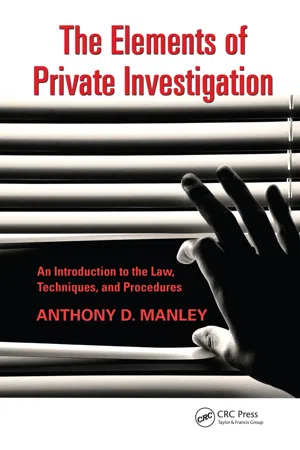
The Elements of Private Investigation
An Introduction to the Law, Techniques, and Procedures
- 448 pages
- English
- ePUB (mobile friendly)
- Available on iOS & Android
eBook - ePub
The Elements of Private Investigation
An Introduction to the Law, Techniques, and Procedures
About this book
In today's increasingly litigious society, the threat of a private investigator (PI) being hit with a civil lawsuit or even criminal charges is very real. Keeping up with the multitude of laws that impact what investigators can and can't do can be daunting but could prove very costly if ignored.Emphasizing legal and liability issues, The Elements o
Chapter 1
A Short History of Private Investigation
It can be said that the first recorded use of spies (for the gathering of information) was during the early Egyptian and Sumerian eras. Spies have been around for thousands of years, and from that sinister beginning they can be considered the forerunners of present-day private investigators. The early investigators in our country were basically private police or bounty hunters employed by large businesses that had money or resources worth protecting. In essence, these individuals were hired to protect the enterprise and its property, and to investigate, arrest, or punish those who would commit a crime against the company. Railroads, express companies, and banks such as Wells Fargo were not above outright revenge and retribution in their attempt to discourage future thievery. Less known than Wells Fargo were Range and Stockmen Associations that banded together and hired men to act as their own personal rangers. Wielding considerable power over the ordinary cowboy, they crossed county and state lines to track cattle rustlers and thieves. They were greatly feared because of their ruthless and harsh treatment of captured outlaws.
One of the most distinguished private agencies was the Pinkerton National Detective Agency. Formed in 1850 by a Scottish immigrant, former deputy sheriff of Cook County, and chief of police of Chicago, Illinois, Allen Pinkerton initially specialized in railway theft and robbery cases. The Pinkertons were the professionals called upon when local police and other private detectives did not have the where-withal or the power to track criminals across state lines. On one historical note, because of his reputation, Pinkerton and his agency were hired to protect Abraham Lincoln personally during his inauguration and appear to have suppressed an assassination attempt against Lincoln. Pinkerton also headed up the Union Army’s Counterintelligence Force, and his organization was a model for the federal agency, which later was to become the Federal Bureau of Investigation (FBI).
In fact, many law enforcement agencies began as private enterprises. Witness the U.S. Secret Service that was formed out of necessity after the assassination of Abraham Lincoln and which was initially protected by the private Pinkerton Detective Agency.
Pinkertons’ activities were not without detractors and critics, however. Their harsh strikebreaking activity relating to coal miners known as the “Molly Maguires” (c. 1875 to 1876) and the iron and steel workers at Andrew Carnegie’s steelworks in Homestead, Pennsylvania (c. 1892), damaged their reputation during those periods and furthered their distinction as “hired guns” for the wealthy.
Regretfully, at that time in our history between 1850 and 1900, most of these private agencies acquired an unfavorable reputation because of their unscrupulous and many times unrestrained activity against anyone that they knew or felt were a threat to the company they were employed to protect. It did not take long for individual states in the early part of the twentieth century to crack down on their illicit activity. Regulation of the private security industry began in California in 1915. As the years passed, the “private eye” held a seedy, sinister, unkempt, and disorderly appearance and usually dealt in circumstances more or less just within the law. However, in recent years, because of threats against our private and personal safety, our family, our employment and social welfare, and our society becoming more and more litigious, private investigation has become a well-accepted course of inquiry and discovery.
One interesting fact is that the Pinkerton logo, which was located on the letterhead and signage outside of their various offices, was “We Never Sleep,” along with a symbol depicting an “open eye” and thereby originating the designation private eye, which was to become the popular term in our language relating to all private detectives.
Qualifications and Licensing
Police or Law Enforcement Officers versus Private Investigators
First, it is important to understand that basic police work and private investigation have little in common. Today, most police officers on patrol will respond to service calls (emergencies, disturbances, noisy neighbors, domestic commotion, to issue traffic citations, and so forth) or to crimes in progress or to reported crimes. Essentially, the police are reactive rather than proactive. A small percentage of police officers and designated detectives within a department are assigned to investigate crimes reported. And within these ranks, specialized squads, such as homicide, arson, robbery, burglary, and crimes against property, produce highly qualified investigators within their field of expertise. Many excellent police investigators in particular fields of endeavor enter the private sector, bringing their expertise. As an example, arson investigators, various types of fraud examiners, and auto theft investigators, to name a few, are of exceptional use and are highly sought after because of their training, credentials, and professional contacts.
There are no formal education requirements for most private investigative positions, although many investigators possess college degrees. A 2- or 4-year degree in Criminal Justice or a related program is helpful to the aspiring private investigator (PI). Moreover, many corporate investigators must possess a bachelor’s degree, along with some type of certification, such as accounting, internal auditing, or business administration.
Today, most private investigative agencies and private investigators are made up of former police officers, ex-military, former investigators from other fields (various federal law enforcement, insurance, automotive), and former government secret or undercover agents. Their field of expertise enhances their professional talent and abilities. Recently, however, the ranks of private investigators have grown to include intelligent persons from colleges, private schools, and security agencies.
However, the classic bumbling literary figure of the “private eye” of the past, or the former police officer who decides to go into “private practice” as portrayed in books and other publications has little in common with actual private investigation as a full-time occupation. Unless the former detective investigator has a particular proficiency in an area that would be advantageous after he or she “retired” from the department, the failure to make the transition is all too common. Some may feel that their “contacts on the job” and former friends cultivated over time will help them. But sooner rather than later, they will find that the longer they are off the job, contacts and “friends” begin to “dry up.”
As noted earlier, many have previous experience in other occupations. Certain professional designations such as Certified Public Accountant (CPA), Certified Fraud Examiner (CFE), and Certified Protection Professional (CPP) are highly regarded because of their exacting requirements for certification—examination and authentication of proficiency, codes of conduct, required preparation, and ongoing maintenance of their standing. These professional designations give status to one as an established and authenticated investigator, particularly in his or her specialty or a similar investigative accomplishment.
Upon leaving the public sector and entering the private sector, the newly licensed private investigator will find that running a private investigation service is a business, and as a business, there are certain business skills that must be possessed that were not required while a public officer. Many former officers become overwhelmed with business tasks that include accounting, tax and other sanctioned compliance, marketing, collections from delinquent clients, personnel problems, and the various overhead costs, such as rent, heat, electric, and telephone. More importantly, the position and authority of the private investigator are no more than that of a private citizen. It is not the same as a police officer who can flash his or her badge (and therefore the status of his or her office) and who has the control and authority to enter into areas of investigation that an ordinary citizen cannot.
Other than the specially trained police officers and military or federal agents noted above, applicants for private investigation should acquire and ultimately possess some knowledge and experience working for a well-rounded legitimate agency in all aspects of the business. Although many applicants may have criminal justice degrees, have loss prevention or security experience, or come from employment as former insurance fraud examiners or claims adjusters, the best training is gained by on-the-job experience under an accomplished professional.
Therefore, we can say that any investigative agency would consider those individuals who possess ingenuity, persistence, and assertiveness, along with good communication, writing, and analytical skills, and are competent in interviewing and interrogation as excellent candidates for the position of PI.
Licensing
Consider entry into private investigation as a vocation; it is not a profession. No degree is required, and in many areas of our country there are no apprenticeships and no ongoing training or instruction as a requisite. Other than a clean background and application for a license, very few states require some sort of experience. Licensing requirements vary considerably; a police officer with no investigative experience or one fired for incompetence after several years would be able to apply for a PI license. Some localities might require an applicant to possess a period of full-time work in a licensed private investigation agency. This period might be 1, 2, or 3 years. However, in many instances, an apprentice who spent the required period as an undercover agent operating a forklift vehicle would qualify.
A most important component in the professional life of a PI is the mandated licensing of anyone who wishes to practice or call oneself a private investigator. The majority of states and the District of Columbia require private detectives and investigators to be licensed. Licensing requirements vary widely; some states have few requirements, some have stringent regulations, and a few have mandatory training programs. At this time, six states have no statewide licensing requirements—Alabama, Alaska, Colorado, Idaho, Mississippi, and South Dakota.1
According to PI Magazine, a leading industry publication, with the industry’s estimated annual sales at about $600 million, there are now about 60,000 licensed PIs in the United States, and approximately 29,930 of them are in the State of New York, a 14.5% increase since 2000. Moreover, the magazine estimates that 500 to 1000 licenses are handed out each month in the United States.2 It is assumed that the rise of interest in this occupation has occurred because of the terrorism attack on September 11, 2001.
Most states and some cities require a certain number of years in the field of investigation, sometimes under the sponsorship or apprenticeship of a licensed PI, attending obligatory classes and passing a written exam. Some states consider a former police officer as having the requisite knowledge and experience in law and investigation to waive the aforementioned obligations. In either case, fingerprints will be taken, and a personal investigation will be conducted by the licensing authority. Finally, an application must be submitted along with the necessary fees. The right to carry a concealed weapon will also require a separate investigation and license in most states.
To practice or pass oneself off as a private investigator (PI) without being licensed as such is a crime. Consider also that because rules and requirements may differ in each state, a PI cannot pursue leads or work in another state unless he or she is licensed in that other state or in the state in which he or she is licensed has reciprocity with that other state. Check with your own state regulations for the licensing requirements and the reciprocal agreements between each state.
Training
Although there are no academic requirements at this time for the licensing of a private investigator, the aspiring novice would do well if he or she would enter into a field of study that would lead to an associate’s degree or a bachelor’s degree in Criminal Justice, Police Administration, Police Science, Security Administration, or a similar program. Colleges across the country now offer curricula in these disciplines, including private schools that dedicate their course of study only in private investigation. A broad base of knowledge in various areas would include criminal-istics; forensic sciences; legal principles; communication skills; computer investigation; case preparation and court presentation; evidence collection and procedures; intelligence and corporate espionage; the art of observation, investigation, interviewing, and interrogation among others. Realize also that some private investigator schools and various professional security and investigative organizations offer specialized training in certain areas. Examples could include in-service training or seminars on arson, criminal, insurance, or financial fraud investigations.
Investigators employed in the corporate sector generally may be required to have an associate’s or bachelor’s degree. Moreover, many times a Master of Business Administration degree may be required for the higher positions within the larger corporations.
However, we must not lose sight of the fact that on-the-job training is the best training for any novice investigator. Whether one is a retired detective or police officer who enters the field having a broad basis of law, investigation, evidence, and court presentation, for instance, he or she already gained some expertise during his or her years on the job. A new entrant into the field of investigation without any public-sector training must do the same, spending time learning from experienced investigators out in the field and in the office, initially doing menial chores and then graduating to more responsible duties. Many novices enter private investigation from positions in contractual or proprietary security businesses, having had a taste of investigation and wishing to better themselves. The investigative agency that looks to hire apprentices should consider those entrants who are intelligent, logical, and quick to learn and are go-getters and self-starters. The author has worked with many police detectives and private investigators who had no formal academic background but were spectacular investigators. Then there are those investigators who seem to have an inborn talent of solving cases based on one’s initial or “gut” feeling, empathy, or perception, and conceptually delving into areas of investigation not ordinarily considered by others.
In-Service Training
Consider also that some PIs will be employed by an investigative agency, such as a novice just entering the field. Expertise will be gained, not only by experience and continuing attendance at seminars, conferences, and special curriculums, but also by in-service training within the group. In addition, acting as part of a team or group during an investigation should be regarded as training of a future leader or supervisor of such a team with the expertise necessary given time and the correct instruction. Other than the one- or two-investigator office, the leader of a team should include the following attributes:
- ■ Planning—The preparation and planning of an operation to achieve the objective for a positive conclusion. Basically, this is the assignment of tasks as to who...
Table of contents
- Cover
- Half Title
- Title
- Copyright
- Dedication
- Contents
- Author’s Note
- Preface
- About the Author
- Introduction: The Novice Private Investigator
- 1 A Short History of Private Investigation
- 2 The Law
- 3 The Criminal and Civil Litigation Process
- 4 The Legal Powers and Limitations of a Private Investigator
- 5 Investigative Techniques and Cautionary Procedures
- 6 Commercial and Industrial Threats and Vulnerability
- 7 Distinctive Situations
- Appendix A
- Appendix B
- Appendix C
- Appendix D: Forms
- Appendix E
- Glossary
- Endnotes
- Selected References
- Web Sites of Interest
- Index
Trusted by 375,005 students
Access to over 1.5 million titles for a fair monthly price.
Study more efficiently using our study tools.
Frequently asked questions
Yes, you can cancel anytime from the Subscription tab in your account settings on the Perlego website. Your subscription will stay active until the end of your current billing period. Learn how to cancel your subscription
No, books cannot be downloaded as external files, such as PDFs, for use outside of Perlego. However, you can download books within the Perlego app for offline reading on mobile or tablet. Learn how to download books offline
Perlego offers two plans: Essential and Complete
- Essential is ideal for learners and professionals who enjoy exploring a wide range of subjects. Access the Essential Library with 800,000+ trusted titles and best-sellers across business, personal growth, and the humanities. Includes unlimited reading time and Standard Read Aloud voice.
- Complete: Perfect for advanced learners and researchers needing full, unrestricted access. Unlock 1.5M+ books across hundreds of subjects, including academic and specialized titles. The Complete Plan also includes advanced features like Premium Read Aloud and Research Assistant.
We are an online textbook subscription service, where you can get access to an entire online library for less than the price of a single book per month. With over 1.5 million books across 990+ topics, we’ve got you covered! Learn about our mission
Look out for the read-aloud symbol on your next book to see if you can listen to it. The read-aloud tool reads text aloud for you, highlighting the text as it is being read. You can pause it, speed it up and slow it down. Learn more about Read Aloud
Yes! You can use the Perlego app on both iOS and Android devices to read anytime, anywhere — even offline. Perfect for commutes or when you’re on the go.
Please note we cannot support devices running on iOS 13 and Android 7 or earlier. Learn more about using the app
Please note we cannot support devices running on iOS 13 and Android 7 or earlier. Learn more about using the app
Yes, you can access The Elements of Private Investigation by Anthony Manley in PDF and/or ePUB format, as well as other popular books in Law & Business General. We have over 1.5 million books available in our catalogue for you to explore.