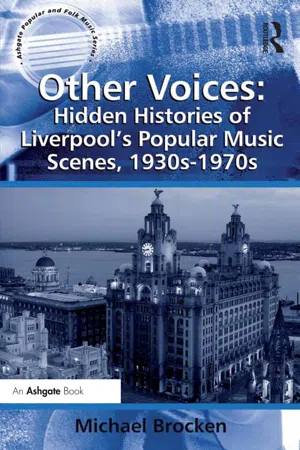
eBook - ePub
Other Voices: Hidden Histories of Liverpool's Popular Music Scenes, 1930s-1970s
- 268 pages
- English
- ePUB (mobile friendly)
- Available on iOS & Android
eBook - ePub
Other Voices: Hidden Histories of Liverpool's Popular Music Scenes, 1930s-1970s
About this book
At times it appears that a whole industry exists to perpetuate the myth of origin of the Beatles. There certainly exists a popular music (or perhaps 'rock') origin myth concerning this group and the city of Liverpool and this draws in devotees, as if on a pilgrimage, to Liverpool itself. Once 'within' the city, local businesses exist primarily to escort these pilgrims around several almost iconic spaces and places associated with the group. At times it all almost seems 'spiritual'. One might argue however that, like any function myth, the music history of the Liverpool in which the Beatles grew and then departed is not fully represented. Beatles historians and businessmen-alike have seized upon myriad musical experiences and reworked them into a discourse that homogenizes not only the diverse collective articulations that initially put them into place, but also the receptive practices of those travellers willing to listen to a somewhat linear, exclusive narrative. Other Voices therefore exists as a history of the disparate and now partially hidden musical strands that contributed to Liverpool's musical countenance. It is also a critique of Beatles-related institutionalized popular music mythology. Via a critical historical investigation of several thus far partially hidden popular music activities in pre- and post-Second World War Liverpool, Michael Brocken reveals different yet intrinsic musical and socio-cultural processes from within the city of Liverpool. By addressing such 'scenes' as those involving dance bands, traditional jazz, folk music, country and western, and rhythm and blues, together with a consideration of partially hidden key places and individuals, and Liverpool's first 'real' record label, an assemblage of 'other voices' bears witness to an 'other', seldom discussed, Liverpool. By doing so, Brocken - born and raised in Liverpool - asks questions about not only the historicity of the Beatles-Liverpool narrative, but also about the absence o
Information
Chapter 1 Looking back, not through – an overview: ‘Beatlesology’ and historicism
DOI: 10.4324/9781315599151-1
More often than not we reinvent the world that has been lost and then invest in this reinvention a much greater significance than was actually the case at the time. History and historiography, privileged by this matrix, can develop an awesome personality of its own. ‘Beatlesology’ has indeed done so, for there are literally hundreds of texts – including many ‘vanity’-style publications – that place each writer at the centre of the narrative. According to this paradigm, there now appears to be so many crucial figures in Beatles history that it is difficult to find anyone at the periphery. For some in Liverpool the meaning of life apparently once centred around knowing this group of individuals. One might suggest that the historicism of the popular music-past via such a minuscule historical sample as the Beatles and their immediate milieu can only ever be a limited way of thinking about that past, especially when local conditions and peculiarities influence all outcomes in many disparate, decisive ways. To produce so many works about the Beatles that specifically concern themselves only with the group, seemingly at the expense of practically everything else, is (at least to this writer) a rather eccentric way of domesticating and veneering the streams of diachrony that not only co-existed but pre-existed them. It appears, at times to be rather like attempting to place the entire history of popular music on the head of a pin. This kind of historicism can be compared with those reductionist histories that propose that all developments can be explained by fundamental principles (such as economic determinism or acts of genius). No history is safe from the ravages of time and people and places disappear, so it is surely self-deceiving to think that artistic achievement can be studied in either a financial or creative bell jar.
Beatles history, as it has come to appear, is in danger of becoming a meta-narrative form in which we read more of the person making the inquiry than we do of the Beatles, or indeed their environment. All popular music historians should attempt to maintain a conversation within the broader cultural field that has given such creativity shape and the phrase ‘discourse analysis’ can be used in the sense that it relates and recounts ideas about history to contexts, interactions, cognition, and power. Also the use of the phrase ‘discourse of history’ suggests that, rather than seeing Beatles history as a given subject from which one can simply learn, like watching a series of brightly coloured lantern slides passing before our eyes, it can be conceived as a series of ways of organizing the past in directions that are openly and frequently contested. This discourse therefore includes and excludes, it centres and marginalizes, and reveals both the explicit and the implicit in ways that contest the powers behind the meta-narratives. Using the term ‘discourse’ comes to indicate that Beatles history is never anything other than diachronic and synchronic fragments. This information should not be news to many Beatles writers, were they not so enamoured of their subjects, so unreceptive to theory, and so wrapped-up in the notion of ‘truth’. One might even suggest that such ‘Fab Four’ meta-narratives are fundamentally misconceived and doomed to disappoint.
A singular history of artistic achievement can never truly be written. The relatively different speeds at which society absorbs, rearticulates and gives any artistic shape space and meaning allow for different readings: different epiphanies, acceptances and refusals; art, and its relationship with the cultural environments within which it is given multifarious meaning, is a moving target. We might describe this relationship in cultural terms as ‘significant creative space’ – creative space to which we can assign a mark of identity, be it a name, a history, or a culture: in short we ascribe political significance to the creativity and our canons are then formulated. However there are problems with such marks of identity when we attempt to historicize the same, for firstly we often see the creativity as relatively stable and assign to it a status of stasis rather than kinesis – we do not allow any other forms of significance (or space) to come into view. We erroneously ascribe distinct ‘othernesses’ to events that actually emerge from and receive uneven sustenance within, the overarching culture (e.g. the very history of the Beatles). Furthermore we tend to focus on narrow concepts of identity (such as subcultures) only to universalize their value and meaning – as if all people received encoded information at one and the same time and decoded it similarly. Finally we tend to acknowledge historically our creative universe by reversing ourselves out of the present, fashioning ‘flawed’ heroes, and perhaps even admonishing certain characters for moving away from our canon (even when we know that creative time is kinetic and subject to fluctuation).
This work intends to highlight several identity-giving ‘significant creative spaces’ around which important spheres of meaning and sound revolved in Liverpool between the pre-WWII era and the late-1970s. The work calls to attention several contexts that the usual rock, pop, or indeed Beatles-related narratives have fallen short of recording and contesting, such as domestic and collective listening practices, record shops as arbiters of co-creative taste cultures, concepts surrounding pejorative genre descriptors and cultural geographies as socio-political delineators of musical authenticity, etc. The illumination of disparate popular music discourses has been overshadowed by an over-concentration on selected genres, idealized images, and the creation of a popular music ‘universal standpoint’ concerning meaning and value (in Liverpool and elsewhere) where no such universality actually exists. There are always several generic fields of play at one and the same time, and these invite the historical researcher to draw different conclusions on popular music value. The case studies introduced below illustrate that in Liverpool during this important period of the twentieth century, real people in real places interacted with several discrete and interlocking popular musical scenes – sometimes at one and the same time.
Trad jazz – you don't see me
People go on about Liverpool being symbolized by the Beatles and things like that. Well you can keep that sort of thing. For me Liverpool is symbolized by the Merseysippi Jazz Band. (Steve Voce in Thompson, 1994:10)
Musical ‘taste’ cannot be shepherded, is almost entirely contingent and reliant on the vagaries of mood, time, place and space. Similarly, popular music reception strategies cannot be pre-planned or constructed like a historical ‘military operation’ – and cannot be historicized, as such. Therefore the partially hidden practices of musicians and receivers somewhat out of canonical focus ought to be investigated in order to delve into chance, convergence and kinetic taste cultures. For the popular music historian a great challenge of recording historical significance via such conjunctures remains. Arthur Marwick states:
Neat equations, still less general laws, do not figure in the historian’s work. The interactions, convergences, ‘feedback loops’, uncovered by historians testify rather to the significance in their subject, as in the natural sciences, of ‘chaos’. (Marwick, 1998:16)
As an example of such idiosyncrasy (indeed ‘chaos’) let us briefly consider the records of (from Merseyside) the Merseysippi Jazz Band – perhaps the longest running British traditional jazz band of all time. This band was by no means prolific in the recording stakes, preferring instead to earn a part-time living from what they loved most – playing jazz, but between 1954 and 1958 they were signed with Carlo Krahmer’s tiny London-based Esquire label; it appears that these records were not always easy to obtain. Liverpool jazz fan Arthur Critchley recalls:
I ordered a copy of a Merseysippis EP in the mid-1950s from Rushworth & Dreapers – about 1955, I think, but could I get it? I went to the shop every Saturday for a month to see if it had arrived but nothing doing. Eventually I got an address for the label, wrote direct and sent them a postal order and it arrived within a week. (Critchley to Brocken, 2006)
A good piece of oral testimony, to be sure, but what can be learnt? Well, in the first instance that hearing certain sounds on record was not always easy in post-WWII Merseyside. This judgment is confirmed by renowned Dylanologist Michael Grey who hails from Birkenhead. At the Robert Shelton Conference held at The Bluecoat Arts Centre in Liverpool in 2001 Grey discussed a time when one might request a record from a Birkenhead record shop only to be told that it was either (a) in the charts and had therefore sold-out or (b) wasn’t in the charts, and so not in stock. This might of course be something of an exaggeration – but perhaps not by much. Actually getting to hear a piece of recorded music in the immediate post-war era in Liverpool could be a rather fraught (yet ultimately exciting) experience. This was unquestionably not always the fault of the record shop because all sounds took a lot longer to permeate society. However, the monopoly of the record industry by only a few record companies such as Decca, EMI, Pye, and Philips, together with the domination of the public broadcasting system by the BBC (and to a lesser extent Radio Luxembourg) meant that the unusual or archaic often went unheard by swathes of people. This was even the case on (‘magical’) Merseyside where, if one believes the myths, records turned up in Liverpool via Cunard vessels months before they were even made, never mind released. Such information informs us that popular music’s relationships with and battles against cultural practices are contingent.
For example, we can see that according to the above Critchley-Grey template in Liverpool and Birkenhead, record collecting was frustrated by the unavailability of certain sounds and created important social and even postal networks surrounding the consumption and production of music (what might have been advertised as being available on record, and what actually was available could be two completely different things). So, for some, records were conditional representations of immanence, difference, and diversity and as such viewed as holding great symbolic value: they were certainly not simply ‘functional artefacts’. For the MJB listening to records was central to new ways of learning to play musical instruments and in understanding different cultures; actually having a recording deal was not especially important to them. However, diachronically participation in such record consumption was not open to all: class and income greatly discriminated between those music consumers who were able to afford records and those who were not. For my father, the apparently simple act of purchasing new records was beyond his income range, hence for him the equally symbolic convergence of radio (and later television).
BBC broadcasts were demarcated by judgements based around various class-based perspectives of popular music; genres such as traditional jazz were aired as representations of authenticity, and the musical interests of certain ‘young people’. The MJB duly benefited, regionally and (at times) nationally from this exposure. But in some households (such as my own), inverted class judgements were at play. My father felt patronized by a great deal of the output of the BBC and only listened to the Light Programme when there was no alternative. When ITV arrived in 1955, it was this TV channel, rather than any offering from the BBC, that became the dominant arbiter of taste in the Brocken household. The point here is that even allowing for the BBC’s exposure of trad jazz, the genre was not ubiquitous among UK listeners. In our living room it was not even instantly ‘recognizable’ amid the sound quotients offered by the Light Programme where one was more likely to hear Al Martino than Mick Mulligan, Perry Como rather than Ken Colyer, and the Merseysippi Jazz Band was a completely unknown quantity.
Arthur Critchley’s comments also ask us to consider Esquire as a ‘commercial’ enterprise, for if distribution was such a problem, was Esquire actually commercial in the real sense of the word, or more like a club or society (as were, to begin with, Tempo and Topic)? It appears that funding for the Esquire sessions were minimal and royalties non-existent, yet the ‘Merseysippis’ continued to record for Krahmer until the latter decided not to record any more British artists in 1959. This, one feels, had more to do with the jazz status, rather than the business acumen, of the label. Sales were in all probability not a great motivator for at least three of those four years, however having reduced to such a minute level that according to Krahmer they ‘just do not warrant further expenditure’ (Krahmer in Leigh, 2002:108), it seems clear that financial expediency won out. But it was probably all of little consequence to the band: the ‘Merseysippis’ made far more money out of gigs and BBC recording sessions. In those pre-M6 days London was about as far away from Merseyside as one could get (even on the train) and although exciting, recording sessions were costly both in time and money, especially when sales were so weak. Ultimately neither the band nor Krahmer appear to have lost a great deal of sleep over the dissolution of this recording agreement.
Prior to the Esquire deal, the Merseysippi Jazz Band organized their own recording session. But this was not necessarily to do with the idea of making a ‘trad jazz record’ for a specialized, independent market, in line with other independent labels such as Tempo and Esquire. In fact the MJB did not appear to have been making any kind of specific statement at all. MJB member John Lawrence informed Spencer Leigh ‘We just wanted the kick out of making a record and we weren’t expecting to sell them’ (ibid:103). This first Merseysippi Jazz Band record was a limited edition 78 rpm of ‘Moose March’ and ‘Friendless Blues’ – recorded by Johnny Roadhouse at his Decibel Studios in Manchester in 1952. In those days, purchase tax had to be added to any record run of over 100 so only 99 were pressed. The band received 8 copies and the rest were sold, here and there. Retrospectively, this can perhaps be seen to have been a significant event for it was probably the first such recording by a Liverpool jazz band, but it was by no means a ‘commercial’ enterprise and was hardly earth shattering news at the time; the fact that the band could actually afford to record this one-off single is, conceivably the most revealing historical signifier. The MJB recordings were not only rooted in somewhat purist (perhaps even ‘alternative’) musical traditions, but also in visible social and material conditions. This recording activity informs us that one mode of enquiry open to us is a consideration of trad jazz’s somewhat middle-class, suburban roots and this could be further corroborated by the fact that although the ‘Merseysippis’ were an adept band working in a niche market, and could have turned professional at any time, they decided against this avenue.
So, the Merseysippi Jazz Band was part of a decidedly ad hoc state of affairs and, together with the memories of Arthur Critchley and Michael Grey, this information almost inadvertently captures taste cultures, retail and wholesale apathy, the tribulations of independent recording labels and studios, together with issues surrounding class and the somewhat unknown direction of trad jazz in the early-mid 1950s. This historical information simply cannot be ignored and its presence counsels the researcher to avoid prescriptive judgements before embarking upon research. There are few social subjects capable of forcing through a redistribution of sensibilities; even though one might suggest that the Beatles were such a group of individuals, the nature, content, goals, organization and affect of not only their creative work, but also of others needs to be scrutinized in order for this assertion to be made with any degree of confidence. It should be conceded that the many musical ‘scenes’ to which the Beatles did not effectively subscribe, have equal significance in any discourse analysis of the Beatles.
Folk music on Merseyside: several northern songs
Liverpool’s dalliances with popular music forms neither began nor ended with beat, or traditional jazz, music. Consider, also, another other important ‘scene’ in late-1950s Liverpool: the one surrounding folk music. For writers of history attempting to record meaning in and of the production and reception of popular music, folk music historicism continues to be a major challenge (see Brocken, 2003). For some, it is hard to make sense of a lot of history without using some kind of idea of ‘fractured’ (thus realistic) causation, and folk music historiography abounds in such fractures (e.g. writers such as Karl Dallas (with Laing, Denselow and Shelton), 1975, Fred Woods, 1979, Niall MacKinnon, 1993). One might even suggest that a kind of reverse avant garde exists in the folk scene where a pre-selected distant image of a past appears more authentic than the vividly inauthentic immediately preceding past. In this kind of mythologized history there seems to be a custodianship of discourse: one is almost inducted into a specific type of dialogue where nobody is particularly interested in what is said as long as it is compatible with, and can be articulated by an approved discourse. Derived from this mode of thought, the historical nature of a great deal of popular music historicism established in the 1960s has also reinforced a certain type of historical conventional wisdom surrounding conflict culture. Some popular music historiography, greatly influenced by folk binary oppositions, has been structured as containing hierarchies and meritocracies based around authenticities contra to the so-called formalized (actually disorganized) structures of the music industry. Here the ‘creative’ pop musician is an ‘artist’ in the ‘folk sense’ – containing the ‘one man against the world’ stereotype that continues to contaminate a great deal of popular music writing.
More recently, some popular music writers (e.g. Moy, 2000, Beadle, 1993, Reynolds, 1990, 1998) have adapted to concepts that suggest a life under conditions of permanent and incurable uncertainty without an over-arching meta-narrative to which we should all reference. According to this matrix a musical life exists in the presence of an unlimited quantity of competing authenticities, unable to prove their claims to be grounded in anything more solid and binding than their own historically-shaped conventions. However, folk causations still channel interpretive disparities to represent ‘the real’ often according to a pre-determined template. The result is that, in folk histories the abandonment of causation seldom occurs, for pre-scribed folk historiography has tended to be linked with ideas constructed by Marxist (and it must be said cod-Marxist) historians about the dialectic process of history being determined by struggle and alienation; this is linked with concepts about production rather than consumption as the primary determinant of the condition of history. However, the historical realms within which Liverpool’s folk scenes emerged are far more complex than this.
It had already occurred to well-known independent broadcaster and documentary maker Daniel Farson ...
Table of contents
- Cover Page
- Half Title Page
- Dedication
- Title Page
- Copyright Page
- Table of Contents
- General Editor’s Preface
- Introduction: Capital of Culture – is anybody listening?
- 1 Looking back, not through – an overview: ‘Beatlesology’ and historicism
- 2 Antediluvian images? Popular music and parochial space in inter-war Liverpool
- 3 Jazz, the Cavern, and skiffle
- 4 Oral histories, public and private spaces; the partially-hidden histories of Joe Flannery and Gardner Road, 1961-62
- 5 I like your hat – country music and Liverpool
- 6 Some Other Guys – R&B in Liverpool
- 7 ‘Mist over the Mersey’ – folk scenes on Merseyside
- 8 Cabaret – reality amid the fake
- 9 Taste-makers, reception, word-of-mouth
- Epilogue
- Appendix
- Bibliography
- Index
Trusted by 375,005 students
Access to over 1.5 million titles for a fair monthly price.
Study more efficiently using our study tools.
Frequently asked questions
Yes, you can cancel anytime from the Subscription tab in your account settings on the Perlego website. Your subscription will stay active until the end of your current billing period. Learn how to cancel your subscription
No, books cannot be downloaded as external files, such as PDFs, for use outside of Perlego. However, you can download books within the Perlego app for offline reading on mobile or tablet. Learn how to download books offline
Perlego offers two plans: Essential and Complete
- Essential is ideal for learners and professionals who enjoy exploring a wide range of subjects. Access the Essential Library with 800,000+ trusted titles and best-sellers across business, personal growth, and the humanities. Includes unlimited reading time and Standard Read Aloud voice.
- Complete: Perfect for advanced learners and researchers needing full, unrestricted access. Unlock 1.5M+ books across hundreds of subjects, including academic and specialized titles. The Complete Plan also includes advanced features like Premium Read Aloud and Research Assistant.
We are an online textbook subscription service, where you can get access to an entire online library for less than the price of a single book per month. With over 1.5 million books across 990+ topics, we’ve got you covered! Learn about our mission
Look out for the read-aloud symbol on your next book to see if you can listen to it. The read-aloud tool reads text aloud for you, highlighting the text as it is being read. You can pause it, speed it up and slow it down. Learn more about Read Aloud
Yes! You can use the Perlego app on both iOS and Android devices to read anytime, anywhere — even offline. Perfect for commutes or when you’re on the go.
Please note we cannot support devices running on iOS 13 and Android 7 or earlier. Learn more about using the app
Please note we cannot support devices running on iOS 13 and Android 7 or earlier. Learn more about using the app
Yes, you can access Other Voices: Hidden Histories of Liverpool's Popular Music Scenes, 1930s-1970s by Michael Brocken in PDF and/or ePUB format, as well as other popular books in Media & Performing Arts & Ethnomusicology. We have over 1.5 million books available in our catalogue for you to explore.