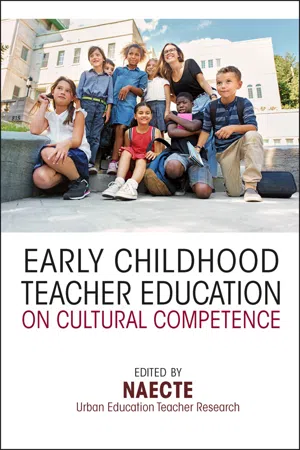
Early Childhood Teacher Education on Cultural Competence discusses how early childhood preservice teachers can use teacher research to explore and gain cultural competence, enabling them to support students and families from diverse backgrounds. The book opens by describing the role of the university in preparing culturally competent teachers in urban settings and then explores historical perspectives of cultural competence. Chapters then move toward more practical perspectives of supporting families from racially diverse backgrounds, understanding diverse families, interprofessional education and collaboration, teacher resiliency, and social justice. Although the chapters focus on cultural competence in urban settings, they offer all early childhood teacher educators a challenge to address cultural competence in all settings.
eBook - ePub
Early Childhood Teacher Education on Cultural Competence
- 166 pages
- English
- ePUB (mobile friendly)
- Available on iOS & Android
eBook - ePub
Early Childhood Teacher Education on Cultural Competence
About this book
Information
Part I
Social Justice Through
the Lens of Early
Childhood Teacher
Education Programs
1 A Social Justice Model for Improving Teacher Effectiveness
In this study, we examine how adapting the social justice principles impact the ability of first year teachers to be effective in classroom management, culturally responsive teaching, and assessment. Our program uses Nieto and Bode’s (2012) comprehensive definition of social justice, which aligns well with best practices for teaching:
Social justice is viewed as a philosophy, an approach, and actions that embody treating all people with fairness, respect, dignity, and generosity. On a societal scale, this means affording each person, the real—not simply a stated or codified—opportunity to achieve her or his potential and full participation in a democratic society by giving each person access to the goods, services, and social and cultural capital of a society, while also affirming the culture and talents of each individual and the group or groups with which she or he identifies.
(p. 12)
Within in this definition of social justice, there are 3 main principles: (1) confronting discrimination toward groups of people who have been marginalized in society because of their gender, race, socio-economic status, sexual orientation or disabilities, (2) enabling everyone in society to reach his or her full potential, and (3) supporting participatory and democratic decision-making. All three principles are critical to the work of teacher educators as they prepare and support teachers for work in schools. As researchers and teacher educators Cochran-Smith, Gleeson, and Mitchell (2010) have written,
The candidate recognizes the power of education in providing access for all students’ full participation in a democratic society. The candidate demonstrates teaching practices that equitably enhance the knowledge, skills, and dispositions of all students and that invite, value, and honor multiple perspectives.
(p. 37)
The teacher education program at Western Michigan University embraces Cochran-Smith’s conception of the impact of a social justice teacher education program as consistent with culturally responsive teaching, equitable assessment practices, and the development of inclusive classroom cultures. Our program’s focus on social justice is in keeping with the needs of the local school districts where the children are from many socioeconomic and racial backgrounds. As Lee (2011) and Villegas (2007) have found, teachers who use these practices tend to have students who are more engaged in learning and more likely to be socially and academically successful.
Meier (2017) writes that, “With the increasingly complex array of curricular choices in early childhood education, teachers and administrators are constantly evaluating the most effective models, approach and materials to support children’s learning” (p. 62). Not only is Meier’s statement true for teachers, administrators, and children, but it is also true for teacher educators and our students. Models are created to help explain and make sense of educational curriculum, ideas, concepts, and how they work in real educational settings. Social justice models also help us investigate complex ideas and critical social issues so that we can advance our understandings.
Developing the Teacher Education Program at Western Michigan University
Five years ago, the teacher education program of Western Michigan developed and is now using a culturally competent model for preparing preservice teachers. It embraces Marilyn Cochran-Smith’s model by taking a developmental approach to teaching social justice. First, students explore their own racial identity and biases in an entry-level class on the teaching profession before they are officially admitted to the program. In their educational foundations classes, they learn more about other cultures and have field experiences that allow them to interact with children from culturally diverse backgrounds in the community. When they take their teaching method courses, they apply what they have learned about cultural diversity in their lesson plans. Finally, during their internship, they spend time studying their school environment and reflect on ways they can make the school environments socially just so that all children can be academically successful. In each course, there are readings and in-depth discussions to support these assignments.
Research on Teacher Education for Social Justice
In order to prepare us to engage in this study of our model and its impact on our students’ learning, we studied research and writings on preservice teacher education and the ways in which teacher educators have mapped social justice pedagogy onto traditional teacher education content, including classroom management and assessment.
Teacher Education and Social Justice
There are numerous models of effective teacher education programs that place social justice at the core of the program. Mills and Ballantyne (2016) write about enabling students to explore their identities at the beginning of the program through readings, discussions, and journaling. Next, they start to do more research about other cultures and spend time in the community interacting with people from culturally diverse backgrounds. Preservice teacher education can begin this process, but developing the capacity to actively teach from a social justice perspective has everything to do with where they teach in their first years and the community of learners with which they engage over their professional lives (Ladson-Billings, 1994; Rust, 2009). In other programs, service learning is used as a powerful experience to help students understand equity and social justice (Baldwin, Buchanan, & Rudisill, 2007; Carrington & Saggers, 2008; Stamopoulos, 2006).
Social Justice and Culturally Responsive Teaching
In schools, social justice and cultural responsiveness go hand in hand. Teachers who work from a social justice stance engage with their students using instructional activities that build on students’ cultural strengths and abilities in order to promote student learning. Gay (2002) describes culturally responsive teaching as “using the cultural characteristics, experiences, and perspectives of ethnically diverse students as conduits for teaching them more effectively” (p. 106). Culturally responsive teachers do not use the same teaching methods and materials for all students. Instead, these teachers adapt their instruction to individual student needs and experiences. This is, as Gay (2010) points out, “teaching that builds on students’ personal and cultural strengths, their intellectual capabilities, and prior accomplishments” (p. 26). These inclusive teaching methods provide opportunities for students to have input in how they learn, which is an example of the social justice principle in democratic decision-making.
Ladson-Billings (1994) asserts that culturally responsive teaching is a pedagogy that recognizes the importance of including students’ cultural references in all aspects of learning. She proposes four dimensions of culturally relevant teaching: (1) holding high academic expectations and offering appropriate support such as scaffolding; (2) acting on cultural competence by reshaping curriculum; (3) building on students’ knowledge; and (4) establishing relationships with students and their homes (Ladson-Billings, 1995). For teachers, the social justice principle on affirming cultural differences implies that to do culturally responsive teaching, teachers need to be aware of biases or discriminatory behaviors they might exhibit. For new teachers, such behavior is often the result of their lack of familiarity with their students’ cultures; it most often shows in the ways in which new teachers respond to students’ nonverbal cultural manifestations and often leads to their imposing rules and regulations (Irvine & Armento, 2001) that create barriers between them and their students. How new teachers learn to work with diversity to create a learning community in the classroom—that is, how their understandings of classroom management are formed—has everything to do with both their and their students’ academic success (Lee, 2011; Villegas, 2007).
Classroom Management and Social Justice
Generally, classroom management describes a teacher’s efforts to oversee a multitude of activities in the classroom, including learning, social interaction, and students’ behaviors (Bosch, 2006; Martin, Yin, & Baldwin, 1998). While often defined by schools of thought—laissez-faire, behavioral—classroom management at its best is the combination of multiple approaches and processes that teachers use to achieve and maintain a classroom environment in which they can teach and instruct, using a variety of tools and techniques to produce behavioral change as needed (Bosch, 2006; Goddard, 2000; McCormick & Shi, 1999). To ensure that the classroom is effectively managed, teachers must be confident of their abilities to set clear expectations and goals, model positive behaviors, and enforce appropriate consequences when needed.
From a social justice stance, the goal of classroom management should always be to build a respectful learning community where children can feel safe to learn, explore, share, and express their views and feelings in positive ways. Implicit here is the belief that if they help to develop the rules, they can understand how to follow them. Essentially, this approach to classroom management might be construed as engaging learners in democratic decision-making. It is a skill that must be learned, practiced, evaluated, and modified by teachers and by their students to fit the changing situation of contemporary classrooms (Bosch, 2006).
Too often, new teachers try one management strategy and become discouraged if it does not produce the desired effects immediately. Bosch (2006) suggests that new teachers must identify their own personal and professional strengths and weaknesses as well as examine their instructional practices. Then they should develop a management plan, implement it, evaluate it, and revise that plan (Bosch, 2006). Working in this way, teachers are also actively applying the social justice principle on affirming cultural differences.
Assessment Literacy and Social Justice
In research literature, assessment literacy has been defined as an understanding of the principles of sound assessment, including terminology and the development and the use of assessment methodologies and techniques (Popham, 2004; Stiggins, 2002). Assessment-literate teachers can identify the strengths and weaknesses of each type of assessment and are able to engage students in the assessment process (Stiggins, Arter, Chappuis, & Chappuis, 2006). They understand the practices and purposes of various assessments and the importance of balanced classroom assessment systems used to gauge student learning.
Furthermore, assessment-literate teachers understand the connection between assessment and instruction. They work to develop assignments that, using multiple formats aligned to their students’ strengths, enable their students to show what they know and can do and invite their students into evaluating their work and developing work plans.
In sum, the social justice principles clearly support best practices in culturally responsive teaching, classroom management, and assessment. Social justice principles should be embedded in teacher education programs to provide a framework for change that can be implemented to improve schools so all children can learn. Therefore, this study examines how well our students applied what they learned about social justice pedagogy with their students in the areas of culturally responsive teaching, democratic classroom management, and equitable assessment.
The Study
Context
The Teacher Education Program:
In the Department of Teaching, Learning and Educational Studies at Western Michigan University, our aim is to develop educators who are committed to teaching for social justice. Therefore, your course work and field experiences are designed to support you in:
- Understanding and expanding your personal worldview and beliefs.
- Increasing your knowledge of schools and social systems.
- Developing methods to respond appropriately to students from diverse backgrounds.
- Teaching content in culturally relevant ways to engage all students in the learning process.
You will have in-class and out-of-class opportunities to interact with faculty and teachers in the field and your peers in professional learning communities throughout your time in the program. Upon graduation, you will have the knowledge, experience, skills and a supportive network to be an agent of social change in your classroom, school and district.
What the Teachers Had to Say
All 19 first year teachers in the urban school who were graduates of our teacher education program were invited to participate in a 30-minute, one-on-one interview in their classrooms after school. (Of those invited, one declined, five did not respond, and four canceled their interviews at the last minute and did not reschedule.) In the end, nine were interviewed. Of the nine teachers in the study, six were female and three were male; six were white and three were people of color. One taught in preschool, four in elementary school, two in middle school, one in high school and one in special education.
The school district serves over 13,000 children, of which 50% live at or below the poverty line and 14% are in deep poverty. It is a racially diverse school district, with Black, Hispanic, and Asian children. Close to 39% of the children in the district are White, 36.6% are Black, 13% are Latino, 9.6% are multi-ethnic, 1.7% are Asian American, and 0.3% are Native American. There are 17 elementary schools, five middle schools and four high schools.
The interviews focused on three major topics:
- Topic I: Understanding of social justice principles.
- Topic II: Teaching effectiveness in classroom management, culturally responsive teaching, and assessment.
- Topic III: Factors that determine first year teachers’ persistence in teaching
Topic I: Understanding of Social Justice Principles
Overall, the teachers defined social justice as a commitment to equality and honoring the unique cultural and intellectual contributions of each student.
Teaching for social justice means that I take my students’ backgrounds into consideration, but don’t let them limit the student’s potential.
(Heidi, Elementary)
Social justice for me is to give similar opportunities. They should be given a high-quality education as much as we can offer them.
(Allison, Elementary)
Among these new teachers, there was an awareness of differences in backgrounds among their students and of a need to help students see these differences as valuable.
When you bring together social justice and culturally responsive teaching, you are getting to know your students on a deeper level, learning about their culture, their background, and embracing that by sharing in each other’s culture at school in a safe environment where each child feels valued and well represented.
(Heidi, Elementary)
Topic II: Teacher Effectiveness in Classroom Management, Culturally Responsive Teaching, and Assessment
We questioned the teachers about how well, on a scale of 1 (lacking), 2 (adequate), and 3 (excellent), they felt they had been prepared to be effective in the areas of classroom management, culturally responsive teaching, and assessment. We also asked them to rate their effectiveness as first year teachers along a conti...
Table of contents
- Cover
- Title
- Copyright
- Contents
- Acknowledgments
- About the Authors
- Introduction: Developing a Vision of Social Justice
- Part I Social Justice Through the Lens of Early Childhood Teacher Education Programs
- Part II A Look at Early Childhood Teacher Educators’ Study of Their Courses
- Part III Social Justice When Early Childhood Teachers Move Their Work Into the Life of the Communities
- Index
Trusted by 375,005 students
Access to over 1.5 million titles for a fair monthly price.
Study more efficiently using our study tools.
Frequently asked questions
Yes, you can cancel anytime from the Subscription tab in your account settings on the Perlego website. Your subscription will stay active until the end of your current billing period. Learn how to cancel your subscription
No, books cannot be downloaded as external files, such as PDFs, for use outside of Perlego. However, you can download books within the Perlego app for offline reading on mobile or tablet. Learn how to download books offline
Perlego offers two plans: Essential and Complete
- Essential is ideal for learners and professionals who enjoy exploring a wide range of subjects. Access the Essential Library with 800,000+ trusted titles and best-sellers across business, personal growth, and the humanities. Includes unlimited reading time and Standard Read Aloud voice.
- Complete: Perfect for advanced learners and researchers needing full, unrestricted access. Unlock 1.5M+ books across hundreds of subjects, including academic and specialized titles. The Complete Plan also includes advanced features like Premium Read Aloud and Research Assistant.
We are an online textbook subscription service, where you can get access to an entire online library for less than the price of a single book per month. With over 1.5 million books across 990+ topics, we’ve got you covered! Learn about our mission
Look out for the read-aloud symbol on your next book to see if you can listen to it. The read-aloud tool reads text aloud for you, highlighting the text as it is being read. You can pause it, speed it up and slow it down. Learn more about Read Aloud
Yes! You can use the Perlego app on both iOS and Android devices to read anytime, anywhere — even offline. Perfect for commutes or when you’re on the go.
Please note we cannot support devices running on iOS 13 and Android 7 or earlier. Learn more about using the app
Please note we cannot support devices running on iOS 13 and Android 7 or earlier. Learn more about using the app
Yes, you can access Early Childhood Teacher Education on Cultural Competence by NAECTE Urban Education Teacher Research Network in PDF and/or ePUB format, as well as other popular books in Education & Early Childhood Education. We have over 1.5 million books available in our catalogue for you to explore.