eBook - ePub
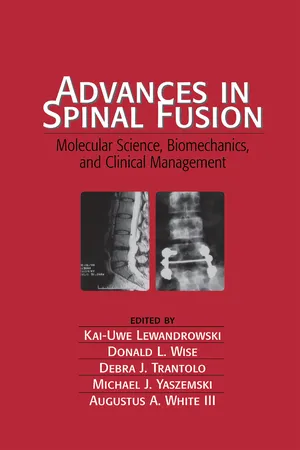
Advances in Spinal Fusion
Molecular Science, BioMechanics, and Clinical Management
- 815 pages
- English
- ePUB (mobile friendly)
- Available on iOS & Android
eBook - ePub
Advances in Spinal Fusion
Molecular Science, BioMechanics, and Clinical Management
About this book
Advances in Spinal Fusion reveals a new generation of materials and devices for enhanced operations in spinal fusion. This reference showcases emerging research and technologies in areas such as biodegradable implants, drug delivery, stem cell isolation and transfection, cell encapsulation and immobilization, and the design of 2D and 3D scaffolds for cells. It captures a cascade of innovations crucial to increased healing and decreased morbidity in spinal fusion methods and mechanics and addresses current standards in analytical methodology and quality control, it describes the selection of biomaterials for improved biocompatibility, biostability, and structure/function relationships.
Information
Table of contents
- Cover
- Half Title
- Title Page
- Copyright Page
- Preface
- Contents
- Frontmatter
- 1 Reduction and Fixation of Sacroiliac Joint Dislocation by the Combined Use of SI Pedicle Screws and an Iliac Rod
- 2 Percutaneous Vertebroplasty in the Treatment of Osteoporotic Fractures
- 3 Biomechanics of Vertebroplasty
- 4 Kyphoplasty and Vertebroplasty for the Treatment of Painful Osteoporotic Vertebral Compression Fractures
- 5 Carbon Fiber-Reinforced Polymer Implants for Spinal Fusion: Biomechanical and Clinical Advantages of a New Material
- 6 Stand-Alone Anterior Lumbar Interbody Fusion Constructs: Effect of Interbody Design, Bone Graft, and Bone Morphogenetic Protein on Clinical and Radiographic Outcomes
- 7 Overcoming Chemical Inhibition of Spine Fusion Brian Claytor and Steven Theiss
- 8 Use of a Cloned Osteoprogenitor Cell in Spinal Fusion
- 9 Axially Loaded Computer Tomography and Magnetic Resonance Imaging of the Lumbar Spine
- 10 Experience with OP-1 in a Rabbit Model of Lumbar Fusions
- 11 Structure and Function of Normal, Degenerate, and Surgically Fixed Spinal Segments
- 12 A Quantitatively Unstable Model to Evaluate the Biological Effects of Mechanical Forces on Spine Fusion
- 13 Ankylosing Spondylitis and Spinal Complications
- 14 Atlantoaxial Transarticular Screw Fixation: Indication, Technique, Risks, and Pitfalls
- 15 Biomechanics of Artificial Discs
- 16 Comparison of the Leukotactic Properties of Nucleus Pulposus, Anulus Fibrosus, and Cartilage Following Subcutaneous Injection in Pigs
- 17 Advances in Bone Graft Substitutes in Spinal Fusion
- 18 Titanium Mesh Cage in Spinal Reconstruction Surgery: Biomechanics and Clinical Application
- 19 Posterior Lumbar Interbody Fusion Using the Brantigan I/F Cage
- 20 SF-36 Health Status and Oswestry Disability Index in Worker’s Compensation Patients with Neck Pain
- 21 Interbody Fusion in the Elderly
- 22 Choice of Anterior and Posterior Thoracolumbar Spinal Implants
- 23 Spondylotic Cervical Myelopathy: Clinical Aspects
- 24 Autogenous Free Fat Grafts After Posterior Lumbar Surgery
- 25 In Vitro Stability of Cervical Spine Cages
- 26 In Vivo Performance of Cervical Spine Cages
- 27 Autologous Growth Factors and Progenitor Cells as Effective Components in Bone Grafting Products for Spine
- 28 Process of Lumbar Spinal Degeneration: Interrelationships Between Disc Degeneration and Facet Joint Osteoarthritis
- 29 Relationships Between Lumbar Sagittal Alignment and Clinical Outcomes
- 30 Histological Findings in Revision Surgery of Instrumented Spine Fusion with the Use of Coralline Hydroxy apatite
- 31 New Developments in Spinal Cord Monitoring
- 32 The Physical Properties and Biocompatibility of Plasma-Sprayed Hydroxyapatite Coating
- 33 Biomechanical Efficacy of Vertebroplasty and Kyphoplasty
- 34 Bioactive Bone Cement for the Treatment of Osteoporotic Vertebral Compression Fracture
- 35 Advances in Technology and Spinal Fusion: A Clinician’s Perspective
- 36 Replacement of Autograft with BMP for Spinal Arthrodesis: Future Perspectives Following Recent Research
- 37 Replacement of Autograft with BMP for Spinal Arthrodesis: Future Perspectives Following Recent Research
- 38 Validity of a Bioactive Ceramic Spacer in Posterior Lumbar Interbody Fusion with Studies of the Stability of the Pedicle Screw for the Osteoporotic Spine In Vivo and In Vitro
- 39 Thoracic Pedicle Screws: Biomechanical Considerations of the Extrapedicular Approach
- 40 Two-Cage Reconstruction Versus Single Mega-Cage or Dual Nested Cages for Lumbar Interbody Fusion
- 41 Spontaneous Remission of Intervertebral Disc Hernia and Responses of Surrounding Macrophages
- 42 Gene Expression Profiling During Osteochondrogenic Events in the Spinal Region: Use in the Development of Promising Spinal Fusion
- 43 Cells, Signals, and Scaffolds: The Future of Spinal Fusion
- 44 Roentgen Stereometric Analysis: A Novel In Vivo Method to Assess Spinal Fusion
- 45 The Morbidity of Autogenous Bone Graft Donation
- 46 Loads on an Internal Spinal Fixation Device Measured In Vivo
- 47 New Anterior Cervical Instrumentation Systems Combining Intradiscal Cage with Integrated Plate: Biomechanics and Clinical Applications
- 48 Improvement of Pedical Screw Fixation with Hydroxy apatite Coating
- 49 Multilevel Cervical Decompression and Reconstruction
- 50 Decision Support Tools in Spinal Surgery: Artificial Neural Networks and Predictive Modeling
- 51 Porous Tantalum for Spinal Interbody Fusion
- 52 Advances in Spinal Fusion
- Index
Trusted by 375,005 students
Access to over 1.5 million titles for a fair monthly price.
Study more efficiently using our study tools.
Frequently asked questions
Yes, you can cancel anytime from the Subscription tab in your account settings on the Perlego website. Your subscription will stay active until the end of your current billing period. Learn how to cancel your subscription
No, books cannot be downloaded as external files, such as PDFs, for use outside of Perlego. However, you can download books within the Perlego app for offline reading on mobile or tablet. Learn how to download books offline
Perlego offers two plans: Essential and Complete
- Essential is ideal for learners and professionals who enjoy exploring a wide range of subjects. Access the Essential Library with 800,000+ trusted titles and best-sellers across business, personal growth, and the humanities. Includes unlimited reading time and Standard Read Aloud voice.
- Complete: Perfect for advanced learners and researchers needing full, unrestricted access. Unlock 1.5M+ books across hundreds of subjects, including academic and specialized titles. The Complete Plan also includes advanced features like Premium Read Aloud and Research Assistant.
We are an online textbook subscription service, where you can get access to an entire online library for less than the price of a single book per month. With over 1.5 million books across 990+ topics, we’ve got you covered! Learn about our mission
Look out for the read-aloud symbol on your next book to see if you can listen to it. The read-aloud tool reads text aloud for you, highlighting the text as it is being read. You can pause it, speed it up and slow it down. Learn more about Read Aloud
Yes! You can use the Perlego app on both iOS and Android devices to read anytime, anywhere — even offline. Perfect for commutes or when you’re on the go.
Please note we cannot support devices running on iOS 13 and Android 7 or earlier. Learn more about using the app
Please note we cannot support devices running on iOS 13 and Android 7 or earlier. Learn more about using the app
Yes, you can access Advances in Spinal Fusion by Kai-Uwe Lewandrowski in PDF and/or ePUB format, as well as other popular books in Technology & Engineering & Biotechnology in Medicine. We have over 1.5 million books available in our catalogue for you to explore.