![]()
Chapter 1
The First Day
The First Day
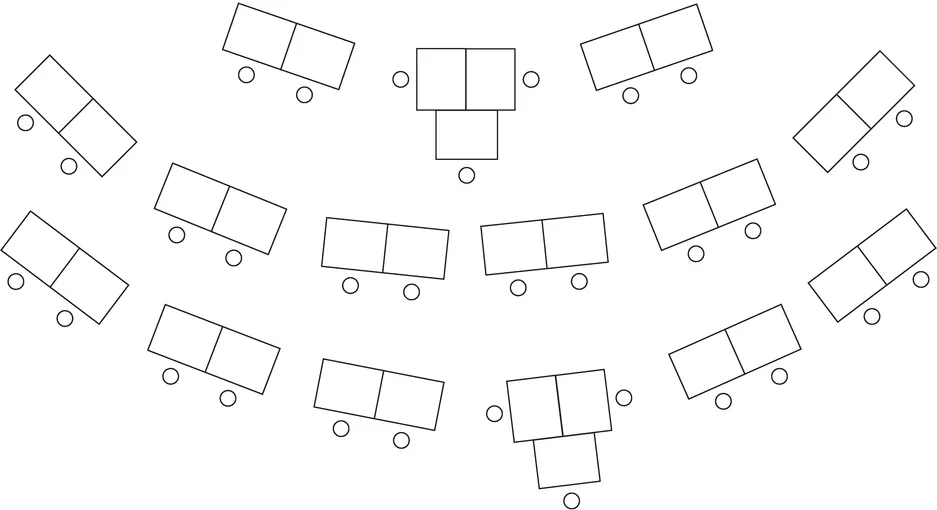
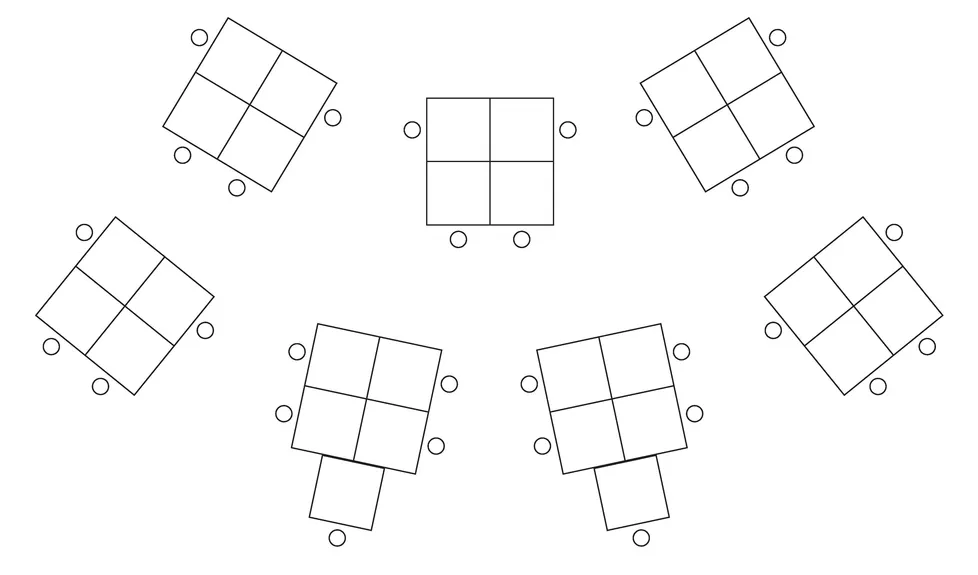
The first day of school is filled with anticipation and excitement for every passionate teacher. Several days prior to meeting my students I prepare for their arrival by arranging the desks into pairs or groups of four and five. (see A Pairs Class and A Four’s Class on page 4.) Notice the “fan” arrangement of the desks which ensures that no student has to turn more than 90 degrees to see the front of the class. Also notice that groups of four are arranged so that no student has to look through the head of a teammate but can see the teacher without obstruction. Furniture arrangement is a key factor in establishing effective cooperation. Hanging from the ceiling above the center of each group is a piece of colorful yarn with a laminated number attached, marking the location of each group. I use the numbers 2 through 10. When I was a “floater,” pushing a cart around the halls, teaching in several rooms, I used gummed labels stuck to the dividers between the ceiling tiles to mark these locations. Identifying group locations is especially helpful when an ambitious custodian cleans the room but leaves the desks against the walls. A simple instruction from me, “Kids, arrange your groups under the numbers” resulted in the room being ready for the day. Students were also taught, depending on the coming activity, to convert the room to a “team” structure or a “pairs” arrangement. This allowed me to conserve my energy and begin to communicate to the students that this was not “my” room, but it was “our” room. Our journey into the collaborative classroom had begun. Telling the present class that the previous class had arranged the desks in 20 seconds adds a spirit of competition and usually the task was performed in less time by subsequent classes.
As each student arrives at the room, a firm handshake and greeting is given. “My name is Mr. Strebe, what is your name? Are you sure you are in my Algebra 2 class? Great to meet you! Sit wherever you wish.” For me, this is a very emotional time. As I would look into the eyes of each student, I am impressed with the fact that the two of us would have many opportunities to make an impression on each other during the year. Neither of us would ever again be the same because we have spent the year together, learning from each other, experiencing life together, growing through difficult times and rejoicing in wonderful successes. How blessed I am to be called to teach!
A Pairs Class
A Four's Class
On that first day most of the students choose to sit near students with whom they are familiar, often with good friends. I desire to put them into teams for the first day where the comfort level is not so high. Suppose there are 24 people in the class. Twenty-four divided by 4 is 6. I take from a full deck those cards numbered from 2 through 7 from each suit and distribute them to each group in numerical order by suit. If this is done properly, each person in a group will have a different number than the others.
Nonverbal Cues
I then develop a nonverbal cue that we will use all year. When my arm is raised, we know it is a sign for silence and that a question requiring a chorus response is coming. They should look into my eyes in anticipation. I ask them to look at the color of the card—either red or black. On the count of 3, my arm will be lowered and the class choruses the color on each card, saying “red” or “black.” I respond, “Way to go! This is a capable group of people.” My arm is raised again and the kids look into my eyes and listen as I instruct, “Look at the number on your card. Ask a neighbor if you are unsure—after all, it has been a long summer.” Each student identifies the number on the card and on the count of 3, my arm is lowered and the class choruses each number. Nonverbal cues are powerful tools. This one is used every day in every class during the year.
Now the students are instructed to repeat the words, “Different color. Different number. Different table.” These words are repeated twice more. The students are then instructed to pair up with someone having a card of a different number with a different color who is sitting in a different group. If the number of students in the class is an odd number, then some lucky student will pair up with the teacher.
Students are encouraged to think about a cool activity they had enjoyed that summer. It could be a trip taken, a game attended or played or something ordinary like sleeping late. They are encouraged to think and not speak. “Make this your secret.” On cue the students with the larger card number in each pair call out in chorus, “I have the larger number.” The student with the larger number then shares the cool activity from the summer with the student who has the lowest number. Then the student with the lowest number shares with the person possessing the highest number.
At this time everyone learns how to touch another person in an acceptable manner—remember, this could be a secondary setting. We give each other a” high five” or we give each other a “pound” or we shake hands. Each pair touches each other in one of these ways and expresses verbal thanks for the shared secret. Developing the habit of saying thanks to each other helps create a “family” climate in the classroom, a place where each person belongs and where learning can occur at an optimum level. Touching each other helps to break through personal barriers each of us brings to a classroom.
The next activity involves movement with a purpose as each student is instructed to find the other students having the same numbered card and create a huddle with them, memorizing the day and month of birth of each one in this new group. So, all the “2’s” are memorizing the birth facts as are all the “3’s”, the “4’s” and so on. After a short time, the students sit in the numbered location (hanging from the ceiling) that matches the number on the card. The students move all their belongings to this new group. They are encouraged to review the birthdates in each team. For this first day only, good friends will probably not be together. If some of the students are known by the teacher, the handing out of the cards can be orchestrated so that certain students are not together while others have been purposely given the same number. One or two volunteers from the class recite the birth dates of each member of the group after which the class claps for this feat of memory. Clapping for each other helps with class climate . I ask the student if that could have been accomplished without the assistance and help of the other three students and, of course, the answer is “no.” I then make that student a promise that if, in the same way, the members of the group are considered as resources during the study of mathematics, learning math will take less time; the math concepts will be remembered longer and learning math will be much more fun.
To illustrate that, we then learn mathematics for the next 15 minutes or so. The kids are enthusiastic, engaged, locked in and ready to learn. After this first segment of learning some students are beginning to drift away mentally and need to be brought back in. It is the first day of school after a long summer away from classes. How can these students be reengaged? The main office has supplied the necessary equipment for this.
Fortunately, it is the first day of school and we tend to welcome our young people to their new community by drowning them in paper, handing out lunch information sheets, insurance forms, bus tickets, the school code of discipline, Internet forms, locker assignments and anything else which will fit on an 8.5 by 11 inch piece of paper. Handing out these materials allows students to take a necessary break. I distribute papers to the students by having one person from each team come to pick up enough forms for the entire team. Perhaps I will ask the student from each team with the earliest birth date in the year, or the person wearing the most blue today, or the person with the shortest or longest hair to come pick up the various documents. Forms that need to be collected are brought to me by the person in the team who might have been at McDonald’s most recently. When students get up out of their seats to accomplish an educational purpose, the learning environment is refreshed, and the teacher is spared the experience of performing the athletic miracle of walking around the room and not falling flat after catching a foot in a book bag strap. When one or more of the forms have been distributed, we get to do it again—we learn in a collaborative setting and have much fun doing it.
Educational Interrupters
After each 15-minute segment, an educational interrupter is used to reengage all students. On the first day, these interrupters have been generously supplied by the administration requiring teachers to distribute many papers. The class continues in this fashion, fulfilling all the requirements of the main office and experiencing the joy, beauty and thrill of mathematics. Do not waste the value of this interrupter by handing out the office’s papers at the beginning of the class. Wait until the students’ attention begins to wane. Depending on the class, interrupters may be necessary after as little as 7 minutes or not until 20 minutes have passed. You are the expert and will determine the correct time to bring the kids back. Toward the end of our class, the “person wearing the most blue” picks up textbooks and information cards for the entire group. The person with the latest birth date in each team could bring the teacher one completed textbook information card for each person. Homework is assigned—yes, homework is given on the first day of school. After all, I love math and I love kids so I will not keep these two loves apart for another night. One or more students will remark about having homework on the first day of school and I ask them if they know why I give them homework. “It is because I love you! If I ever forget to give you homework, please question my care for you.” Sure enough, one day I purposely hold back the assignment and Larry asks whether or not I still love them. I feign shock, give the homework, assure them of my love and ask them to thank Larry who is now in deep trouble with the class. The first night’s homework is a math assignment and the task of reading and studying my syllabus. In addition, the students are to bring the syllabus to the next class.
Notice that on the first day I used no time in class to present my class rules. Students have been engaged in learning the subject matter, participated in small team competitions and actively distributed many documents. Every minute has been filled with activity, and there has been no down time.
The last thing the kids do is print their first and last names on one side of a color-coded 3 by 5 card (a different color for each class period). An announcement is made that a quiz on the syllabus— yes, a real quiz, one that will count and be recorded in the grade book—will be given during the next class.
As the kids leave I meet them at the door, shake hands, look each student in the eye and tell them a hearty and sincere “Thanks for being here.” Our adventure together has begun, and I am looking forward to the next class, but only after an evening of refreshment and contemplation.
The first day of school in this math class has been activity filled, productive and fun. This was not always the case in my career and the change must be credited to my son when he was an eighth-grader. Jon came home after his first day and I expected him to have a more joyful attitude than the one he had. After all it was the first day of school! You get to see your friends, brag about your summer and even be reunited with an occasional cool teacher. Instead, his response was, “Dad, I am back in jail again!” I wondered how that could be true. He said, “Well, Dad, stay with me here. First period was English and do you know what we did? Heard the rules. Second period was math and more rules. Then came social studies and the teacher dictated the rules.” The story was the same for each of the 7 periods. Jon was correct. He was back in jail again. I had never looked at the first day of school through the eyes of a student. What Jon described was not a good phenomenon. I determined that I would never again have a first-day experience that would be dull and boring and rules filled. Up until that moment I had not appreciated the students’ total first-day experience. I had not looked at them beyond the time I had them in my class. Often students have said to me at the end of my “new” first day that this class was the most fun they had all day—and they were learning mathematics besides! Truly, kids can teach us much if we listen.
On the evening of the first day of school I was usually exhausted and fatigued—it had been a long summer for me too. Those nonstudent days in August had allowed me to get my room ready, to prepare lesson plans and renew with staff, but nothing gets you ready for that first day filled with interactions and challenges. It was a good tired because I was expending much energy doing something I loved—teaching kids. After a wonderful meal and conversation with the best woman God ever created, my dear wife, it was time to prepare for the next day. I lay out the blue name cards from period 1 on my dining room table, one of my most valuable educational tools. I arrange the cards into pairs, reflecting on the students I observed on the first day, thinking about their personalities, how they interacted with other students, what needs and strengths were displayed. The purpose is to put each student with a partner or partners with whom they will work well, based on the very superficial information from my memory and from notes I took during the first class. If the number of students in the class is an odd number, one trio will be needed. This process is repeated for each class using the color-coded cards, matching pairs of students by observed strengths and needs. If I am on an alternating day schedule, I have two days to accomplish this task.
For me, this is a very familiar and comfortable way to manage the first day. Some may find it cumbersome, especially the first time implemented. It may be advisable to use this student-matching process in just a few classes, perhaps only one class, until the necessary skills are achieved. Creating a collaborative classroom can be started at most any time during the school year. The teacher, who is the expert in the classroom, should make these decisions and will eventually become proficient.
![]()
Chapter 2
First Weeks
Pairs Rehearsal
The next day in each class I set up the room with pairs of students (see A Pairs Class, on page 4) and lay the name cards on the desktops, greeting the students at the door with a handshake and “n...