![]()
Section 1
Getting started, keeping going
Congratulations and welcome to the BOOK (or e-version!). Whatever your degree scheme: Geography, Environmental Science and Earth Sciences (GEES) or related disciplines such as Transport Studies, Tourism, Ecology, Marine and Ocean Sciences, Land Management and Landscape Studies, this book should help YOU to be successful. It should demystify aspects of university life and study, and build your confidence to learn effectively.
Section 1 focuses on information which will be particularly helpful at the start of your degree, and worthwhile throughout. Chapter 1 has essential information for when you start, and is worth reading later to see what might have passed you by in the excitement of the early weeks. ‘Reflecting, reviewing and acting’, Chapter 2, is designed to help you think through what is happening in university and other parts of your life, and make choices as you progress. It’s about taking action, having control of your study. This links very closely to Chapter 3, a very practical approach to managing time, helping you to fit in many activities and really enjoy all aspects of university life. Chapters 4 and 5 cover useful stuff that may be vital depending on your circumstances. Skip-read the subheadings to see what is valuable for you. ‘Looking after yourself’, Chapter 4, should help you recognise some of the pressures of university life and point you to the huge range of supportive people and resources. The last chapter in this section concentrates on ‘employability matters’, because it does! GEES students are hugely employable, but you need the confidence to present your expertise in a way that employers understand and leads to job offers, and the huge range of jobs available to you is confusing. This chapter should enable you to make effective links between your university study, extracurricular and part-time work experience, and take time to explore opportunities, which will make your final year and transition to the workplace easier.
How to use this book
No single idea is going to make a magic difference to your learning, but taking time to think about (reflect on) the way you approach tasks like reading and thinking, listening and writing, researching and presenting should help. Studying is a personal activity. There are no ‘right’ ways, but there are tips, techniques, short cuts and long cuts. Reading this book in one go will not help. Look through the chapter headings and index. Read a couple of things that interest you now. When you are uncertain, worried or stuck at any point in your degree study, there should be a useful section. Some parts are relevant in the first year, others, like the dissertation advice (Chapter 25), will matter more in later years.
The Try This activities encourage you to get involved and build on your existing skills. Adapt the activities to your needs. Some statements in the book are deliberately controversial, designed to encourage thinking. Most of the figures and examples are deliberately ‘less than perfect’. Consider how they can be improved; it’s called active criticism. Universities have IT and sports facilities – getting more skilled means using the facilities and ‘working out’. Your first year is a good time to practise and enhance your study skills as you adjust to your new life, but it is important to keep practising and reflecting throughout your degree. Experience is built by doing, not by watching.
Most people using skills books or websites, or on training courses, find that 90 per cent of the material is familiar, but new ideas make involvement worthwhile. The 90 per cent increases your confidence that you are on the right track, and the new ideas spark rethinking, reassessment and refining. You have been studying for 15 years at least, and are very skilled in various ways. Some approaches at university will be new, but a quick glance here should help you to understand what’s going on. Chapters are deliberately very short, giving you the basics, some activities to practise and references to other texts and websites. Whole guides are written about essay writing, dissertations and fieldwork. Where you need more information, search online and at your university’s learning skills centre.
The trick with university study is to find a combination of approaches that suit YOU, promote your research and learning, and enhance your self-confidence. As with all books, not all the answers are here, but who said study would be a doddle?
I hope that you will enjoy some of the humour; this book is meant to be gneiss and fun with serious points. Geologists probably have the best jokes, but they are all pretty dire. The crosswords follow the quick crossword style familiar to readers of UK newspapers; the answers have vaguely GEES connections. The fun activities give your brain a quick break. Light relief is vital in study; if you find deep thinking leads to deep kipping, have a coffee and solve a crossword clue – just remember to restart thinking after your break! Enjoy studying at university – it is exciting, fun and a challenge.
CARPE DIEM
‘May the Force be with you’ – Yoda
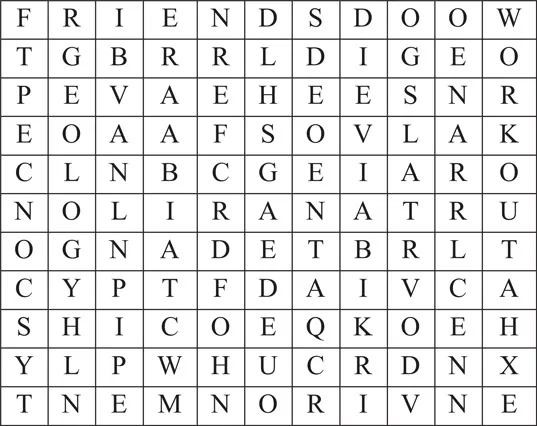
Wordsearch 1
Can you find the words and phrases in the grid? Words are written forwards, backwards and diagonally. Solution in Chapter 28.
Contour, Concept, Environment, Fern, Fohn, Friends, Geography, Geology, Heave, Idea, Icefall, Oasis, Online, Pipe, Research, Tea break, Tilt, Travel, Vacation, Workout, Woods.
![]()
1
Transitions – essential info
‘Teach? No,’ said Granny. ‘Ain’t got the patience for teaching. But I might let you learn.’
(Pratchett 1995)
So many new people – what do they do? Well, ask them – it’s a great way to break the ice and find out about all the people that will be important in your life for the next … years. Amongst them you will find:
Lots of new and experienced students – just like you. Friends for the next … years and some friends for life.
Lecturers – they tutor, coach, mentor, facilitate, do administration, plan and deliver teaching, move classroom furniture about, troubleshoot problems and research when they can find time.
Professors are more experienced lecturers with tutoring, teaching, administration and research to keep them busy. They are probably involved in university administration.
Postgraduate tutors and demonstrators are students doing higher degrees and helping with teaching. They can be great fun, hugely helpful in class, practicals, on fieldwork and can tell you the best places to buy bread …
School administrators are the really use...